No. 25 December is an ordinary working day in Vietnam. It is widely celebrated all the same. Thông báo 6150/TB-BLĐTBXH on the holiday schedule for 2025 — Xây dựng chính sách, the Vietnamese Government portal (chinhphu.vn), 3 December 2024
How to say it
Vietnamese
Giáng sinh an lành
Giáng sinh an lành
say it: ZANG sin an LAN
A synthesised voice — not a recording of a person — saying Giáng sinh an lành
in vi-VN.
Not «merry». Giáng sinh is the Nativity — literally the descent and birth — and an lành means peaceful, safe, well. The wish is for a peaceful Christmas rather than a joyful one, and it is paired almost always with năm mới bình an, a peaceful new year.
This is the form the Vietnamese state uses. The Minister for Ethnic and Religious Affairs wrote to Catholics and Protestants on 23 December 2025 wishing them «Giáng sinh an lành, năm mới bình an», and used the same words again at the end of the letter. Noel, borrowed from French, is the other word in everyday use and is what the newspapers put in their headlines.
The crowd outside the cathedral is bigger than the congregation inside it
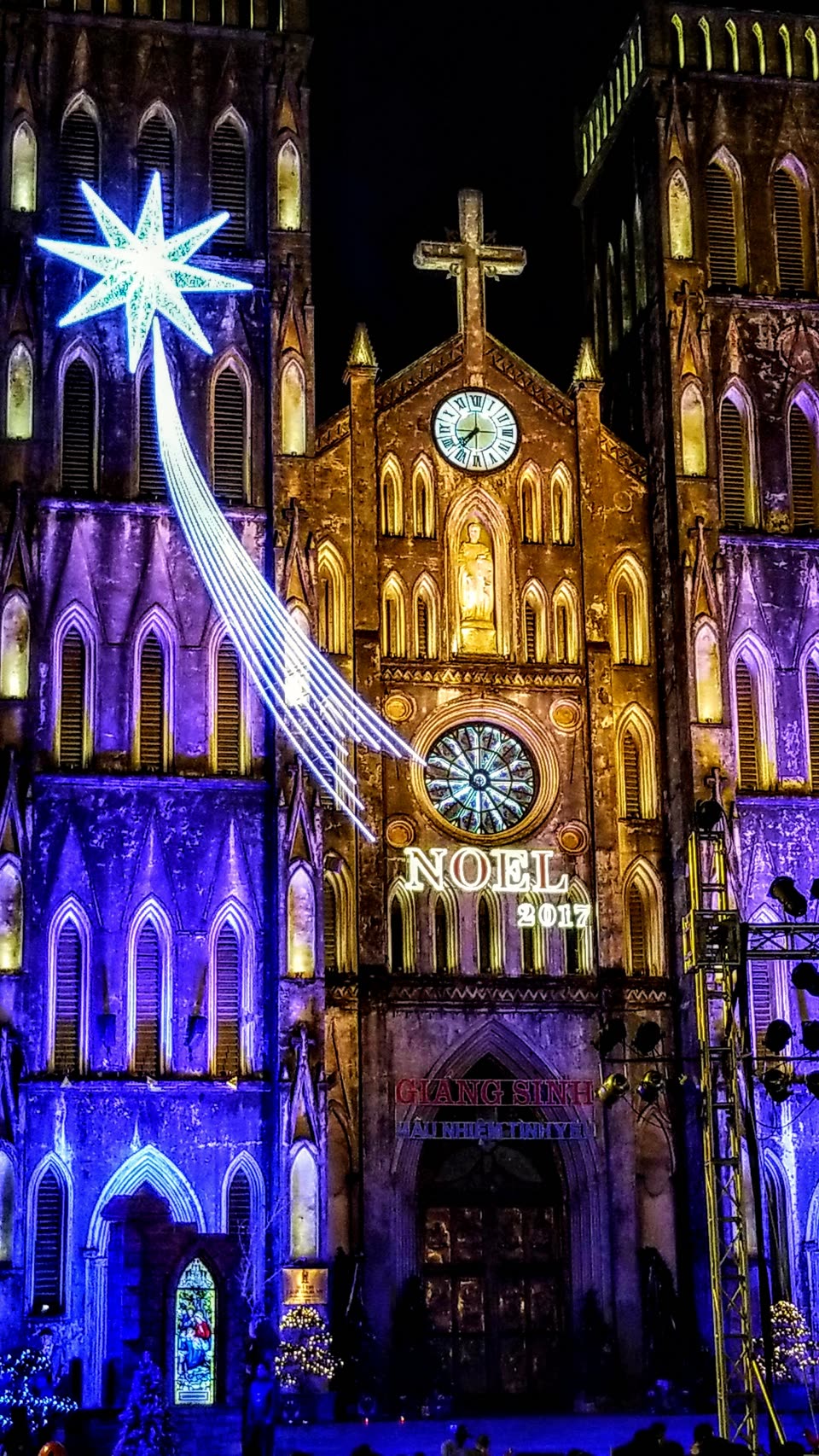
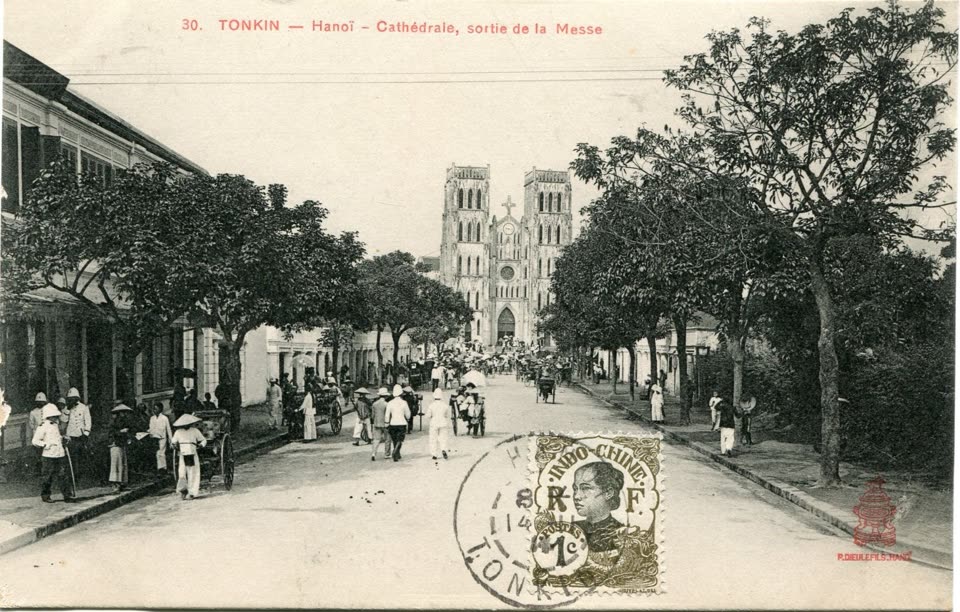
On the night of 24 December the streets around St Joseph's Cathedral in Hanoi fill up. VTC News reported in 2025 that «Từ khoảng 23h, các tuyến phố xung quanh nhà thờ đông kín người, nhiều thời điểm gần như không còn chỗ trống.» — from about eleven at night the streets around the cathedral were packed, with almost no room left.
Most of them are not there for the Mass. They are there for the moment: «Đúng 0h ngày 25/12, tiếng chuông Nhà thờ Lớn vang lên, báo hiệu thời khắc Giáng sinh.» At exactly midnight the cathedral bells rang out to mark Christmas, and people stopped to listen or filmed it on their phones.
For Catholics it is two nights and a morning, and the figures are the state's own
Nhân Dân, the Communist Party's daily, quotes a Hanoi resident: for Catholics «Christmas is marked solemnly on the night of December 24 and on December 25 with masses and the singing of hymns at churches».
The community that does it is counted precisely in the same article: «Viet Nam currently has 27 Catholic dioceses and more than seven million followers, accounting for over 7% of the population, along with more than 7,000 clergy and around 30,000 members of religious orders.» That is one of the largest Catholic populations in Asia, in a country where the feast is not a day off.
Hàng Mã Street sells the decorations, and students go to look at them
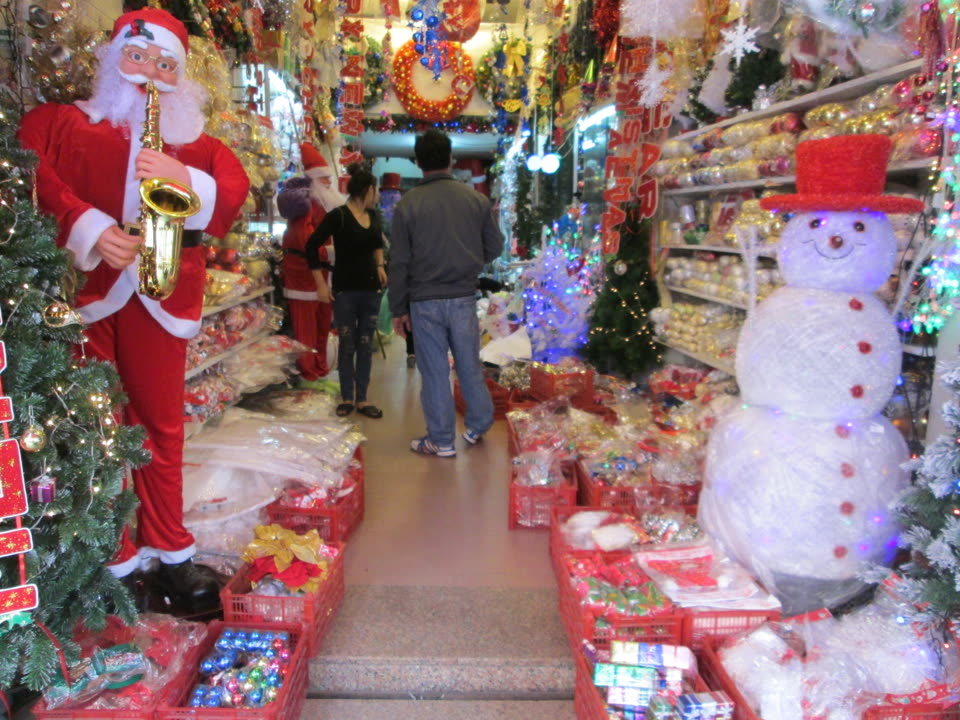
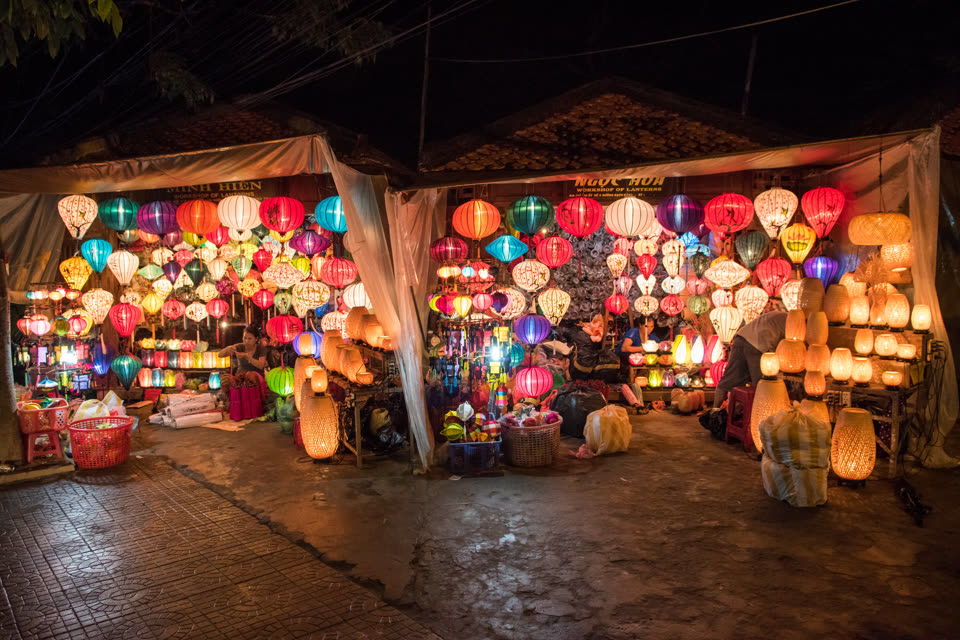
The street in Hanoi's Old Quarter that sells paper offerings and lanterns for the lunar festivals turns over to Christmas in December. Nhân Dân quotes a student at the National Economics University saying that although Christmas is not a traditional Vietnamese festival, «he and his friends often visit churches and public spaces such as Hang Ma Street to experience the festive and welcoming atmosphere».
That is the shape of the Vietnamese Christmas outside the churches: not a family occasion at home but an evening out, in the street, with friends.
Ministers call on the dioceses, and write a Christmas letter
Nhân Dân reports that «In recent years, Party and State leaders have paid visits to Catholic dignitaries and communities nationwide during the Christmas season, extending greetings and reaffirming the spirit of national solidarity.» Nhân Dân is the Communist Party’s own paper, writing about its own government.
The letter behind that sentence is public. On 23 December 2025 the Minister for Ethnic and Religious Affairs wrote to Catholic and Protestant clergy and congregations to wish them «Giáng sinh an lành, năm mới bình an» — a peaceful Christmas and a peaceful new year.
It arrived in the sixteenth century and stopped being only Catholic quite recently
Nhân Dân puts the arrival and the change in two sentences: «The festival was introduced to Viet Nam in the 16th century alongside the arrival of Western missionaries. For a long period, it was observed mainly by the Catholic community.» And then: «For non-Catholics, particularly young people, Christmas has become a popular cultural event and an integral part of year-end festivities.»
So the churchgoers and the crowd are not the same people. Seven million Catholics go to Mass; the crowd in the street at midnight is far larger, and Nhân Dân describes it as non-Catholic and mostly young.
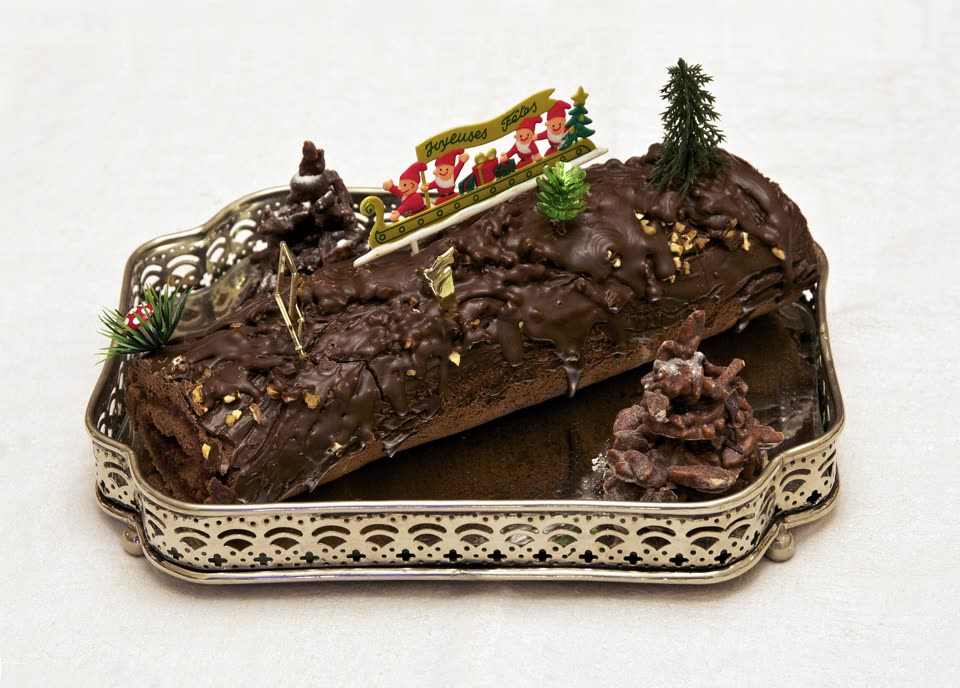
The Christmas meal in Vietnam is a réveillon, under that name, and the dish that survived the crossing intact is the log cake.
Tuổi Trẻ, on Christmas Eve 2024: «Bữa ăn réveillon Giáng sinh (nửa đêm Noël tới sáng) không biết du nhập vào xứ ta lúc nào. Đây là bữa ăn độc quyền của dân Pháp theo Thiên Chúa giáo.» Nobody knows when the midnight-to-morning meal arrived; it came in as the private property of French Catholics.
What the writer was taught the meal consisted of, at a French-curriculum school: «Khái niệm đó gồm: bữa ăn phải có gà tây nhồi (dinde) là món chính và muốn gì muốn phải có cái bánh khúc củi Giáng sinh - bûche de Noël.» A stuffed turkey for the main, and come what may, the bûche. The turkey went. The bûche did not.
It is not an old custom in most houses and the report says so: «Hơn mười năm trở lại đây, réveillon phổ biến dần trong các gia đình người Việt có điều kiện» — over the last ten years or so it has spread among Vietnamese families who can afford it.
The turkey was not kept, and what replaced it is a local chicken — or, better, a pair of pigeons.
Tuổi Trẻ: «Con ngỗng hoặc con gà tây bữa ăn réveillon đã được người Sài Gòn thay thế bằng con gà ta, ngon lành hơn nữa là đôi chim câu.» The goose or the turkey, replaced in Saigon by the native chicken, and better still by two pigeons. The restaurateur Lê Anh Tú of 48 Bistro is quoted on the pigeon order book being heavy at réveillon.
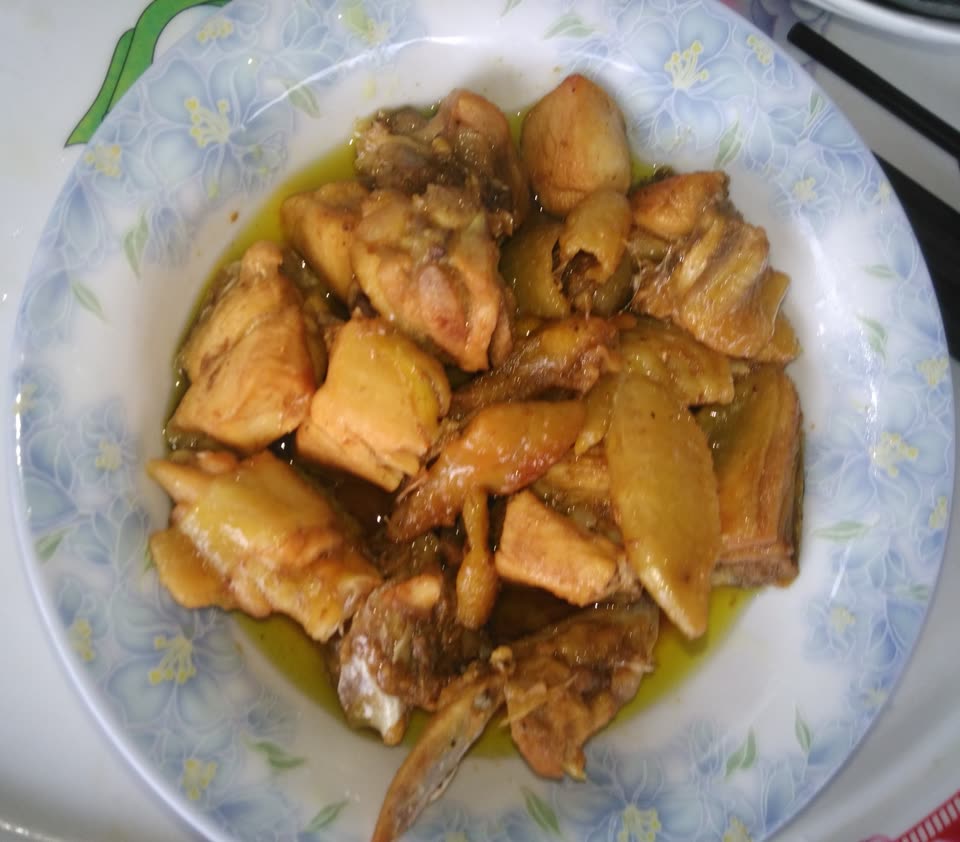
The bird is then cooked by a method that is not French at all. It is stuffed with ngũ quả — red dates, dried longan, shiitake, wood ear and lotus seeds, mixed through blanched chicken offal — then sewn shut and braised «kho tàu», which, the writer explains, is what southerners call cooking a thing in coconut water. He suggests doubling the five fruits so that half go inside the bird and half into the pot, and the name of the dish is his own: «Cũng có thể gọi đó là gà nhồi kho tàu» — you could also call it stuffed chicken kho tàu.
The meal around it is not a fixed menu. «Bữa ăn réveillon là bữa ăn dân chủ vì mọi người được hỏi ý kiến thích ăn gì» — the réveillon is a democratic meal, because everybody gets asked what they would like.
Widely repeated claims about Christmas in Vietnam that do not survive
checking. Each one says what is actually the case, because a correction
with nothing in its place leaves you worse off than before.
Contradicted
Christmas is a public holiday in Vietnam
What is actually the case. It is a working day, and the confusion is understandable: Hanoi and Ho Chi Minh City on the night of 24 December look like a country on holiday.
The labour ministry's annual notice sets out the leave arrangements and names the occasions it covers — «thông báo về việc nghỉ tết Âm lịch, nghỉ lễ Quốc khánh, nghỉ lễ ngày Chiến thắng 30/4 và ngày Quốc tế lao động 01/5» — and neither Giáng sinh nor Noel is anywhere on it.
What is true, and is the more interesting fact, is that the state marks the day without granting it. Ministers visit the dioceses, a cabinet minister writes a Christmas letter, and the Party daily runs a Christmas feature. Nobody gets the day off.
Every December the labour ministry publishes the arrangements for the following year's public holidays. The notice of 3 December 2024, on the government's own portal, says what it covers in its first line: «thông báo về việc nghỉ tết Âm lịch, nghỉ lễ Quốc khánh, nghỉ lễ ngày Chiến thắng 30/4 và ngày Quốc tế lao động 01/5» — lunar new year, National Day, 30 April, 1 May.
The words Giáng sinh and Noel do not appear on that page at all. The one occasion the Vietnamese state arranges a week of leave around is Tết, which in 2025 ran from 25 January to 2 February.
Every claim carries its own citation. They are collected below, so you
can see what the page rests on and how much of it comes from where.
Bộ trưởng Dân tộc và Tôn giáo gửi thư chúc mừng nhân dịp lễ Giáng sinh năm 2025 — Báo Lào Cai, carrying the letter of the Minister for Ethnic and Religious Affairs, 23 December 2025. Retrieved 2026-10-31. archived 11 March 2026The opening: «tôi gửi tới quý vị chức sắc, chức việc, tu sĩ cùng toàn thể đồng bào Công giáo, Tin Lành lời thăm hỏi thân tình và lời chúc Giáng sinh an lành, năm mới bình an!» And the close: «kính chúc quý vị chức sắc, chức việc, tu sĩ và toàn thể đồng bào Kitô giáo một mùa Giáng sinh an lành và năm mới bình an, hạnh phúc.»
Christmas in Viet Nam blends faith, culture and national unity — Nhân Dân, the Communist Party of Viet Nam's daily, English edition, December 2025. Retrieved 2026-10-31. archived 17 February 2026The Party paper's own account, and its figures are the state's: «Viet Nam currently has 27 Catholic dioceses and more than seven million followers, accounting for over 7% of the population, along with more than 7,000 clergy and around 30,000 members of religious orders.» On the history: «The festival was introduced to Viet Nam in the 16th century alongside the arrival of Western missionaries. For a long period, it was observed mainly by the Catholic community.» On who keeps it now: «For non-Catholics, particularly young people, Christmas has become a popular cultural event and an integral part of year-end festivities.» And on the visits: «In recent years, Party and State leaders have paid visits to Catholic dignitaries and communities nationwide during the Christmas season, extending greetings and reaffirming the spirit of national solidarity.»
Những khoảnh khắc ấm áp trong đêm Noel — VTC News, 25 December 2025. Retrieved 2026-10-31. archived 23 April 2026On the crowd: «Từ khoảng 23h, các tuyến phố xung quanh nhà thờ đông kín người, nhiều thời điểm gần như không còn chỗ trống.» And on the hour itself: «Đúng 0h ngày 25/12, tiếng chuông Nhà thờ Lớn vang lên, báo hiệu thời khắc Giáng sinh.»
Thông báo 6150/TB-BLĐTBXH on the holiday schedule for 2025 — Xây dựng chính sách, the Vietnamese Government portal (chinhphu.vn), 3 December 2024. Retrieved 2026-10-31. archived 14 April 2026The labour ministry's annual notice, on the government's own portal, and it says in its first line which occasions it is about: «thông báo về việc nghỉ tết Âm lịch, nghỉ lễ Quốc khánh, nghỉ lễ ngày Chiến thắng 30/4 và ngày Quốc tế lao động 01/5» — the lunar new year, National Day, Victory Day on 30 April and International Workers' Day on 1 May.