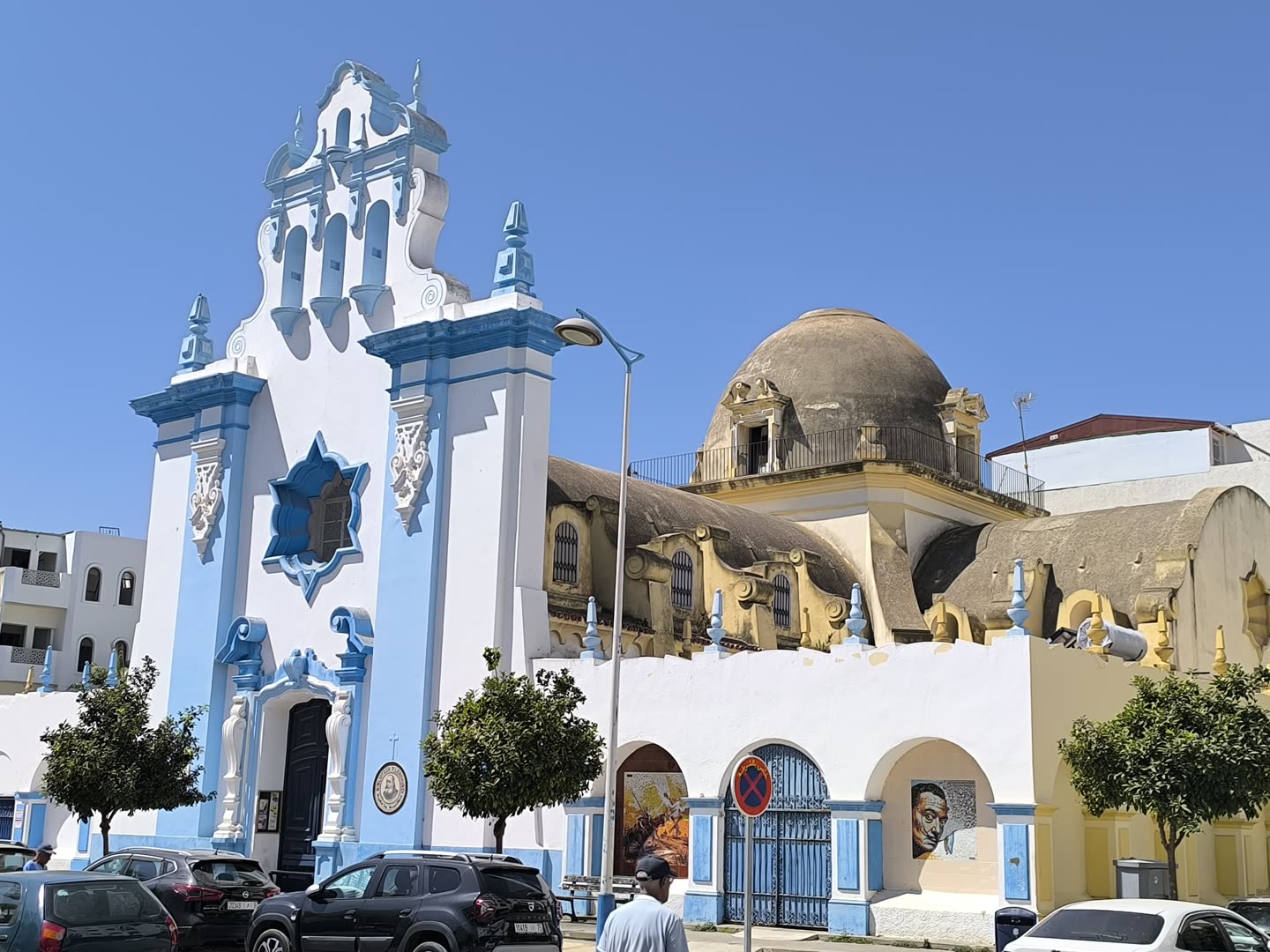
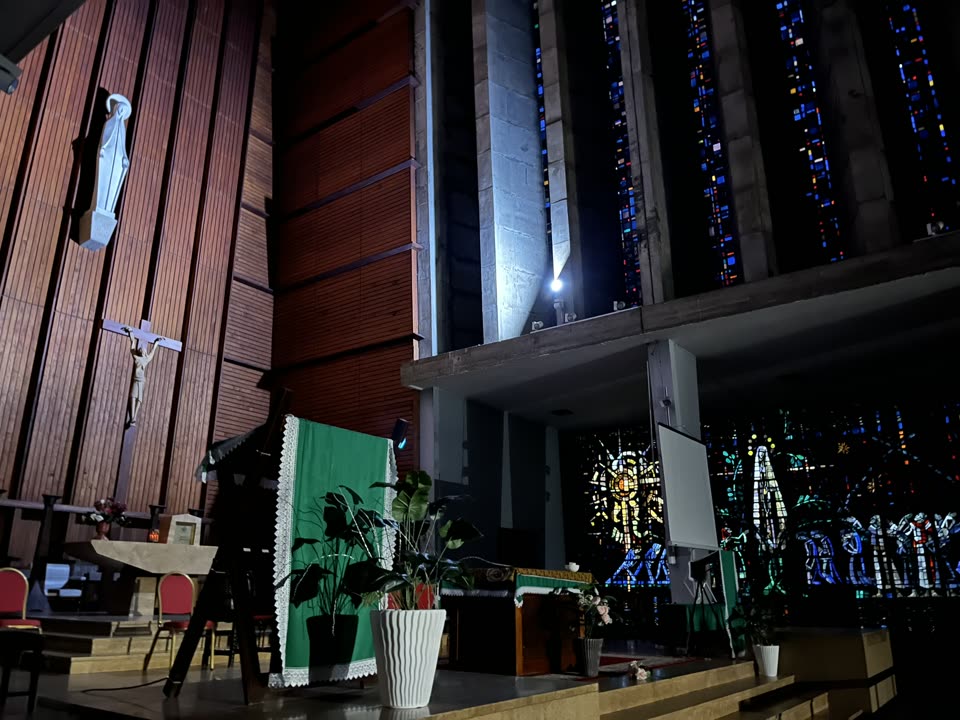
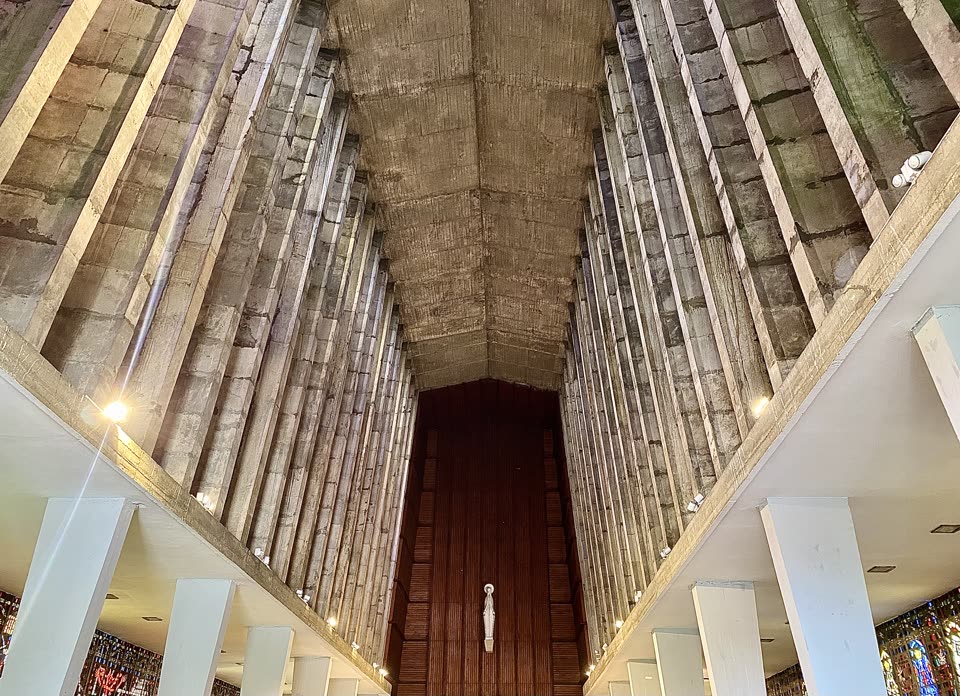
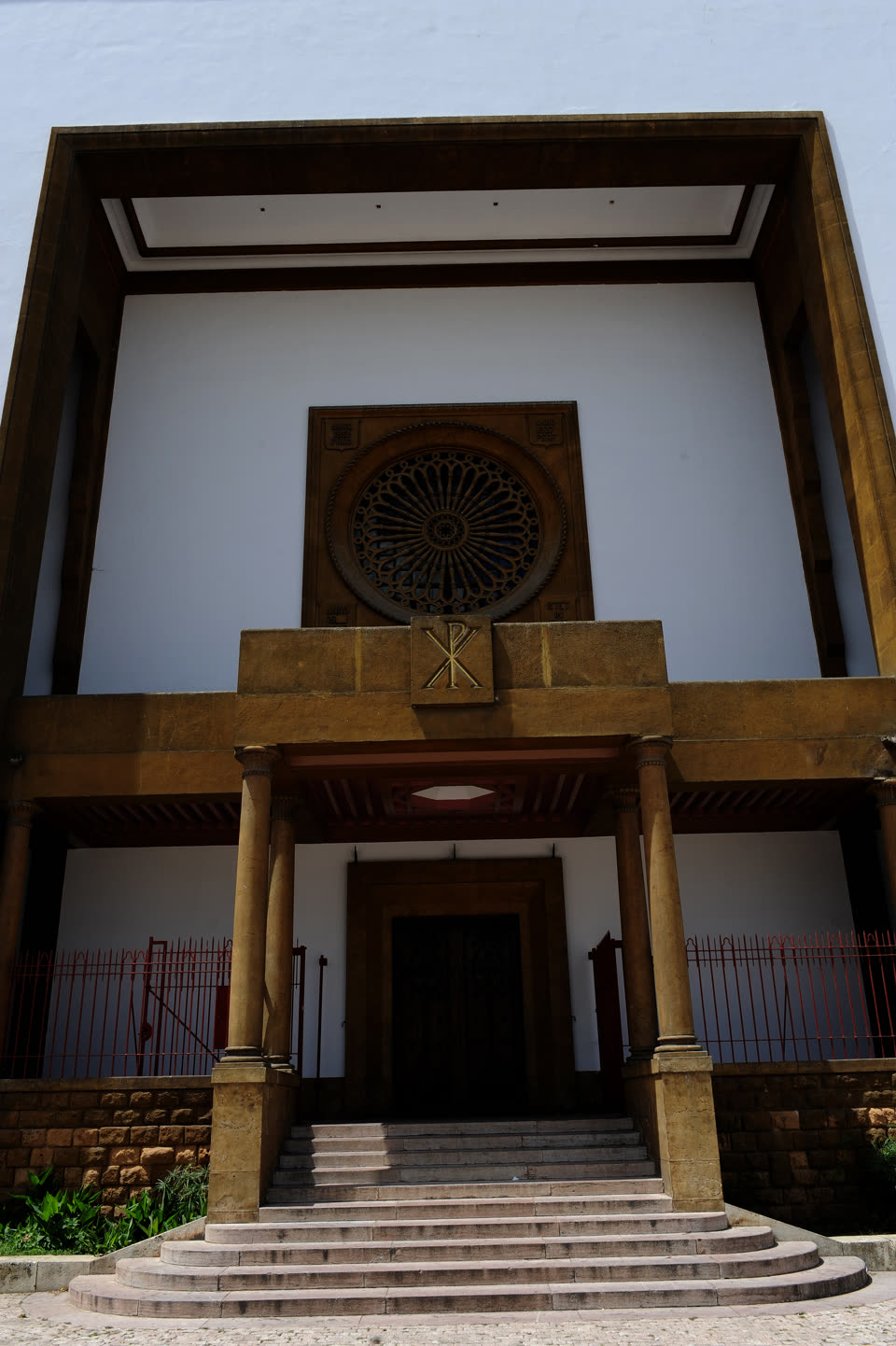
No. 25 December is an ordinary working day in Morocco. It is kept by minority communities. Horaires de travail et jours fériés — Ministère de la Transformation numérique et de la Réforme de l'Administration, Kingdom of Morocco
How to say it
French
Joyeux Noël
Joyeux Noël
say it: zhwah-YUH no-EL
A synthesised voice — not a recording of a person — saying Joyeux Noël
in fr-FR.
French, which is the working language of the Catholic Church in Morocco and of most of its congregations. The parish priest of Rabat cathedral told Vatican News in December 2024 that he had been surprised a few days earlier to be wished a Joyeux Noël — by a Moroccan civil servant.
No Arabic or Amazigh Christmas greeting is in ordinary use in Morocco.
Casablanca's Christmas is a sub-Saharan African Christmas
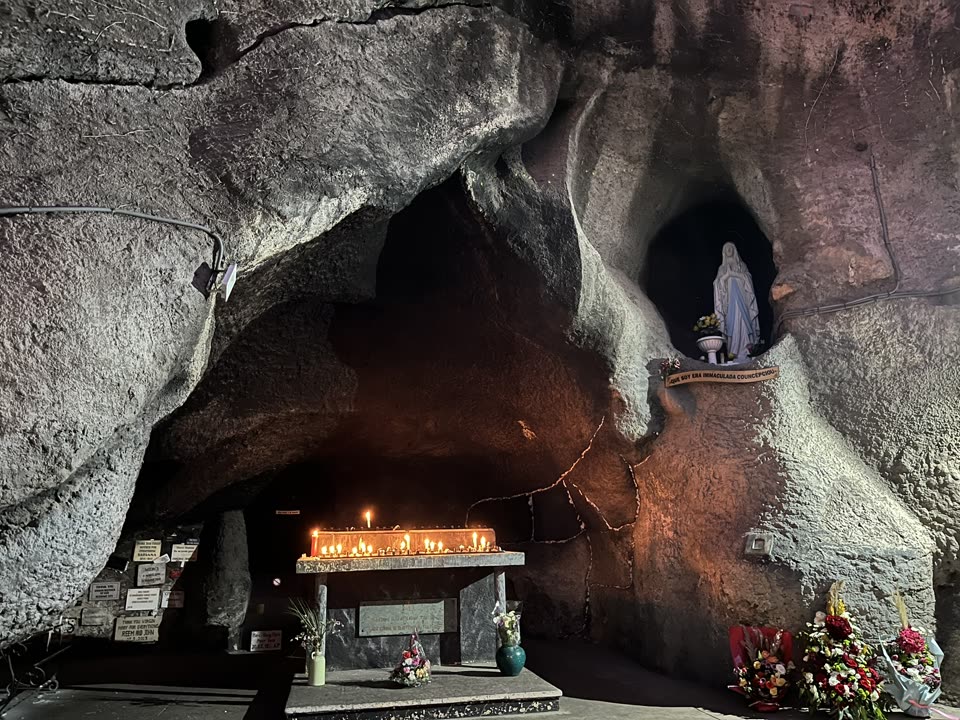
Notre-Dame de Lourdes stands over the rond-point d'Europe in Casablanca, and on Christmas Eve the people going into it have mostly come from somewhere else. Le360, reporting from the night: «Il faut noter que les chrétiens résidant au Maroc sont en majorité originaire d'Afrique subsaharienne.»
That matches what the churches themselves count. Their leaders put the foreign-resident Catholic population at at least 30,000 and the Protestant at about 10,000, «many of whom are recent migrants from sub-Saharan Africa or lifelong residents whose families have resided and worked in the country for generations but do not hold citizenship».
The priest who led the Christmas Mass at the same church in 2016, Father Franklin Agnidé, was reported explaining the spirit of the communion and «l'importance de la communauté africaine dans sa paroisse» — the importance of the African community in his parish.
The archbishop stands at the door and greets the people going past
The Christmas solemnity at Notre-Dame de Lourdes begins outside it. The Archbishop of Rabat takes up a position at the main door of the church before going in to lead the service, and greets whoever is there.
Le360’s reporter, on the night of 24 December 2023: «Positionné à la porte principale du lieu de culte, le Cardinal […] salue les passants avant de regagner l’intérieur de la bâtisse pour diriger la solennité de Noël.» The passers-by: people going along the street, who have not come for the Mass.
The archdiocese’s own newsletter, in a parishioner’s account of the same night, has him there for the congregation as well: «Juste avant le début de la célébration, Son Éminence a accueilli les fidèles à l’entrée de l’église, leur serrant la main et leur souhaitant joyeux Noël.»
In a country where the law allows the government to expel any foreign resident it judges «a threat to public order», and has used that clause against people suspected of proselytising, a churchman standing in the street at Christmas saying hello is a deliberate thing to do.
Casablanca's cathedral parish does not say Christmas once. H24info, filming at Notre-Dame de Lourdes: «des centaines de Chrétiens au Maroc se sont retrouvés pour les deux messes de Noël à l'église de Notre Dame de Lourdes de Casablanca».
The reporters went to the earlier one: «l'office de 18h30, dédié aux enfants et aux familles, pour célébrer selon la foi catholique la naissance de Jésus». They talked to the priest, Antoine Exelmans, and to the congregation, «d'origine subsaharienne ou française pour la plupart» — mostly of sub-Saharan or French origin.
That year the Mass was said under pandemic restrictions, and the report's own verdict on it was that the heart was in it anyway.
What Morocco's Christmas has instead of a national custom is a set of gestures across the line between communities, and they get reported one at a time.
At an interfaith gathering in Casablanca in December 2023, a Senegalese resident, Joseph Ciss, described a Moroccan association bringing together the Christian, Jewish and Muslim communities of the city: «Les Marocains nous ont gratifiés de buches de Noel, en présence du gouverneur d'Anfa, de la consule générale des Etats-Unis d'Amérique.» Moroccans handing out yule logs, with the governor of the Anfa prefecture and the American consul general in the room.
It is one man's account of one evening, and it is on the page as that rather than as what Moroccan families do.
A civil servant wished the priest of Rabat cathedral a Joyeux Noël, and he told the Vatican about it
The smallest story here is the one its own participants think is the biggest.
Père Daniel Nourissat, parish priest of the cathedral of Rabat, speaking to Vatican News in December 2024: «J'ai été surpris il y a quelques jours d'entendre une fonctionnaire marocaine me souhaiter "Joyeux Noël". C'est un signe que vraiment progresse le respect et l'estime mutuelle. Et ça, c'est vraiment mon espérance.»
A Moroccan official wishing a French priest a happy Christmas, reported to Rome as evidence that something is moving.
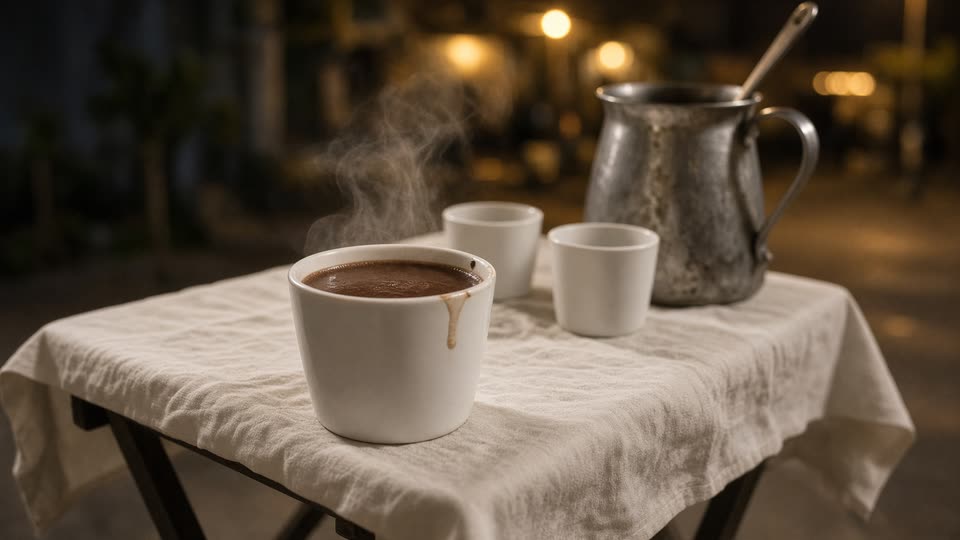
Morocco has no Christmas dish. What it has is one cup, handed out at the church door on the way home.
The archdiocese of Rabat’s own newsletter, in a parishioner’s account of the Casablanca Christmas vigil of 24 December 2023: «Aux environs de 23h30, la cérémonie a pris fin, et à la sortie de l’église, les fidèles ont eu droit à l’habituel chocolat chaud servi par les sœurs de la chapelle d’Anfa.»
The word carrying the custom is «habituel». The hot chocolate is not something that happened that year — it is what the sisters of the Anfa chapel do, and the congregation coming out at half past eleven at night expects it.
Widely repeated claims about Christmas in Morocco that do not survive
checking. Each one says what is actually the case, because a correction
with nothing in its place leaves you worse off than before.
Contradicted
Christmas is banned in Morocco.
What is actually the case. It is not a holiday and it is not hidden. Those are different things, and Morocco is where the difference is most visible.
The Moroccan state's own list of seventeen paid holidays has no 25 December on it, so offices and schools open and the day is worked. What happens anyway is public: Masses in Casablanca, Rabat, Tangier and Marrakesh, two of them at Notre-Dame de Lourdes on Christmas Eve alone, with a Moroccan news crew filming inside the church and the Archbishop of Rabat standing at the door greeting people in the street.
What the law does restrict is conversion, not celebration. The government may summarily expel any foreign resident it judges «a threat to public order», and it has used that clause against people suspected of proselytising. The churches of Morocco serve foreign residents, and that is the line they work on.
The Moroccan civil service closes for seventeen days a year, and the list is Islamic feasts, national days, and 1 January.
The most recent addition is not Christmas. It is the Amazigh new year, Yennayer, on 14 January, added to the official list on royal instruction — «suite aux orientations royales visant à instaurer le premier jour de l'an Amazigh, un jour férié national officiel».
So Morocco's calendar now carries two new years, one of them Berber, and no Christmas. Offices open on 25 December.
The United States State Department's 2023 religious freedom report, on a population of 37.4 million: «More than 99 percent of the population is Sunni Muslim. Groups together constituting less than 1 percent of the population include Christians, Jews, Shia Muslims, and followers of the Baha'i Faith.»
Inside that fraction, the Christian part is mostly not Moroccan. Alongside the foreign-resident Catholics and Protestants there are small Anglican communities in Rabat, Casablanca and Tangier, and about 3,000 foreign residents who identify as Russian or Greek Orthodox — a Russian Orthodox community in Rabat and a Greek one in Casablanca.
How many Moroccan citizens are Christian is contested and nobody has counted: community leaders give 1,500 to 12,000, and the Moroccan Association of Human Rights gives 25,000.
Vidéo. Casablanca: la messe de Noël à Notre Dame de Lourdes — H24info (Casablanca). Retrieved 2026-10-31. archived 20 January 2022The two services, the 18:30 hour, the priest's name and the make-up of the congregation are all its own reporting, and so is the closing line about the pandemic: «Malgré la pandémie, le coeur était à la fête.»
Noël: en prière, les chrétiens subsahariens du Maroc se sentent comme chez eux — Khadim Mbaye, Le360, December 2023. Retrieved 2026-10-31. archived 12 June 2026It describes the congregation arriving «un à un» at the church «qui surplombe le rond-point d'Europe», and gives the Archbishop of Rabat at the main door: «Nous sommes ici à Casablanca pour célébrer la nuit de Noël qui correspond à la naissance de Jésus-Christ. C'est un évènement très important.»
Horaires de travail et jours fériés — Ministère de la Transformation numérique et de la Réforme de l'Administration, Kingdom of Morocco. Retrieved 2026-10-31. archived 8 October 2026The ministry that sets the working hours of the Moroccan civil service, publishing the list of paid holidays: «Ces jours fériés sont au nombre de 17 jours répartis entre les occasions religieuses et nationales.»
Morocco 2023 International Religious Freedom Report — United States Department of State, Office of International Religious Freedom. Retrieved 2026-10-31. archived 10 August 2026For the size and origin of the congregations: «Foreign-resident Christian leaders estimate there are at least 30,000 Roman Catholic and approximately 10,000 Protestant noncitizens, many of whom are recent migrants from sub-Saharan Africa or lifelong residents whose families have resided and worked in the country for generations but do not hold citizenship.» And on where they are: «Most foreign-resident Christians live in the Casablanca, Marrakesh, Tangier, and Rabat urban areas, but small numbers are present throughout the country.»
Au Maroc, la cathédrale de Rabat ouvre le Jubilé de l'espérance — Vatican News (French), December 2024. Retrieved 2026-10-31. archived 26 July 2025Père Daniel Nourissat, curé of the cathedral of Rabat, in his own words: «J'ai été surpris il y a quelques jours d'entendre une fonctionnaire marocaine me souhaiter "Joyeux Noël". C'est un signe que vraiment progresse le respect et l'estime mutuelle. Et ça, c'est vraiment mon espérance.»