Christmas Day in Russia is 7 January. That is 25 December by the Julian calendar the church keeps. It is a public holiday.
How to say it
Russian
С Рождеством Христовым!
S Rozhdestvom Khristovym!
say it: s ruzh-dyist-VOM khris-TOH-vym
A synthesised voice — not a recording of a person — saying С Рождеством Христовым!
in ru-RU.
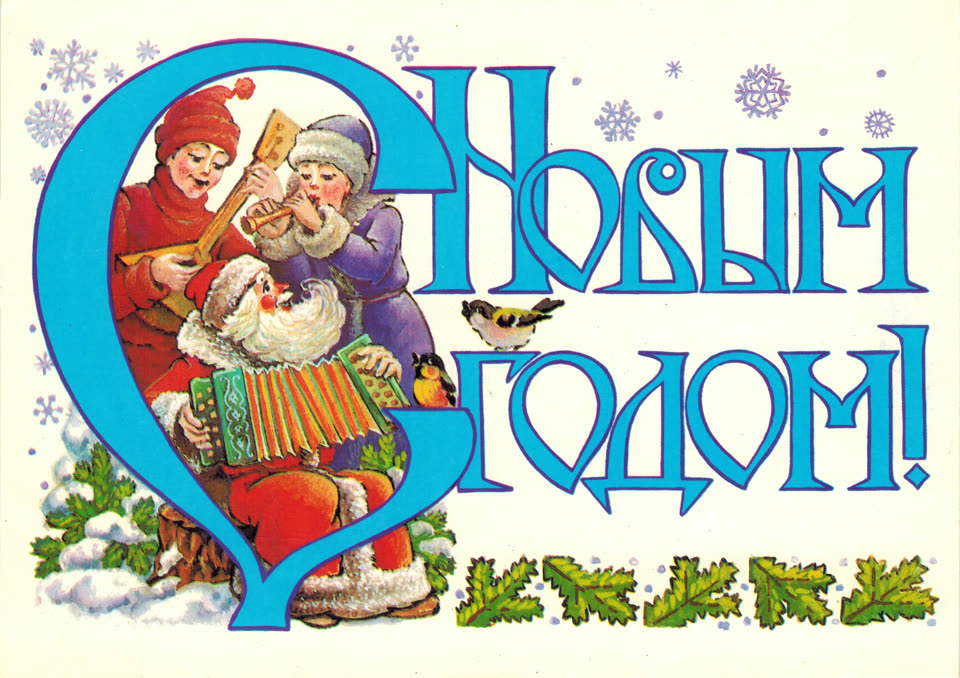
Literally «(congratulations) with the Nativity of Christ» — the verb поздравлять is implied and dropped, which is why the phrase begins with a preposition and has no verb in it. The shorter «С Рождеством!» is the everyday form. Note the register: this is the greeting for the feast, and it is not the one most Russians say most often in the season. That is «С Новым годом!» — happy New Year — which is the greeting of the holiday this country actually keeps on a national scale.
A synthesised voice — not a recording of a person — saying С Новым годом!
in ru-RU.
The greeting that actually carries the Russian winter. The statute gives 1–6 and 8 January to Новогодние каникулы, the tree is a New Year tree, the gift bringer arrives on 31 December, and the feast on the 7th sits inside that block.
Presents arrive on 31 December, at New Year, a week before the feast. The modern figure is not a Christmas gift bringer who moved; he is a New Year figure who was assembled around a New Year tree after the tree was rehabilitated in 1935. Dushechkina dates the canonical image to the start of the twentieth century and the obligatory New Year role to the second half of the 1930s.
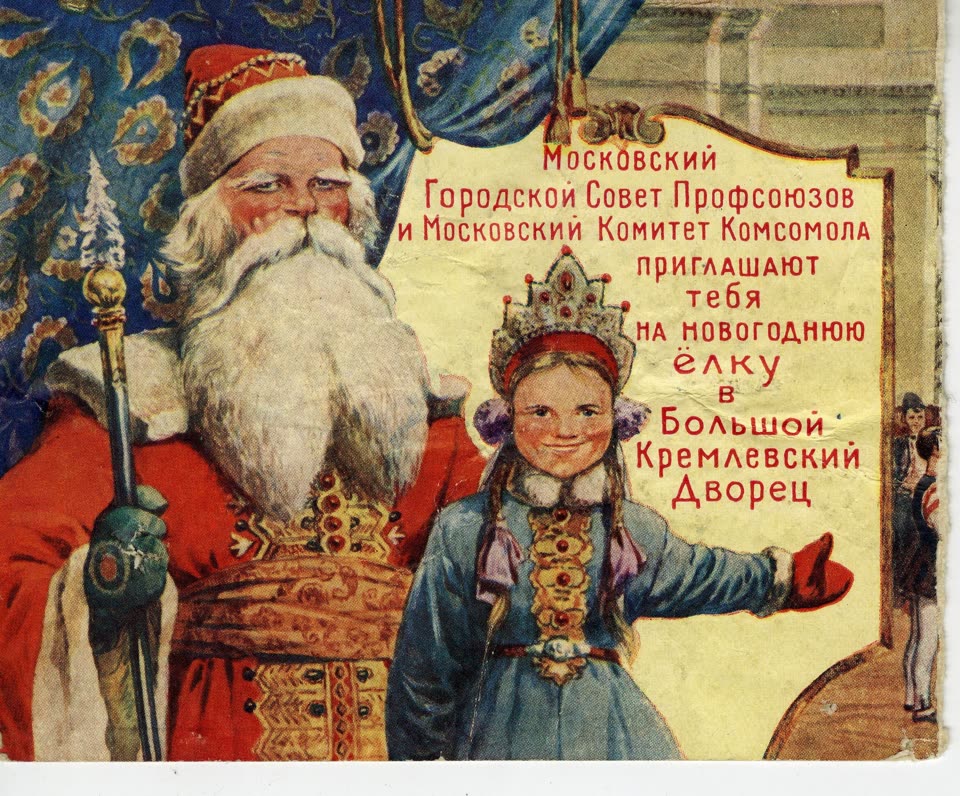
Snegurochka — Снегурочка, the Snow Maiden — travels with him and is the sharper fact. She has no place in folk ritual — «образа Снегурочки в русском народном обряде не зафиксировано» — but she does exist in folk tale, as the girl made of snow who comes to life, and Afanasyev analysed those tales in 1867. Ostrovsky conceived his 1873 «весенняя сказка» under the influence of exactly that work, and in the play she is the daughter of Frost and Spring. She becomes his granddaughter later, at the Soviet children's tree, and the two of them first appeared together at a New Year tree in the Moscow House of Unions at the beginning of 1937 — the Column Hall tree of 1 January that year is the one the Presidential Library dates, and it records only Ded Moroz. A daughter in the play, a granddaughter at the tree, sixty-four years apart.
Sochelnik — the eve named after what is eaten on it
The eve of the Nativity is навечерие Рождества Христова, and is commonly called сочевник or сочельник after the character of the day's meals. The food it is named for is сочиво — grain boiled with honey. The Orthodox Encyclopedia's rule depends on the day of the week. When the eve falls on a Saturday or a Sunday there are two meals, and the second, after Vespers, is «сочиво обварено или кутию с медом» — which is where the day's name comes from. On a weekday there is one meal, after the liturgy, and only «варение со елеем». The weekday services are the Royal Hours in the morning and, in the afternoon, Vespers joined to the Liturgy of St Basil the Great carrying the feast's readings; on a Saturday or Sunday the Royal Hours move to the Friday and the liturgy is St John Chrysostom's, at its usual hour.
НАВЕЧЕРИЕ — Православная энциклопедия, т. 48, С. 222–223
Svyatki — the twelve days, and the games the church kept trying to stop
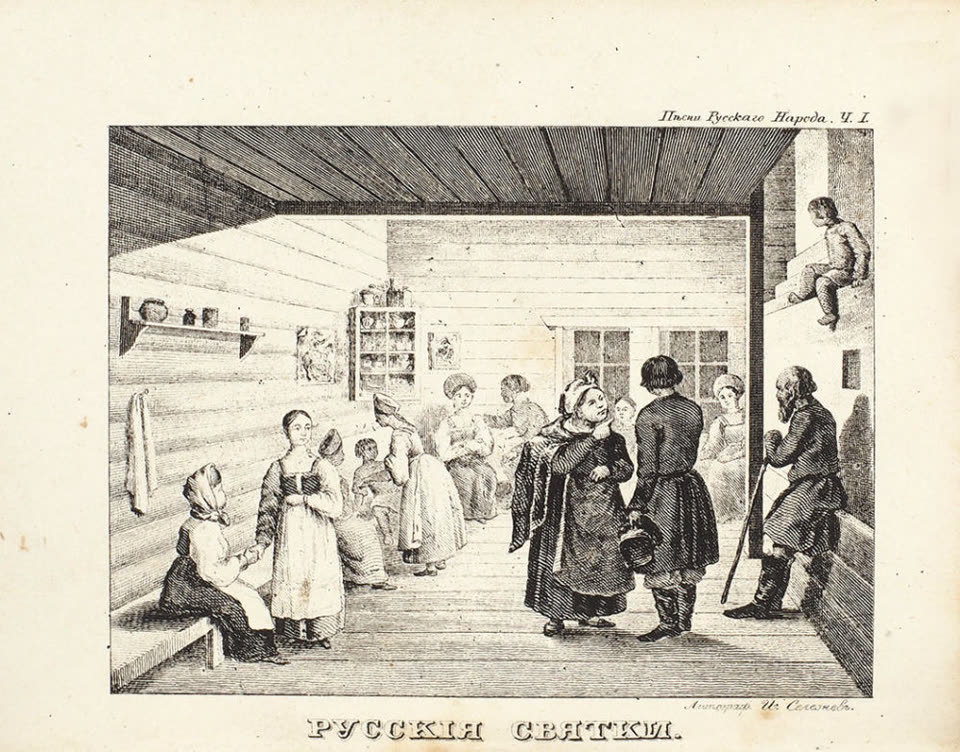
The twelve days from the Nativity to Theophany are Святки — 25 December to 5 January old style, 7 to 18 January new style. The name is from the Old Russian «святокъ», a feast, in use from the seventeenth century. In Russian popular tradition they were a period of games, divination (гадания) and customs the church read as pagan survivals, and the record of that reading is a long series of prohibitions: the Stoglav of 1551 (ch. 41 q. 24; ch. 92), and a Patriarchal decree of 24 December 1684 forbidding, over the Nativity eve and through Svyatki, the holding of игрища and «наряжаясь в кумирские одеяния, производить по улицам пляски и петь соблазнительные песни».
СВЯТКИ — Православная энциклопедия, т. 62, С. 98–99, published 1 October 2025
The fast is not broken at a star
The best-known rule about Russian Christmas Eve — that nothing is eaten until the first star appears — is a pious Russian custom and not a rule of the church. The Typikon does not contain it. What the service actually has is a candle, brought out from the altar after the liturgy, which stands for the star over Bethlehem; the fast runs to the end of that service rather than to the sky.
The Christmas Eve table is laid for the dead as well
The сочельник meal is a family supper that popular belief understood as repeating the meal of the Holy Family after the birth. The food is fasting food — blini with honey, pies with mushrooms, potato and grain, kasha — with кутья and узвар obligatory. And the people at it are not only the living: among the Russians of the Southern Urals the dead members of the family, «родители», were held to take part, released by God onto the earth to rejoice at the Nativity too. The shared meal bound ancestors and descendants, and was a kind of offering to the dead in exchange for the goods they could give the living.
On Christmas Eve evening or Christmas morning a small straw fire — a пурына — was lit by every house in the Southern Urals, with a piece of incense and a candle-end brought from church thrown in for holiness. The rite is called «ножки греть родителям», warming the parents' feet: the fire is for the dead relatives coming from the other world, and each household burned its own. The family stood around it in silence remembering their dead, and the head of the house might say «Мама, папа, няня, дядя, мы тебе ножки греем». In the Orenburg Cossack stanitsas the same fire was explained differently — it was lit to warm the infant Christ, born into a winter frost with nothing but a cold sky above him.
Slavlenie Khrista — the star on a pole, and the carol that threatens you
House-visiting is the characteristic Svyatki rite: groups of children, then youths, then young married couples, going round the village with congratulations. «Славление Христа» entered Russian folk practice in the second half of the seventeenth century under Tsar Alexei Mikhailovich, and re-enacted the magi arriving at the manger — the славельщики carried a рождественская звезда on a long pole, made of straw, paper, or a wooden hoop covered with paper and fitted with long rays of splinters. In the Belgorod villages they built it on the evening of the eve, at the moment the first star appeared in the sky — the star of the custom made when the star of the sky arrived. They knocked at the window, were invited in, went to the icon corner, prayed, and sang the Christmas troparion, closing with «С Рождеством, с праздничком!».
The songs then asked to be paid, and threatened the household if they were not. One recorded in the Southern Urals runs: «Не дадите пирожка, я корову за рога, / Возьму корову за рога, телушку за хвост / И уведу их в колхоз…»
Vasilyev vecher — sowing grain indoors, and a pig named after a saint
14 January, which is 1 January on the old calendar, is Васильев день, and its eve — Васильев вечер — is the night before — St Basil the Great, Basil of Caesarea. Its eve carries щедрование, also called посевание: boys, or in some places the village shepherds, go from house to house scattering grain and singing congratulation songs, and are paid in baked goods, sweets or coins. The required dish of the meal is the «кесаретский» поросёнок — Basil's pig, or any pork dish — eaten as a rite to secure a good harvest. A saint of Caesarea gives his name to a pig eaten for the crops.
Gadaniya — the half of Svyatki the church never stopped
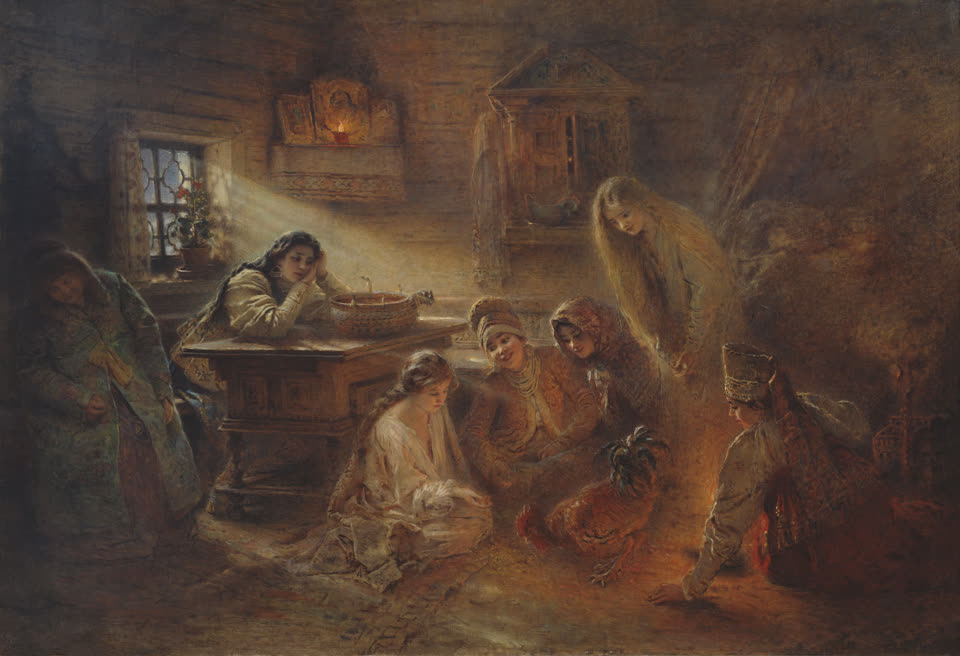
The second half of Svyatki is the «страшные вечера», and it carries the divination. Girls told their fortunes about marriage — whether, when, where, and the name of the betrothed — by pouring melted wax or molten tin into water and reading the shape, and by drawing lots. The mummers belong here too: bright costumes and masks, arriving at the youth gatherings or at houses with noise, singing and dancing, and taking food or money for it. More than a century of prohibition, from the Stoglav of 1551 to the Patriarchal decree of 1684, did not remove any of it; it is what the museum still describes as the content of the period.
Святки — Российский этнографический музей (Russian Ethnographic Museum), Этнокалендарь
Calling Frost to the table — «гукание Мороза»
Before the Christmas Eve meal begins, the householder or one of his sons throws the door wide and calls Frost in to eat. In Melovoye, Rakityansky district: «Мороза, Мороза, / Ходи до нас вечерять, / Да только не морозь ягнят, телят / И маленьких ребят!» Only then does the family sit, in strict order — the host in the centre, grown sons to his right, the mistress, the parents and the youngest children to his left — and only the host may taste the kutya first.
In the Belgorod–Kursk villages he carries that first spoonful out to the threshold instead, and the invitation turns into a threat: «Мороз, Мороз, ходи к нам в хату куттю есть! А в летку не приходи, под кореньями сховайся! А станешь морозить, будем тебя кнутом сечь!» — come and eat, but do not come in summer, hide under the roots, and if you freeze anything we will take a whip to you. Recorded in Terebreno, Krasnoyaruzhsky district.
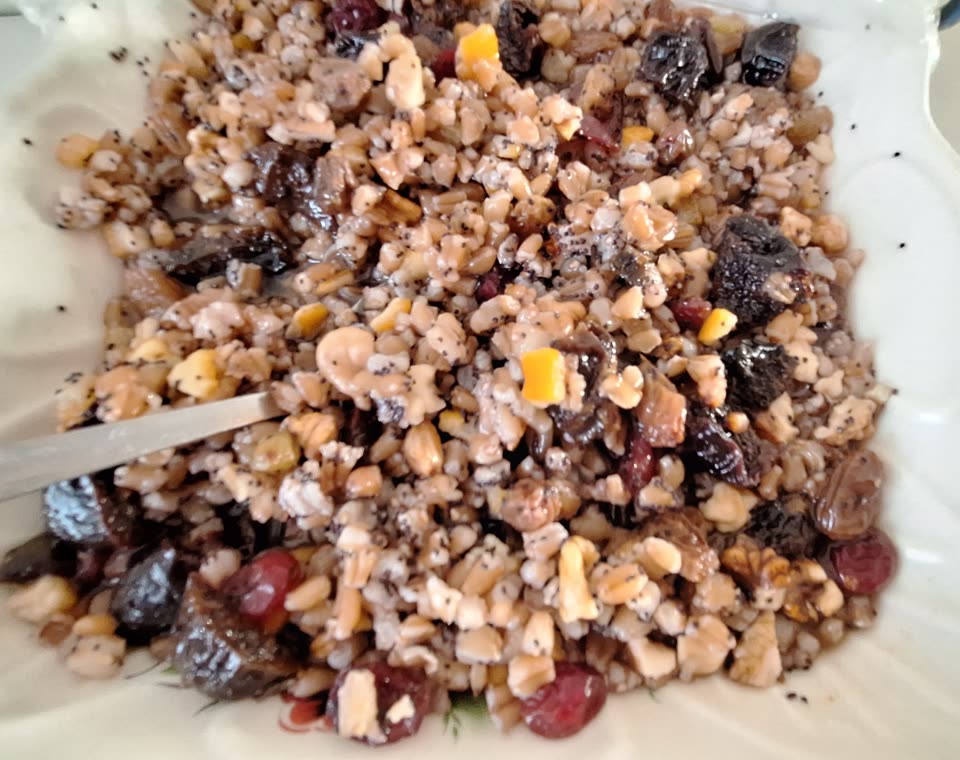
Sochivo, or kutya — grain boiled with honey сочиво, кутья
The dish the eve is named after. Wheat, barley or rice boiled with honey; the church rule for the eve names it directly as «сочиво обварено или кутию с медом». The name сочиво is Church Slavonic for soaked grain — wheat, lentils, peas, barley — which is why the eve is сочельник.
НАВЕЧЕРИЕ — Православная энциклопедия, т. 48, С. 222–223
Uzvar — dried fruit boiled with honey узвар, взвар
The other half of the ritual pair. Узвар is made from dried fruit and berries — apples, pears, plums, cherries, currants — stewed in a pot with honey. Shangina records кутья and узвар as the two обязательные dishes of the Christmas Eve table, and reads them together: both are built from grain and fruit, and their symbolism is the renewal of life through death, because grain and berries die and are reborn every year. The honey is from the bee, which the same tradition calls «божья угодница».
The Christmas table after the fast — and three different kutyas рождественский стол; кутья постная, богатая, васильевская
What the fast ends into, recorded in Belgorod villages: кутья, fish dishes, заливное, студень from pig and beef trotters, home-made pork sausage, ham, blini, взвар, small baked goods («бабышки», «куличики»), honey gingerbread, biscuits shaped as farm animals, meat pies and round loaves. The Christmas loaf itself was wheat flour decorated with lozenges, circles and zigzag «ковылышки».
And the kutya is not one dish but three, by an informant's own count — Ломатина М. Г., born 1931, of Nizhnyaya Pokrovka, Krasnogvardeysky district: «Три кутти бувает. Под Рожтво – постная, и под Хрященье, а под Новый год – васильевская куття – жирная». A lenten one for Christmas Eve, another for Epiphany, and a rich one for the New Year, Basil's kutya, made with fat. The Christmas one is «голодная», hungry kutya, cooked on взвар with honey or sugar, ground nuts and pounded poppy seed.
Widely repeated claims about Christmas in Russia that do not survive
checking. Each one says what is actually the case, because a correction
with nothing in its place leaves you worse off than before.
Oversimplified
Russians celebrate Christmas on a different date from everyone else.
What is actually the case. It is the same date. Russian Orthodox Christmas is 25 December on the Julian calendar, which is 7 January on the Gregorian one — a thirteen-day difference that exists because the Russian state adopted the Western calendar by decree in 1918 and the church did not follow. Nobody moved the feast. The civil calendar moved out from under it. The thirteen days in the decree and the thirteen days between 25 December and 7 January are the same thirteen days.
And the thirteen days are not permanent. The gap between the two calendars widens by three days every four hundred years: it was twelve in the nineteenth century, it is thirteen from 1900 to 2100, and from 2101 the Julian 25 December will fall on 8 January.
You must not eat anything on Russian Christmas Eve until the first star appears in the sky.
What is actually the case. It is a pious Russian custom and the church's own rule book does not contain it — «Устав такого не предусматривает» in as many words. The Typikon ties the meal to the end of the service, not to the sky: on a weekday, one meal after the liturgy. The star in the liturgy is a candle, carried out from the altar, standing for the star over Bethlehem.
What it is instead is a custom people really kept. The Belgorod ethnographers record it twice in the same villages — «До первой звезды есть на Рождество не полагалось» and «До первой звезды за стол не садились», nobody ate and nobody sat down before the first star — and the lads who went from house to house with a paper star on a pole made it at the moment the real one appeared, «та самая, что зажглась во время рождения Иисуса Христа». So the answer is not that the rule is marginal. It is that it belongs to the village and not to the Typikon, and the two are different kinds of authority.
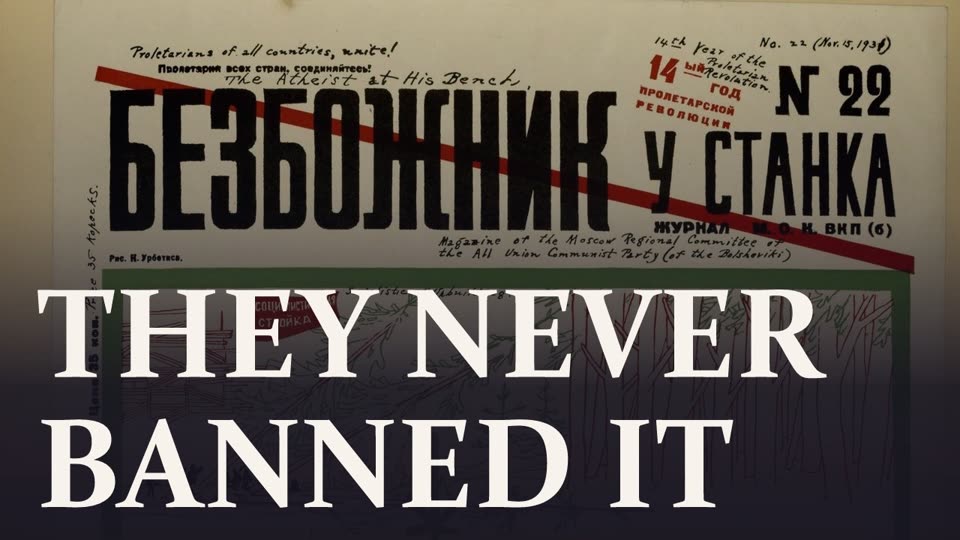
What is actually the case. Christmas was never banned by name. It lost its day off as one of a class, in a regulation about shift rotas. Article 6 of the labour regulation approved by Sovnarkom on 24 September 1929, for enterprises moving to the continuous working week, lists the only days on which work is forbidden — 9 January 1905 and Lenin's memory, the Internationale, the October Revolution anniversary — and then disposes of everything else in one sentence: «В день нового года и в дни всех религиозных праздников (бывших особых дней отдыха) работа производится на общих основаниях». New Year and the Nativity go together, in the same clause, and the whole of the church calendar is handled by a parenthesis: former special rest days.
The rest of the shape matters too, and it is why «banned» is the wrong word rather than merely a strong one. The word collapses three separate things that were taken away by different means and came back one at a time, across sixty-two years. The rest days went in one clause of 1929; the tree was attacked separately, in the anti-religious campaigns of the same years, as a «поповский обычай» — a priestly custom, «религиозный хлам». The tree returned in December 1935, as a New Year object rather than a Christmas one. The day off returned in 1947, and it was 1 January rather than the Nativity. The feast itself waited until 7 January 1991, the first after the Supreme Soviet of the RSFSR declared it a non-working day on 27 December 1990 — a year before the Union it had been removed by stopped existing. All three came back. Not one of them came back as what it had been.
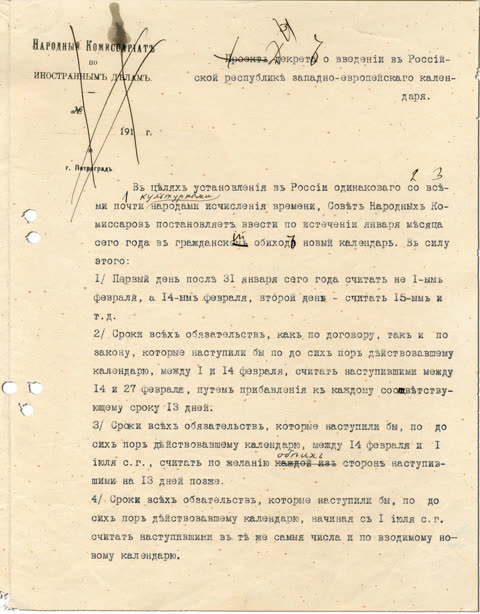
The thirteen days between Russian and Western Christmas are written into a Bolshevik decree about deadlines and pay. The Sovnarkom decree introducing the Western European calendar orders that «Первый день после 31 января сего года считать не 1 февраля, а 14 февраля» — and then spends eight of its ten clauses on wages, pensions, loan interest and contract deadlines, adjusting each by thirteen days. The state moved to the Gregorian calendar and the church did not, and that administrative gap is the whole reason Russian Christmas is on 7 January.
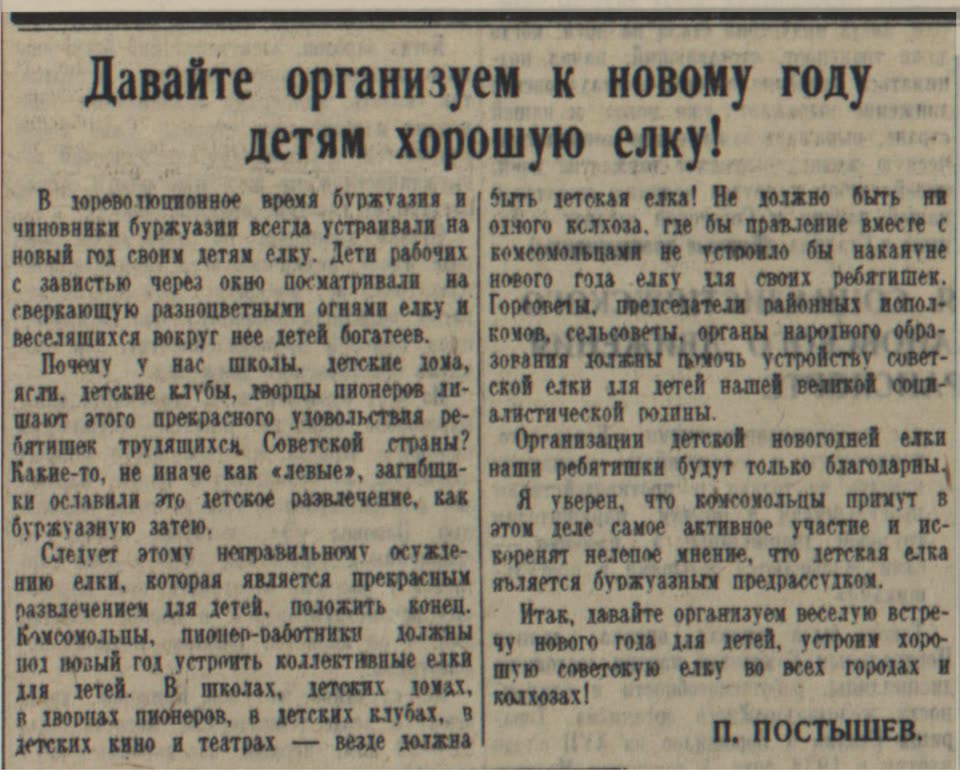
The first Soviet New Year tree was in Kharkiv, three days after the newspaper article that permitted it. P. P. Postyshev published «Давайте организуем к новому году детям хорошую ёлку» in «Правда» on 28 December 1935, and the tree went up on 31 December at the Palace of Pioneers there — in Ukraine, not in Moscow, whose own came a year later on 1 January 1937. But 1 January did not become a holiday and a day off until a decree of the Presidium of the Supreme Soviet on 23 December 1947.
Snegurochka has no folk ritual behind her, which is not the same as having no folk original. Ded Moroz has a plausible ancestor in an East Slavic ritual Frost; the Snow Maiden is not recorded in Russian ritual at all — but she is in the folk tales, as the girl made of snow who comes to life and melts, and Afanasyev had analysed them in 1867 when Ostrovsky conceived his «весенняя сказка» of 1873 under his influence. In the play she is Frost's daughter. She only becomes his granddaughter when the two of them are put on a stage together at a Soviet children's New Year party in the Moscow House of Unions at the beginning of 1937.
There is a tsar's complaint about Moscow carol-singing, and it reads like a noise ordinance. Russian documents of the sixteenth and seventeenth centuries describe the Svyatki house-visiting in detail, and a decree of Alexei Mikhailovich begins by naming where it happens: «Ведомо нам учинилося, что на Москве, наперед сего в Кремле, и в Китае, и в Белом, и в земляных городах, и за городом, и по переулкам, и в черных, и в Ямских слободах по улицам и по переулкам, в навечерие Рождества Христова кликали многие люди Коляду и Усень». The Kremlin, Kitai-gorod, the White and Earthen towns, the lanes and the coachmen's quarters — the authorities knew exactly which streets, because they were trying to stop it.
Russia has moved its New Year twice and its whole calendar once. The year began on 1 March for centuries; from the end of the fifteenth century the church moved the новолетье to 1 September. Then in December 1699 Peter I decreed that the day after 31 December of the year 7208 «от сотворения мира» would be 1 January 1700 «от Рождества Христова» — the year number changed by more than five and a half thousand, and the New Year moved from September to January in one night. The 1918 decree did something different again: it did not move New Year's Day, it moved every date in the country by thirteen days. The familiar Russian winter — New Year on 1 January, Christmas on the 7th — is what the last two left behind.
Новый год — Российский этнографический музей (Russian Ethnographic Museum), Этнокалендарь
The tree could come back because it had never meant much to the Russian church. The museum puts it plainly: the custom of dressing an evergreen came to Russia from Germany and «не приобрел здесь религиозного значения» — it acquired no religious meaning here. That did not save it. The Soviet campaigns of the late 1920s attacked it anyway, as a «дикарский», «поповский» обычай and «религиозный хлам» — a savage and priestly custom, religious junk. What the absence of real church meaning bought was the ease of the reversal: in 1935 a tree could be handed back to children as a New Year tree without conceding anything to anybody. The feast did not come back for another fifty-six years.
Новый год — Российский этнографический музей (Russian Ethnographic Museum), Этнокалендарь
Russian carols treat the feasts as three men walking over a bridge. In Belgorod villages the колядки speak of Kolyada and Ovsen as living persons, and of the holidays themselves the same way: Kolyada goes to the smithy, forges an axe, cuts an oak, builds a little bridge — and over it come «три братца»: «Первый братец – Рождество Христово, / Второй братец – Василь Косарецкий, / Третий братец – Крещенье Христово». Christmas, St Basil's day and Epiphany, crossing in order over a bridge a mythological figure built for them.
The law that gave Russia its Christmas back is two sentences long. «В связи с обращением Патриарха Московского и всея Руси Алексия и уважая религиозные чувства верующих, Верховный Совет РСФСР постановляет: Объявить 7 января (Рождество Христово) нерабочим днем.» — in response to the appeal of Patriarch Alexy of Moscow and All Russia, and respecting the religious feelings of believers, the Supreme Soviet of the RSFSR resolves: to declare 7 January, the Nativity of Christ, a non-working day. Dated 27 December 1990, signed in the House of Soviets by the first deputy chairman, R. I. Khasbulatov. So 7 January 1991 was the first Russian Christmas in sixty-two years that was a day off — the tree had come back in 1935 and 1 January had been a holiday again since 1947, and the feast itself waited until the last days of the Soviet Union.
Every claim carries its own citation. They are collected below, so you
can see what the page rests on and how much of it comes from where.
с Рождеством — Russian entry — Wiktionary. Retrieved 2026-10-05. archived 25 December 2025Gives IPA [s‿rəʐdʲɪstˈvom] for the short form and names «с Рождеством Христовым» as the fuller synonym, with the elliptical поздравлять explained in the etymology.
Дед Мороз и Снегурочка (fragments from «Русская ёлка», СПб., 2002) — Отечественные записки, № 1 (10), 2003. Retrieved 2026-10-05. archived 9 February 2026Verbatim used above: «образа Снегурочки в русском народном обряде не зафиксировано»; «В начале 1937 года Дед Мороз и Снегурочка впервые явились вместе на праздник ёлки в московский Дом союзов»; «К началу XX века образ Деда Мороза окончательно оформился».
НАВЕЧЕРИЕ — Православная энциклопедия, т. 48, С. 222–223. Retrieved 2026-10-05. archived 30 July 2026The fasting rule as given: on a weekday one meal after the liturgy with «варение со елеем»; when the eve falls on a Saturday or Sunday, two meals, the first after the liturgy («по уломку хлеба и от вина мало»), the second after Vespers.
СВЯТКИ — Православная энциклопедия, т. 62, С. 98–99, published 1 October 2025. Retrieved 2026-10-05.
Как правильно провести сочельник? — Православный журнал «Фома». Retrieved 2026-10-05. archived 25 February 2026Verbatim: «Не есть до появления первой звезды — это благочестивый русский обычай. Устав такого не предусматривает.» And on the candle: «А можно вспомнить, что свеча, которую утром после литургии выносят из алтаря, символизирует Вифлеемскую звезду.»
В Москве состоялась первая новогодняя ёлка / 1 января объявлено праздничным и выходным днём — Президентская библиотека имени Б. Н. Ельцина (Boris Yeltsin Presidential Library). Retrieved 2026-10-05. archived 1 January 2026The 1935 and 1937 dates and the Postyshev quotation are from /history/2074168, which cites «Правда» of 2 January 1937, Khrushchev's memoirs, and Душечкина Е., Берсенева Л., «Три века русской ёлки» // Наука и Жизнь, 2007 № 12. The 1947 decree is from /history/619836: «23 декабря 1947 г. Указом Президиума Верховного Совета СССР 1 января был объявлен праздничным и выходным днём».