

Santa Claus
He has a Canadian postal code. H0H 0H0 is a real, working address inside Canada's postal system, and a letter sent to it is answered, in the language it was written in.
Write a letter to Santa — Santa letter program — Canada Post
A country-by-country atlas of how Christmas is actually kept
All countries · North America
Next: Friday 25 December 2026
Christmas Day in Canada is 25 December. It is a public holiday.
English
Merry Christmas
Merry Christmas
A synthesised voice — not a recording of a person — saying Merry Christmas in en-CA.
The English half of a country that says both. Canada's Christmas statements are issued twice over, once in each official language, and neither is a translation printed under the other — they are two versions of the same text, each ending in its own greeting.
Statement by Prime Minister Carney on Christmas — Office of the Prime Minister of Canada, 24 December 2025
French
Joyeux Noël
Joyeux Noel
say it: zhwah-YUH no-EL
A synthesised voice — not a recording of a person — saying Joyeux Noël in fr-CA.
The French half. In Québec and in francophone communities across the country the season itself is «le temps des Fêtes» — the holidays, plural, running from Christmas Eve to New Year — and a December greeting is as likely to be «Joyeuses Fêtes» as «Joyeux Noël».
Déclaration du premier ministre Carney à l'occasion de Noël — Cabinet du premier ministre du Canada, 24 December 2025
He has a Canadian postal code. H0H 0H0 is a real, working address inside Canada's postal system, and a letter sent to it is answered, in the language it was written in.
Write a letter to Santa — Santa letter program — Canada Post
Québec
Which days off a Canadian gets at Christmas depends on who signs the cheque. The Canada Labour Code gives federally regulated employees ten general holidays, and two of them are at Christmas: «Christmas Day and Boxing Day».
Most Canadians are not federally regulated. Québec's own labour standards set eight statutory holidays, and the December entry is a single line — «Le 25 décembre (fête de Noël)». 26 December is not on that list, so for most Québec employees Boxing Day is an ordinary working day.
The gap runs the other way too. Remembrance Day and the National Day for Truth and Reconciliation are federal general holidays and are not Québec ones: «Le jour du Souvenir (11 novembre) et la Journée nationale de la vérité et de la réconciliation (30 septembre) ne sont pas des jours fériés au Québec. Les salariés protégés par le Code canadien du travail, ont cependant droit à ces congés payés.»
Canada Labour Code, section 166 — Justice Laws Website, Government of Canada
Les congés fériés — Éducaloi
Newfoundland and Labrador
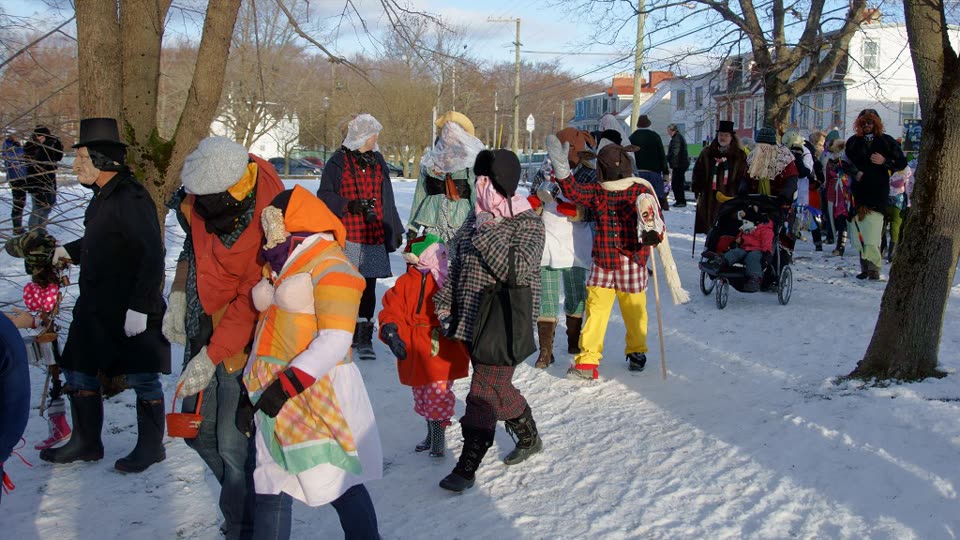
In Newfoundland and Labrador, groups of friends and family dress up in whatever is in the house and walk from door to door over the Christmas season. Heritage NL, which commemorated the custom in 2011, describes it as «a tradition practiced in various forms for over 300 years… the practice of visiting several homes throughout an evening while dressed in a disguise».
The disguise is the point, and so is the game. «They might change their walk, talk, shape, or size — whatever it takes to make them unrecognizable to the hosts of the homes they visit. Upon entering a home, the hosts try to guess the identities of the mummers hidden behind some kind of mask. Once identified, the mummers remove their mask. The hosts then usually offer them drink and food.»
Some houses make it a condition: «In many homes, a host would not offer a drink until they guess the mummer's identity.» And then, in Heritage NL's own phrase, «with the lifting of the veil, the stranger becomes the friend» — everybody socialises until the mummers suit up and go to the next house.
Mummering — Provincial Historic Commemorations Program — Heritage NL (Heritage Foundation of Newfoundland and Labrador)
Newfoundland and Labrador
The custom did not survive in a museum. Heritage NL lists what it turned into: «it continues as a Christmastime house visit; it has become a type of performance for summertime Come Home Year celebrations; it's the topic of a still-popular song; and it's represented in art and craft».
Then the list of objects, which is the part that shows how far it has travelled: «mummer Christmas tree ornaments, dolls, embroidered pillows and quilts, wrapping paper, gift cards, paintings, photos, books, t-shirts, wine bags, coffee mugs, and Christmastime specialty beer».
It has also been academic property since the 1960s — «a continual area of interest for academics since the 1960s» — and in the 1970s it gave a political theatre troupe its material. St. John's now holds a Mummers Parade in December.
Mummering — Provincial Historic Commemorations Program — Heritage NL (Heritage Foundation of Newfoundland and Labrador)
Ontario
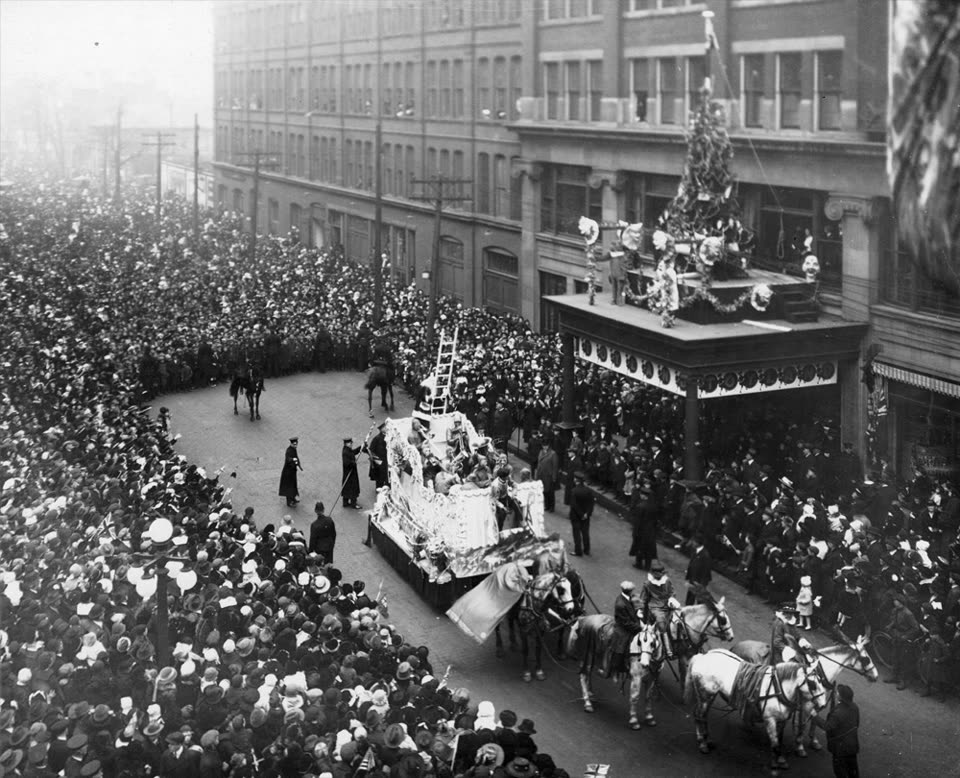
Toronto's Santa Claus Parade has run since 1905, and the organisers' own history is specific about how small it started: «The first Santa Claus Parade was held on December 2, 1905 and was sponsored by Eaton's department store. In this premiere Parade — one float picked up Santa from Union Station and delivered him to the downtown Toronto Eaton's store.»
It grew fast and strangely. By 1913 «Eaton's arranged for Santa to be pulled by live reindeer, which had been imported from Labrador specifically for the Parade», with a dedicated vet and a diet of moss; afterwards the reindeer retired to an Eaton's executive's property outside the city. That same year children began walking the route with Santa and «dropped letters to Santa into baskets on poles carried by bearers. Every letter with an address received a personal response from Santa.»
And it is not a Christmas-week event: the parade now runs in the second half of November — «The 122nd Santa Claus Parade Returns Sunday, November 22nd».
History — The Original Santa Claus Parade — The Santa Claus Parade, Toronto

Canada Post runs Santa's mail. The address is «Santa Claus, North Pole, H0H 0H0, Canada» — a postal code built as a joke on ho ho ho, routed like any other — and the service is real: «For more than 40 years, Canada postal elves have been busy helping Santa sort through over one million letters per year from around the world!»
It is done by staff on their own time. The government's 2011 announcement describes «an employee-led volunteer initiative — with employees (current and retired) donating over 200,000 hours of time every year». Letters start arriving in July, and every one with a return address is answered, in the language it was written in.
There is a deadline, printed on the page like any other service: letters to Santa in 2026 must be posted by 9 December.
Write a letter to Santa — Santa letter program — Canada Post
20 Million Santa Fans Can't Be Wrong! — Government of Canada news release, 22 December 2011
Québec
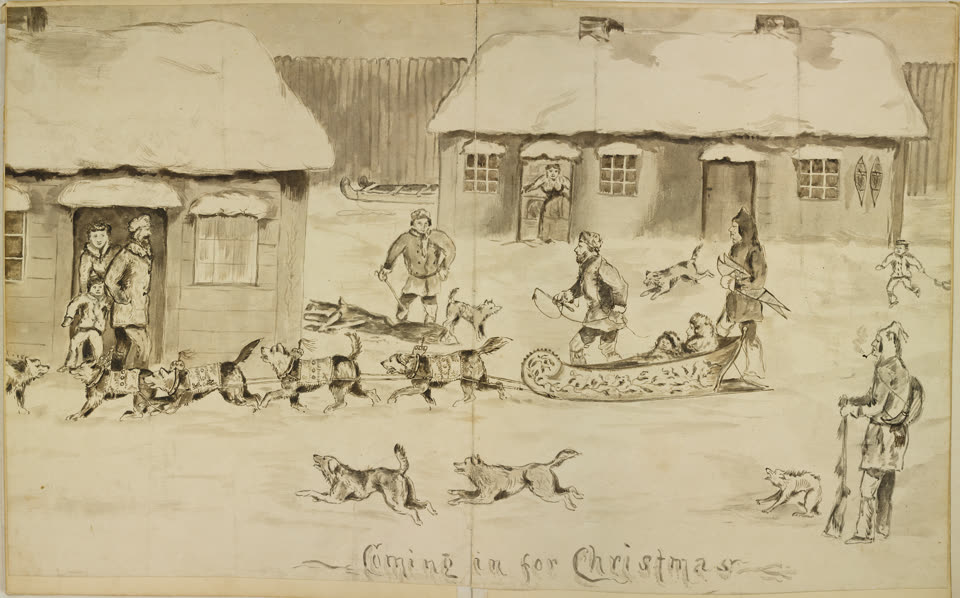
Christmas Eve in Québec traditionally ran in one unbroken movement from the church to the table. Bibliothèque et Archives nationales du Québec, describing the custom around 1900 out of its own holdings of illustrated papers: «La messe terminée, le parvis de l’église s’emplit des voix des fidèles. Toutes les familles reprennent le chemin de la maison pour le réveillon.» The Mass over, the church forecourt fills with the voices of the congregation and every family sets off home for the réveillon.
There was one more delay before anybody ate: «Arrivés au foyer, les convives doivent encore attendre que soient distribués les cadeaux pour enfin se mettre à table.» The presents came first, and then «Le festin servi, la maisonnée se rassemble autour de l’abondant repas.»
Somebody had to stay behind, and it was always the same somebody. «Souvent, la mère ou la grand-mère doit se priver de la messe de minuit» — often the mother or the grandmother had to go without the midnight Mass, because she was responsible for the food and for the small children who were too young to go. The turkey had to be basted and the tourtière watched; the croquignoles, the pâté de Noël and the plum pudding had to be finished. BAnQ quotes a period account of what else was cooling: «les têtes en fromage et les guertons [cretons] refroidissent en attendant la fringale qu’auront les gens de la messe» — the head cheese and the cretons cooling against the hunger of the people coming back from church.
Then the furniture went back. «Qu’on parle de gigue, de rigodon, de « tapeux de pieds », les familles québécoises mettaient la musique et la danse à l’honneur pendant ces soirées festives et rassembleuses.»
The recipes outlasted the century: BAnQ points readers at La cuisine raisonnée, first published in 1919 and still in print.
Les réveillons de Noël d’antan au Québec — Bibliothèque et Archives nationales du Québec, 19 December 2023
Québec
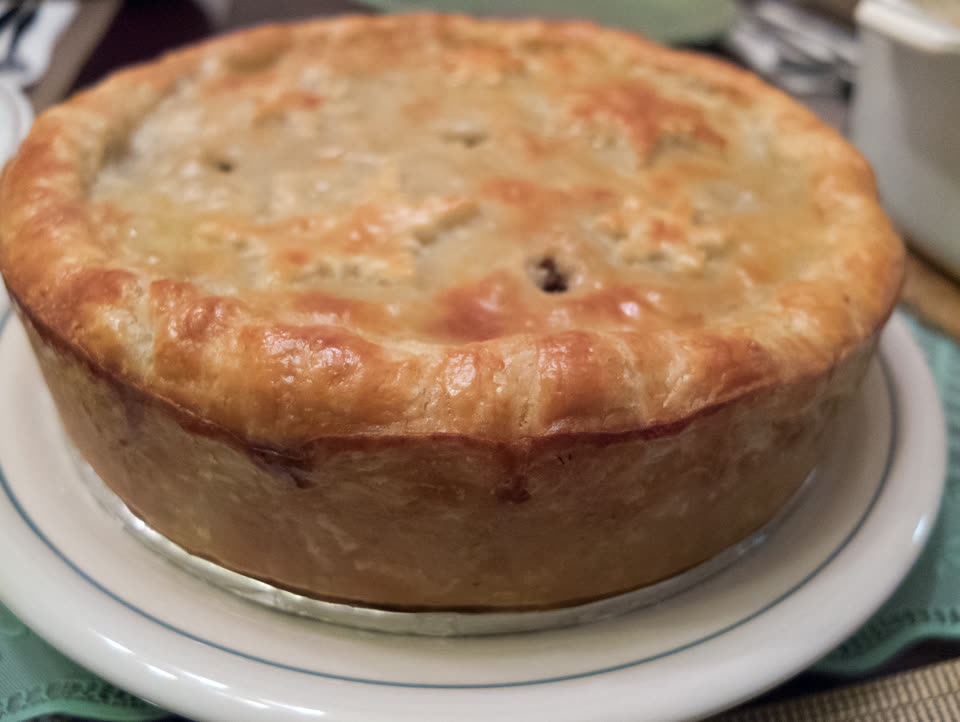
A deep pastry pie of minced meat — pork, usually, sometimes with beef or game — that is the one dish a Québec Christmas table is expected to carry. Radio-Canada calls it «un plat traditionnel de Noël, très célèbre au Québec».
It is a family object as much as a recipe. «Tout le monde connaît l'histoire, tout le monde a une tante, une grand-mère, une mère, qui fait la meilleure tourtière du monde» — everyone has an aunt, a grandmother or a mother who makes the best tourtière in the world — says James Sharman, a British-born pastry chef who now sells them in Toronto. One of the bakers in the same report makes hers from her father's recipe, which he died without writing down.
And it is leaving Québec. Since the pandemic, the broadcaster reports, the tourtière «devient peu à peu un plat incontournable sur les tables des fêtes de fin d'année des Torontois et, plus largement, des Canadiens» — slowly becoming unavoidable on Toronto tables, and on Canadian ones more broadly.
Après la poutine, la tourtière part à la conquête du monde — Radio-Canada, Yannick Jacques and Cécile Bernard, 23 December 2024
Québec
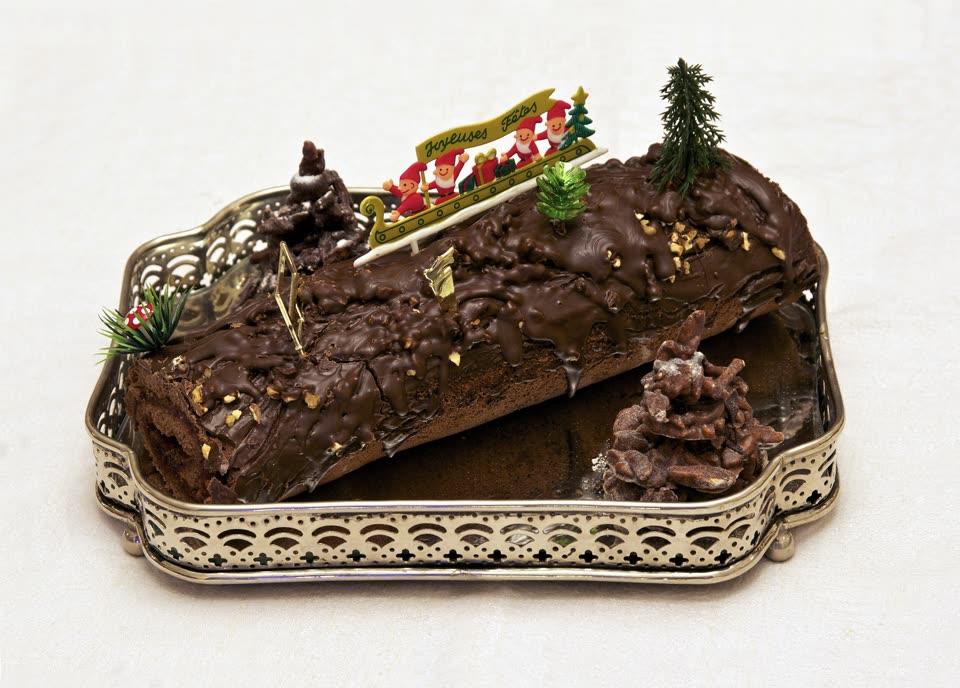
A rolled sponge iced and scored to look like a log, and in Québec it is younger than almost everything else on the table.
The log itself is old and the cake is not. Radio-Canada, quoting the UQAM food historian Jean-Pierre Lemasson: «La tradition de la bûche est exclusivement française. Peu à peu, elle est devenue une tradition francophone.» Nineteenth-century French pastry cooks turned a log of wood into a pastry; Québec took much longer to want it.
Lemasson dates the change to the end of the war and names the mechanism: «Au Québec, il faut attendre la fin de la Seconde Guerre mondiale avant que la bûche connaisse le succès, « avec notamment l’immigration de pâtissiers, des savoir-faire et des échanges culinaires entre le Québec et la France »». A decade later, a second Radio-Canada report puts the same thing in a different decade and the same place: «L’engouement des Québécois pour ce dessert est arrivé plus tard, dans les années 1950», and «Les pâtissiers français ont rendu la bûche de Noël populaire ici.»
It is not an old réveillon dish and the evidence is an absence. BAnQ’s account of the Québec réveillon around 1900 lists the turkey, the tourtière, the croquignoles, the pâté de Noël, the plum pudding, the head cheese and the cretons. The bûche is not in it.
La bûche de Noël, un symbole millénaire… mais un dessert récent — Radio-Canada, 24 December 2015
Pain sandwich, tourtières et dinde : les origines de nos traditions culinaires des Fêtes — Radio-Canada, Félix Ouellet, 31 December 2025
Widely repeated claims about Christmas in Canada that do not survive checking. Each one says what is actually the case, because a correction with nothing in its place leaves you worse off than before.
Oversimplified
What is actually the case. It is a statutory holiday in federal jurisdiction, and in several provinces, and it is not one in Québec. The Canada Labour Code's list of general holidays ends «Christmas Day and Boxing Day», which covers banks, telecommunications, interprovincial transport, Canada Post and the federal public service — and those employers are a minority of Canadian workplaces.
Québec's labour standards set eight statutory holidays, and the only December entry is «Le 25 décembre (fête de Noël)». For most Québec employees 26 December is a working day, whatever the calendar on the wall says.
The other nine provinces and three territories each legislate their own list, and «only Québec» would be as loose a claim as the one it corrects. The thing to take away is that Boxing Day has no single national answer.
Canada Labour Code, section 166 — Justice Laws Website, Government of Canada
Les congés fériés — Éducaloi
The 2021 census counted «over 19.3 million people reported a Christian religion, representing just over half of the Canadian population (53.3%)». The same release gives the trajectory in one line: «this proportion is down from 67.3% in 2011 and 77.1% in 2001».
Alongside it, «approximately 12.6 million people, or more than one-third of Canada's population, reported having no religious affiliation». Catholics remain the largest single denomination at 10.9 million people, 29.9 per cent; the United Church is 3.3 per cent and the Anglican Church 3.1.
In British Columbia and Yukon, more than half the population reported no religion at all.
The Canadian census: A rich portrait of the country's religious and ethnocultural diversity — Statistics Canada, The Daily, 26 October 2022
On 22 December 2011 Canada Post announced that «Santa's Post Office has confirmed Santa and his postal elves have just delivered their 20 millionth response letter, to a child in London (Ontario)». What the child had asked was not disclosed — the letters are private — but the answer was.
The same release prints Santa's answers to the ten questions he was asked most that year. How many elves work for you: «9,876». Do you know Frosty the Snowman: «He's my next-door neighbour. I love his hat.» Is Mrs. Claus a good cook: «Have you seen my waistline?»
The programme's stated purpose is literacy: it encourages children to write letters, and to address them correctly.
20 Million Santa Fans Can't Be Wrong! — Government of Canada news release, 22 December 2011
The 1913 parade imported live reindeer from Labrador to pull Santa through Toronto. They travelled with a dedicated veterinarian «who looked after them and supplied their special diet of moss», and when the parade was over they went to live on the property of an Eaton's executive outside the city.
The same year, the parade invented a postal service of its own: children walking the route «dropped letters to Santa into baskets on poles carried by bearers», and «every letter with an address received a personal response from Santa» — sixty-nine years before Canada Post took the job on nationally.
History — The Original Santa Claus Parade — The Santa Claus Parade, Toronto
Every claim carries its own citation. They are collected below, so you can see what the page rests on and how much of it comes from where.


