Christmas Elsewhere

A country-by-country atlas of how Christmas is actually kept

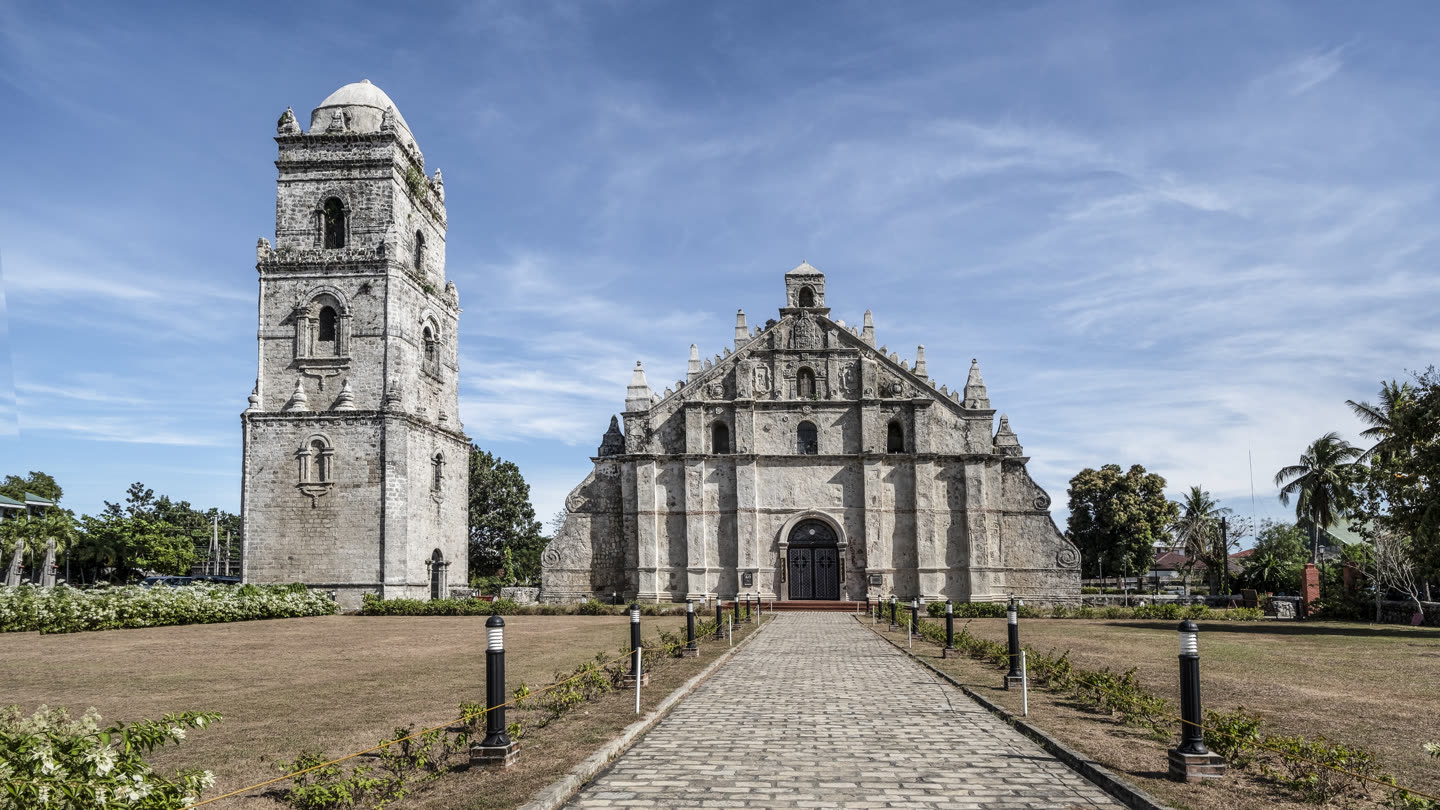
Paoay Church seen head-on from the end of its paved path. The facade is a wide, low gable of pale weathered coral-stone and brick, flanked along both flanks by a row of colossal buttresses that step out from the walls as solid masonry wedges, the outermost pair curling into great stone scrolls where they meet the ground. Small pinnacles and shallow niches run up the gable to a little belfry at the apex, and a single arched wooden door sits at the centre above a few steps. Standing completely apart from the church to the left is a square three-stage bell tower of the same stone, capped with a pale dome, each face carved with arched niches. Clipped hedges and bollards line a brick path running straight to the door, dry grass lies to either side, palms and dark trees close both edges of the frame, and high thin cloud streaks a blue sky.
Luzviminda7641 · CC0

All countries · South-eastern Asia

Christmas in the Philippines

Christmas falls on
25 DecemberGregorian calendar
A public holiday
YesProclamation No. 1006 — Declaring the Regular Holidays and Special (Non-Working) Days for the Year 2026 — Office of the President of the Philippines, via LawPhil (Arellano Law Foundation)
Who brings the presents
Ninong and ninang (godparents)ninong at ninang · arrives 25 December
Watch the episode Christmas in the Philippines, on YouTube
—days
—hrs
—min
—sec

Next: Friday 25 December 2026

When is Christmas in the Philippines?

Christmas Day in the Philippines is 25 December. It is a public holiday.

How to say it

  • Filipino

    Maligayang Pasko

    say it: mah-lee-GAH-yang pas-KOH

    A synthesised voice — not a recording of a person — saying Maligayang Pasko in fil-PH.

    A speaker from Manila, saying Pasko — the second word of the greeting, not the whole phrase. Wikimedia Commons, Public domain.

    The stress is on the last syllable. English-language guides almost universally respell this as "PAHS-koh", and that is wrong: Tagalog Paskó is mabilis, stressed on the final syllable, which the IPA /pasˈko/ makes explicit. The transcription here is for Pasko alone, not the whole phrase. Maligaya is "happy", and the -ng is the linker. Like メリークリスマス in Japan, the word is a loan and that is the point: Pasko is Spanish pascua, which is Latin pascha, which is Greek páskha — Passover.

    Pasko — Tagalog entry — Wiktionary

Who brings the presents

Ninong and ninang (godparents) ninong at ninang

The present is an aguinaldo and it is asked for rather than delivered: children go to the houses of their godparents and elder relatives on Christmas Day, greet them with the mano — taking the elder's hand to their own forehead — and receive money or a gift. Santa Claus exists here and is not the mechanism; the godparent is.

Aginaldo — Sagisag Kultura (2015) — National Commission for Culture and the Arts (NCCA), Philippine Cultural Education Program; ed. Virgilio S. Almario

How Christmas is kept

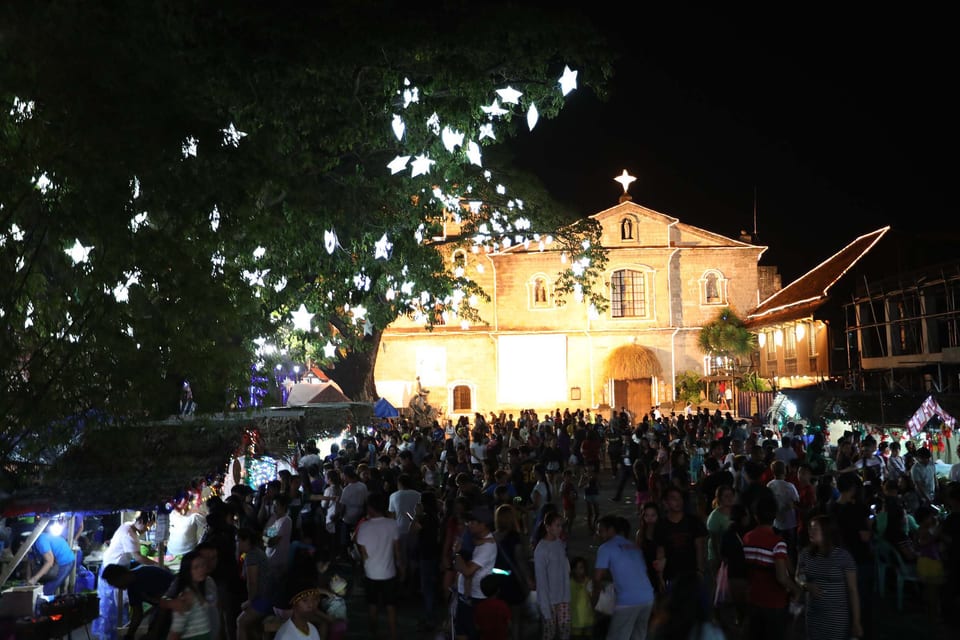
St Joseph Parish Church, Las Pinas, at night: a stone colonial facade floodlit warm gold, a crowd of several hundred filling the plaza in front of it, and a huge acacia strung with two dozen white five-pointed star lanterns hanging through the branches. Food stalls with working lamps down the left edge and along the right, a nipa hut against the church wall, a lit star on the pediment. Nobody posed. Taken 17 December 2017.
Government of the Philippines · PD-self
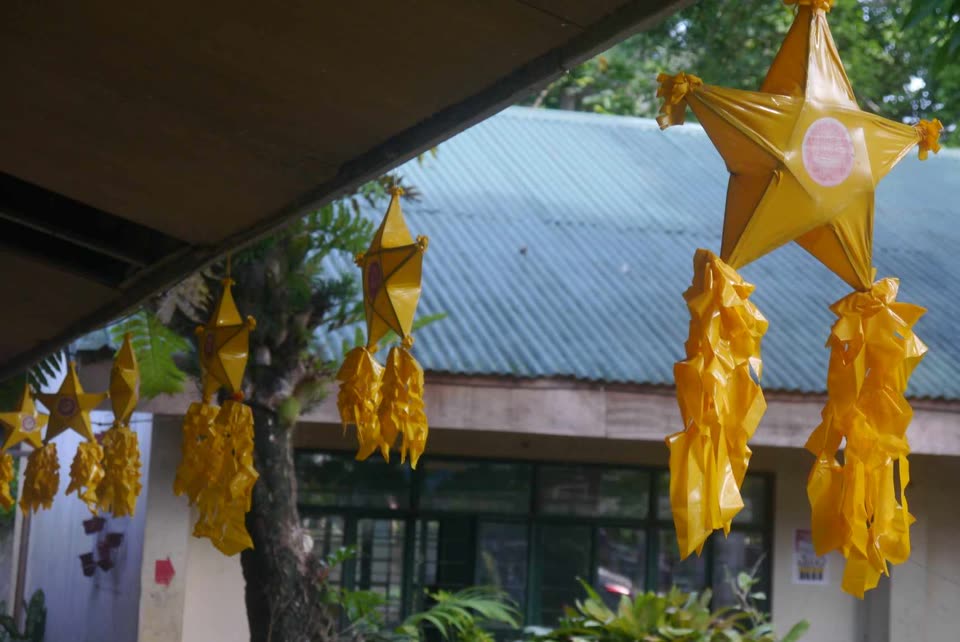
Yellow plastic star lanterns hanging in a row from the edge of a corrugated roof outside a school, photographed from below against green trees in daylight. The nearest is a five-pointed star with a printed paper disc at its centre and two long tails of crumpled yellow plastic streaming from its lower points; four more hang behind it along the eave, smaller with distance. Behind them stands a classroom block with a pale green roof and dark window frames, and a palm trunk rises through the middle of the frame.
Iyen.gb · CC BY 4.0

Christmas begins on 1 September

The season opens with the "-ber months" — September, October, November, December — and it opens on the first day of the first of them. Radio stations turn to carols, malls decorate, and a widely observed hundred-day countdown starts on 16 September. Nothing decrees any of this. It is a commercial and social convention, and it is near-universal.

Filipinos kick off world's longest Christmas season with 'ber months' — Arab News — Ellie Aben

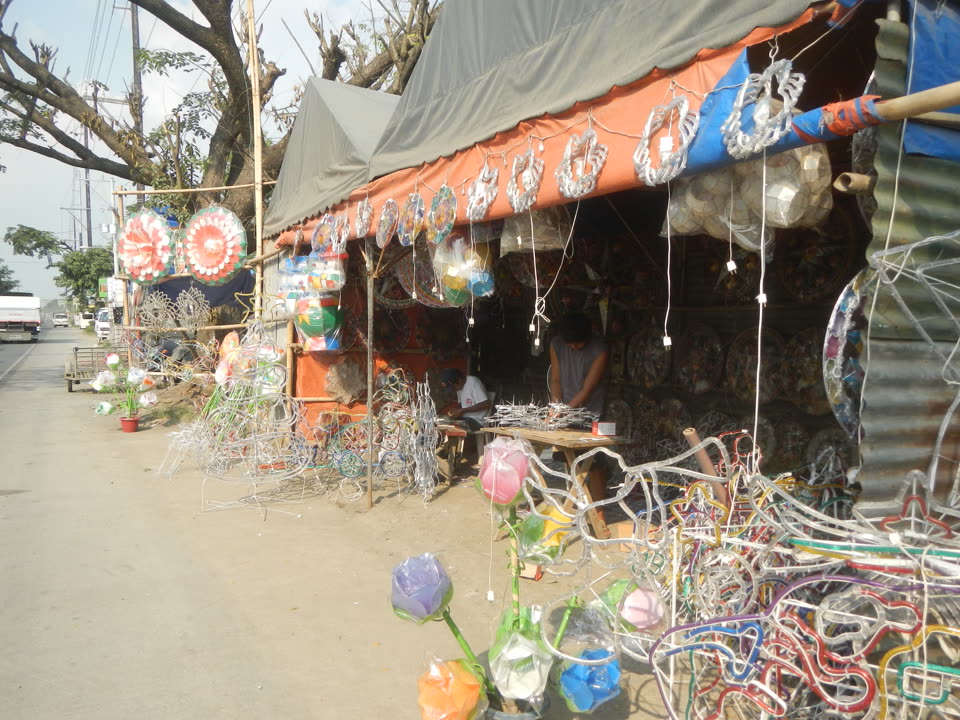
A roadside stall selling Christmas lanterns on a highway, photographed in daylight in late October. Under an orange and grey awning hang rows of finished parols — flat discs of coloured plastic and capiz, white wire stars, round lanterns still in their bags — and the ground in front is heaped with more: bare wire frames shaped as stars and reindeer, and pastel plastic flowers on sticks. Two men sit at a low table inside the stall bending wire, one in a baseball cap, the other in a sleeveless shirt. A truck passes on the near-empty road at the left under a hard-pruned bare tree.
Judgefloro · CC0

Who actually starts it

Not the church, and not the public. SM Supermalls — ninety shopping centres — began putting up Christmas ornaments in August. A decorations market in Quezon City started stacking its shelves on the thirty-first of July. "Starting early gives shoppers more time to enjoy that experience," says the chain's senior assistant vice president, Christian Mathay, which is the most honest sentence anybody says about the four-month Christmas. A sales clerk of seventy-three, Cora Lansangan, puts it differently: "We can smell it coming."

'The ber months': Christmas arrives early in the Philippines — Agence France-Presse, via the Bangkok Post

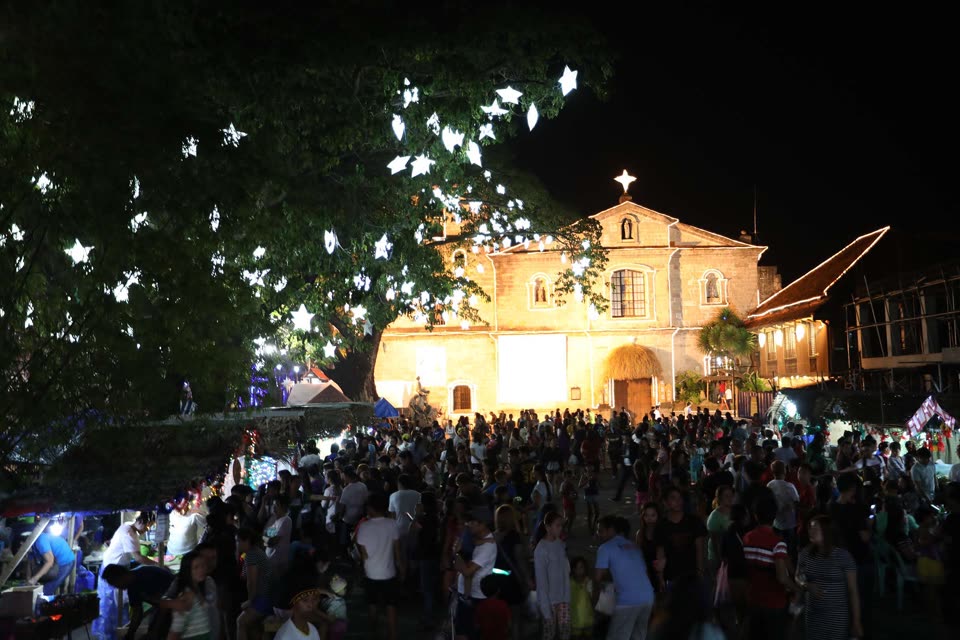
A crowd of several hundred standing outside a stone church in the dark, photographed from a rise. Big white five-pointed star lanterns hang in the branches of a great tree across the left half of the frame and more are strung over the churchyard; a lit star stands on the church's gable and the stone front is floodlit gold. Stalls with tarpaulin roofs and strings of lights line the near edge, a nativity shelter of dry palm leaves stands against the church wall, and the crowd fills the whole yard between them.
Government of the Philippines · Public domain

Simbang Gabi — nine dawn masses

Nine consecutive Masses before first light, 16 to 24 December, usually around four in the morning. The Church's own instruction describes them as solemn votive Masses of the Blessed Virgin Mary: white vestments, the Gloria sung, festive ornamentation — in the middle of Advent, which is otherwise penitential. Spanish friars brought the practice so farmers could hear Mass before going to the fields.

Instructions on the celebration of Aguinaldo Masses, Misa de Gallo or Simbang Gabi — CBCP News — Catholic Bishops' Conference of the Philippines, Media Office

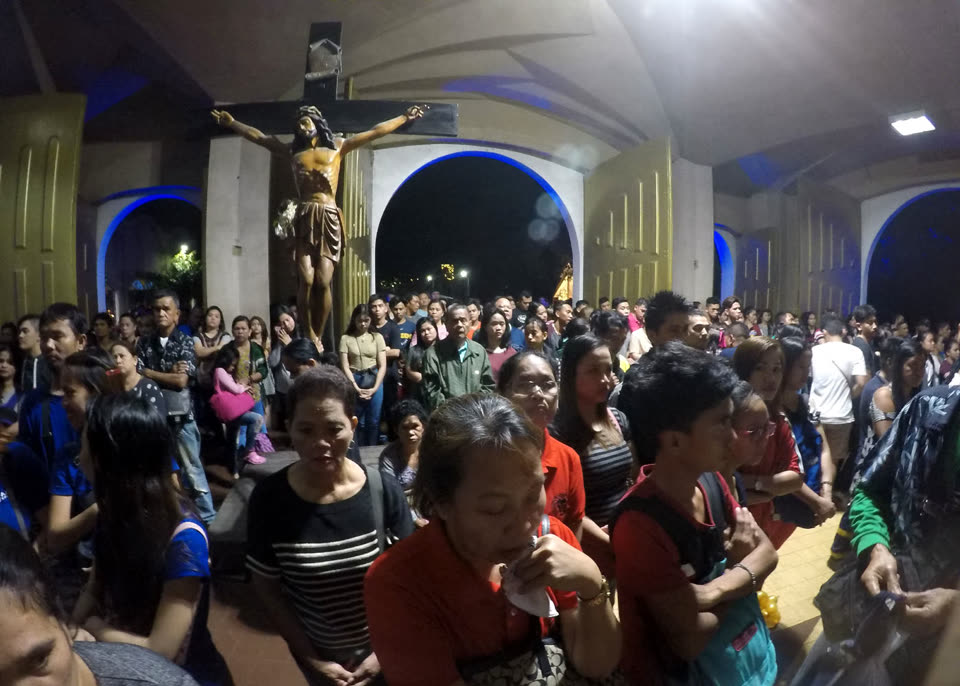
A dense crowd standing shoulder to shoulder in an open arcade outside a church before dawn, lit by ceiling lights with blue light washing the arches behind them. A large dark wooden crucifix with a carved figure of Christ stands among them against a pillar. Nearly every face is turned the same way, towards the church; several people hold their hands pressed together, a woman at the front holds a tissue to her mouth, and backpacks and shoulder bags show that many have come straight from somewhere else. Through the arches it is still black night.
Avito C. Dalan for the Philippine News Agency · Public domain

Misa de Aguinaldo — the mass that is itself the present

The Spanish name for Simbang Gabi, and it carries the reason. Aguinaldo is a gift. Getting out of bed in the dark for nine consecutive mornings is what the faithful give; the Mass is offered as the present. It is the same word as the money a godchild collects on Christmas Day, so one term holds both ends of the exchange together — and it only holds them in Spanish.

Misa de Aguinaldo: A Sacred Pilgrimage for the Birth of Christ — Basilica Minore del Santo Niño de Cebú (Order of St Augustine)

The evening Simbang Gabi was invented by a curfew

Many parishes now run Simbang Gabi in the evening instead of before dawn, and the reason is not convenience but martial law: curfew hours stopped people reaching church in the early morning, so the Mass moved to the night before. It proved popular with workers and outlasted the curfew that caused it. The bishops later widened the window further — evening Masses from 6pm, morning Masses as late as 6am — to spread congregations out during the pandemic.

Instructions on the celebration of Aguinaldo Masses, Misa de Gallo or Simbang Gabi — CBCP News — Catholic Bishops' Conference of the Philippines, Media Office

Lubenas — nine nights of lanterns

In Pampanga and Tarlac a procession goes out on each of the nine nights, on the eve of every dawn Mass. A cross-shaped lantern leads; twelve more follow in pairs on bamboo poles for the apostles; behind them a platform carries the barangay's patron saint, with brass band or guitars and chanted prayers. Some towns carry fish-shaped lanterns instead. The name is Kapampangan for the Spanish novena.

Lubenas and Simbang Gabi: Kapampangan Christmas tradition — Daily Tribune (Philippines) — Jonas Reyes

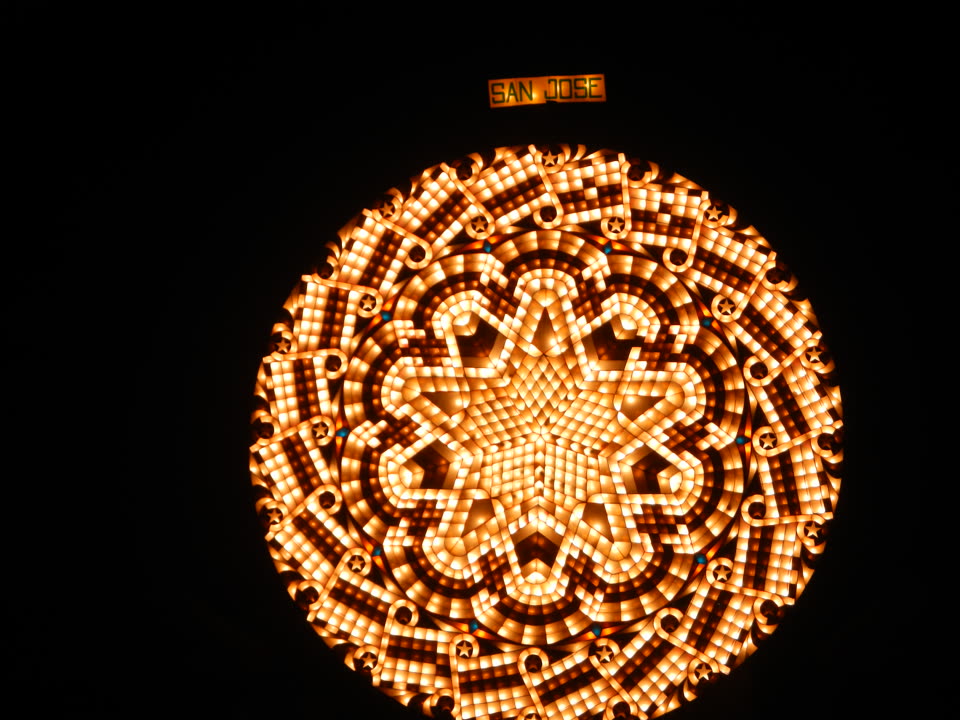
One barangay's giant lantern at the Ligligan Parul in San Fernando in December 2012, lit and photographed straight on against a black sky so that nothing else is in the frame. It is a disc filling almost the whole picture, built up from thousands of small bulbs set in close rows along ribbons of material: an eight-pointed star at the dead centre, then ring after ring of looping bands folding over one another, each loop ending in a small five-pointed star. Almost all of it burns warm amber-gold, with a few points of turquoise spaced around the inner rings. Above it hangs a small separately lit board reading SAN JOSE, the barangay that built it.
Ramon FVelasquez · CC BY-SA 3.0

The Giant Lantern Festival, and the year the electricity arrived

San Fernando in Pampanga is where the parol stopped being something you carry. The competition — Ligligan Parul — grew straight out of the lubenas processions and began around 1908, and then in 1931 electricity reached the town and the lanterns changed kind rather than degree. Each barangay now builds one, cooperatively, carrying over five thousand bulbs. The patterns are not programmed: the wires end in hairpins that ride against a rotor, a large steel barrel turning under the lantern, making and breaking each circuit in turn. It is a hand-built commutator driving a light show, invented in a provincial town in the 1930s and still how it is done.

About — the festival’s own history — Giant Lantern Festival, City of San Fernando, Pampanga (official festival site)

A lantern is fourteen to eighteen feet across

The scale is the part that does not survive a photograph. These are not window stars: the competition lanterns run fourteen to eighteen feet in diameter, built over about three months by teams of twenty, and they are shown as a month-long display rather than a single evening.

San Fernando Giant Lantern Festival — Tourism Promotions Board Philippines (tpb.gov.ph)

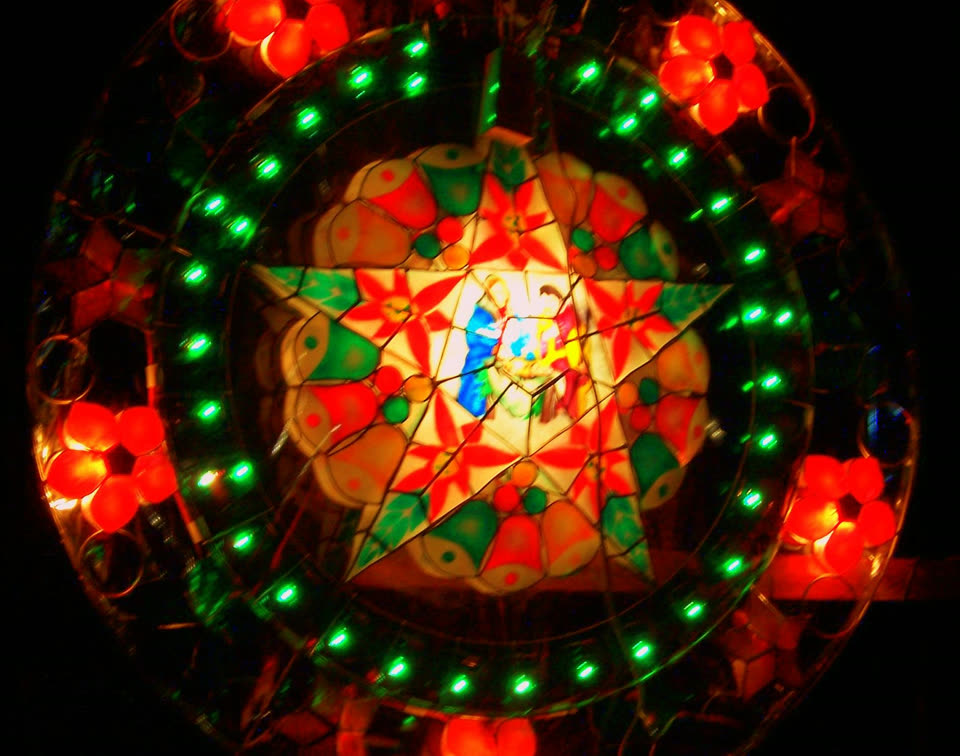
A lit parol photographed at night, filling the frame. At its centre is a five-pointed star of translucent panels painted with red flowers and green leaves, and inside the star a painted nativity — a blue-robed figure, a kneeling figure in red, a child — glowing yellow from the lamp behind it. Around the star runs a wide ring carrying two circles of small green bulbs, and bunches of red bulbs are fixed at the four corners of the lantern. The picture is slightly blurred, the way a hand-held photograph of a bright object in the dark will be.
bingbing · CC BY 2.0

The parol

The star lantern in every window began as a working light: a lamp in a translucent jar, carried to find the way to a four-in-the-morning Mass in a town with no street lighting. The word is Spanish farol, a lantern. Bamboo frame, papel de Japón, a candle inside; the five-pointed star is read as the star of Bethlehem. Capiz shell, plastic and fibreglass came later, and so did electricity.

What did the earliest parol look like? Kuya Kim sheds light on the origins of the Christmas lantern — GMA News Online (GMA Network)

Panunuluyan

On Christmas Eve a couple playing Mary and Joseph process through the town asking for lodging. At each house they sing the request — men take Joseph's lines, women Mary's — and each household refuses them, with reasons. The procession ends at the church, where the refusals stop and the nativity is uncovered as the Gloria is sung.

Filipino Catholics reenact Christmas story on Noche Buena — Catholics & Cultures — Rev. Michael C. McFarland Center for Religion, Ethics and Culture, College of the Holy Cross

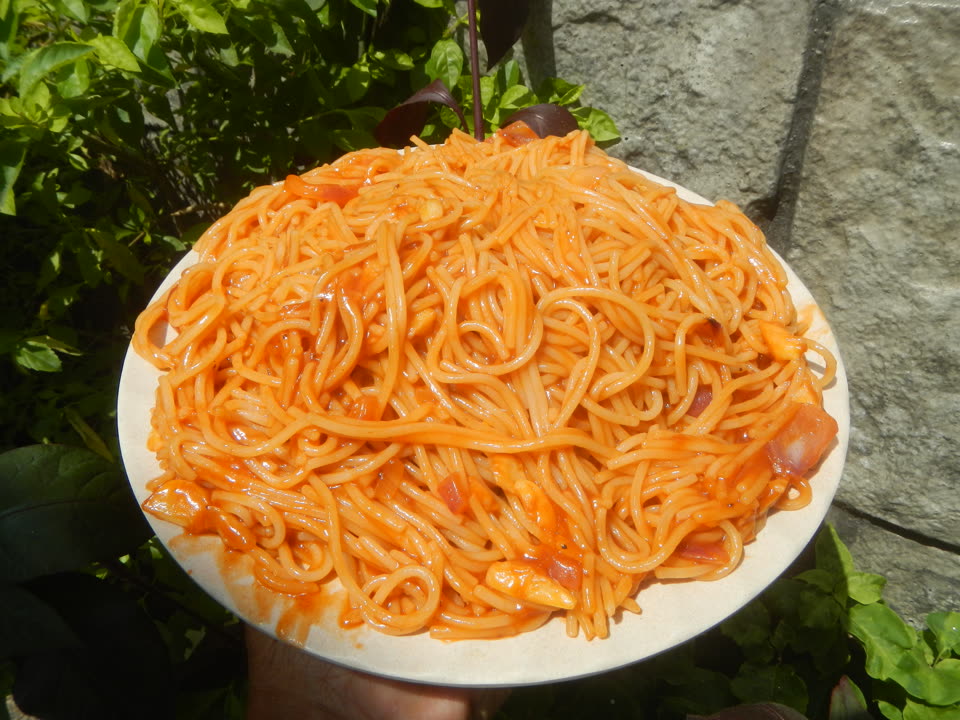
A plateful of Filipino-style spaghetti held up on one hand in bright sunlight: thin noodles in a sweet orange tomato sauce with slices of red hotdog through them, heaped high on a plain cream plate against garden leaves and a rough stone wall.
Judgefloro · CC0

Noche Buena

The family meal after the Christmas Eve Mass, eaten at or after midnight and treated as the centre of the whole season — more than Christmas lunch. Roast or fried chicken, lechon, adobo, caldereta, pan de sal, spaghetti, rice cakes, fruit. Presents are opened afterwards and the night frequently runs to morning.

Filipino Catholics reenact Christmas story on Noche Buena — Catholics & Cultures — Rev. Michael C. McFarland Center for Religion, Ethics and Culture, College of the Holy Cross

Pamamasko and the mano

On Christmas Day children go round the houses of their godparents and elder relatives to collect the aguinaldo. The greeting is the mano — the elder's hand taken and touched to the child's forehead — and the gift follows it. An older variant is karoling, where children sing at the door for it instead.

Aginaldo — Sagisag Kultura (2015) — National Commission for Culture and the Arts (NCCA), Philippine Cultural Education Program; ed. Virgilio S. Almario

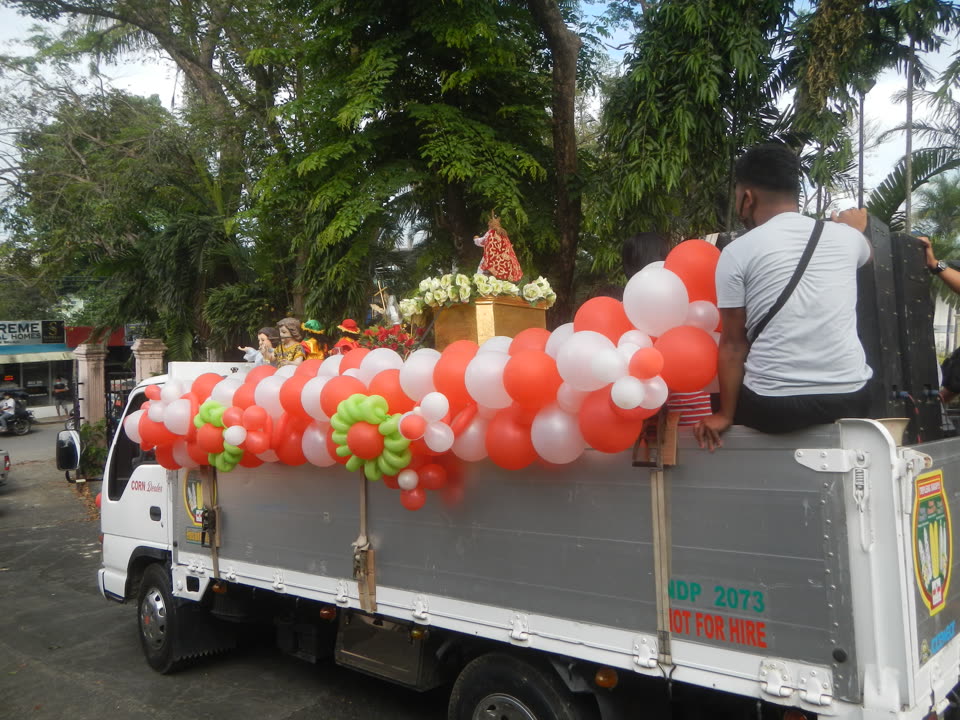
A small white flatbed truck carrying an image of the Santo Niño in procession, photographed from the kerb. The image stands at the front of the bed on a gold-painted box banked with white flowers, dressed in red and gold with a crown; smaller dressed figures stand around it. An arch of red and white balloons with two green rosettes runs the length of the truck's side. A man in a white T-shirt with a face mask pushed under his chin sits on the tailgate with his back to the camera, and a child in a striped top stands beside him. Palms and a tiled gatepost line the road behind.
Judgefloro · CC0

It ends in the third week of January

The season closes on the Feast of the Santo Niño, kept on the third Sunday of January — later than Epiphany, and later than the Baptism of the Lord that ends Christmastide in the Roman calendar. The date is an inheritance: the feast was originally 28 April, and Pope Innocent XIII's reform of 20 December 1721 moved it to the second Sunday after Epiphany, which that year fell on the third Sunday of January.

Why is the Fiesta Señor held every third Sunday of January? — Basilica Minore del Santo Niño de Cebú (Order of St Augustine)

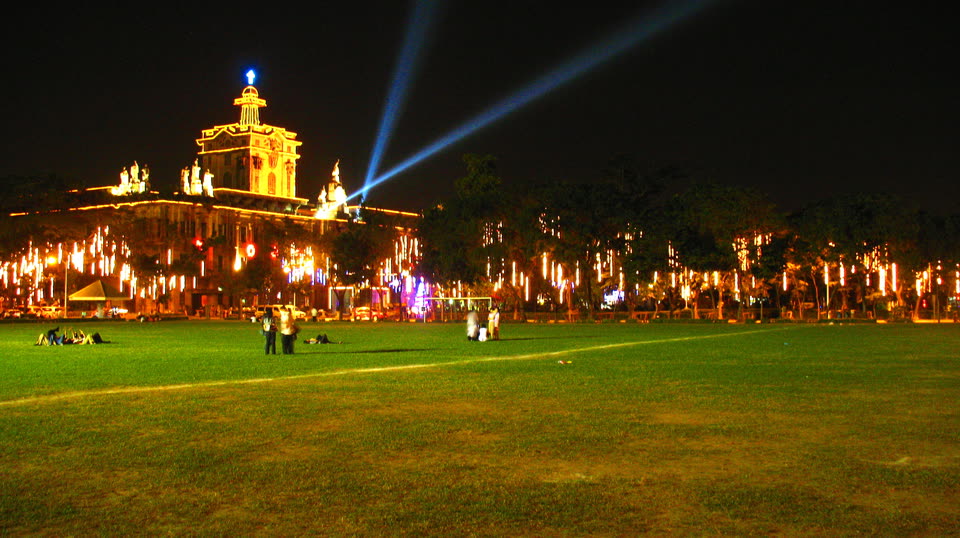
A floodlit baroque building seen at night across a wide dark playing field. Its central tower is lit gold and carries a blue-lit figure on top, with statues standing along the roofline on either side. Hundreds of vertical tubes of light hang from the trees in front of it and away to both sides, like rain stopped in the air, and two searchlight beams cross the black sky above. Small groups of people sit and stand on the grass in the middle distance, too far off to make out.
Pampi1010 at English Wikipedia · Public domain

It arrives at the end of the typhoons, which is the point

September in the Philippines is the wet end of the year — the months of flooding and the months of storms. Mark Godwin Villareal, a sociologist at the University of Santo Tomas in Manila, reads the timing as exactly that: the countdown starts as the worst of the weather finishes, and it offers "a kind of continuity and stability in our social life despite these economic, political, or even personal challenges." In Pampanga in 2026 the lantern workshops flooded weeks before the season. Angelica David, a fifth-generation lantern maker of twenty-six, on what that cost: "Water seeped into the showroom, so we had to clean up instead of working. The thing with lanterns is, they're waterproof."

'The ber months': Christmas arrives early in the Philippines — Agence France-Presse, via the Bangkok Post

And they come down on 6 January. Mostly.

Epiphany, when the magi are said to have arrived, is when the decorations are taken down — and the qualifier matters, because a good many of them are not. Ricky Angeles, a school superintendent from Cabanatuan, leaves his parol in the window the whole year round along with the lights in the garden, and explains it on grounds no theologian would recognise: "We need a lengthy display period to justify their cost."

'The ber months': Christmas arrives early in the Philippines — Agence France-Presse, via the Bangkok Post

What is eaten

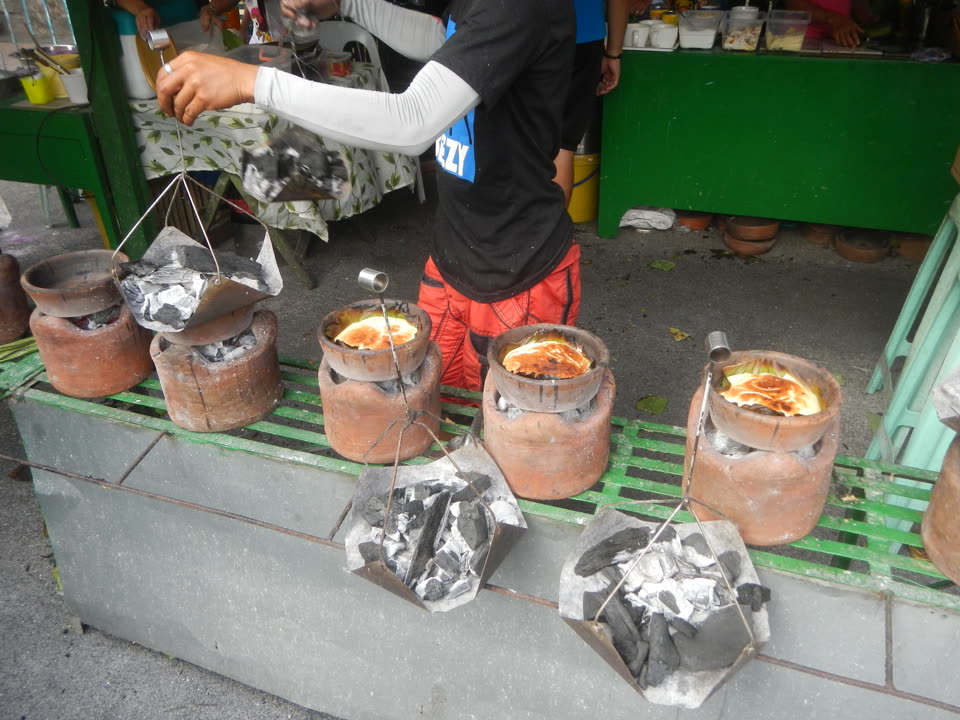
A roadside bibingka stall: squat terracotta pots on a rack, each holding a browned rice cake on a banana leaf, with glowing charcoal under the pots and more charcoal in flat metal trays hung above them. The vendor stands behind the rack in a black T-shirt and orange shorts, lowering a tray of coals by its wire handle; the frame cuts off above their shoulders.
Judgefloro · CC0

Bibingka

A round rice cake baked between charcoal above and below in a clay oven, lined with banana leaf so the underside scorches. Salted egg, white cheese, butter, sugar. It is a Simbang Gabi food before it is a Christmas food: heavy enough to carry a farmer from a four o'clock Mass through a morning's work, which is what it was for. Regional versions run from bibingka royal in Ilocos to bibingka kabog in Negros Oriental, made with millet rather than rice.

The Many Faces of Bibingka — IFEXConnect — CITEM, Center for International Trade Expositions and Missions, Philippine Department of Trade and Industry; Idge Mendiola

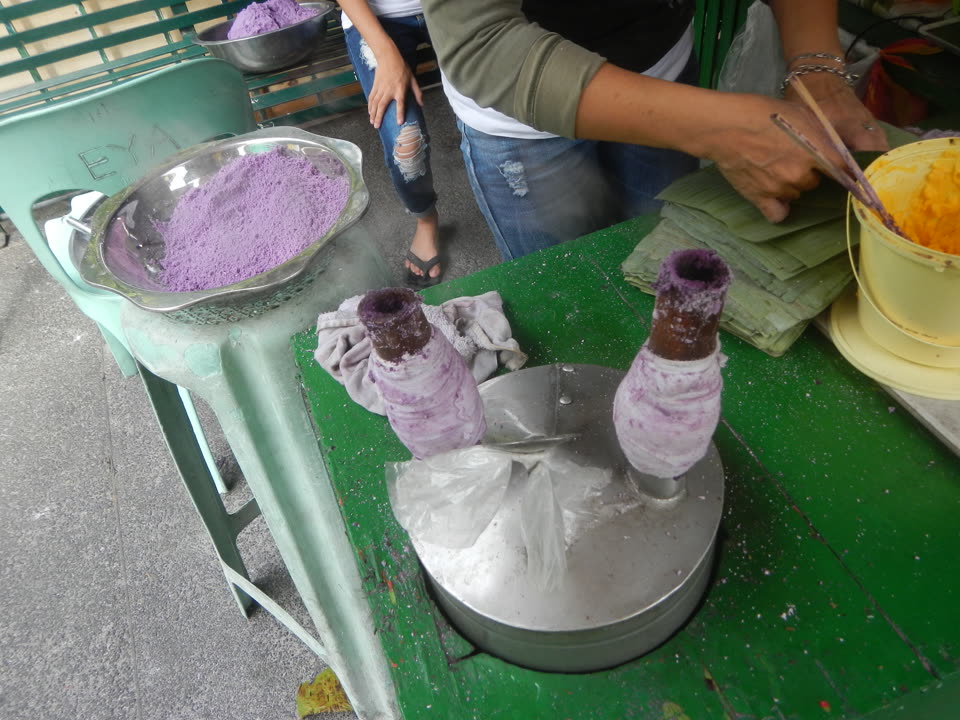
Two bamboo tubes packed with purple glutinous rice standing upright in a metal steamer on a green street stall, with a dish of violet rice flour, a stack of cut banana leaves and a tub of orange coconut jam beside them. Two stallholders work at the table — one reaching in with a thin wooden stick, one standing by in ripped jeans and flip-flops — and both are cut off by the top of the frame.
Judgefloro · CC0

Puto bumbong

Glutinous rice steamed inside bamboo tubes, turned out onto banana leaf, brushed with butter and finished with grated coconut and dark sugar. Stalls set up outside the church from three in the morning and sell it to people coming out of Mass, with ginger tea or thick chocolate. The purple should come from pirurutong, a dark heirloom rice soaked overnight and ground — but pirurutong is hard to get, and a great deal of what is sold now is white glutinous rice coloured with ube flavouring.

Why Filipino Christians Greet the December Dawn With Purple Rice — Atlas Obscura (Gastro Obscura) — Pam Casis

What people get wrong

Widely repeated claims about Christmas in the Philippines that do not survive checking. Each one says what is actually the case, because a correction with nothing in its place leaves you worse off than before.

Oversimplified

The Philippines has the world's longest Christmas season, running four months from September to January.

What is actually the case. The four-month run is real, near-universal and worth an episode — but it is commercial and social, not liturgical, and the two get reported as one thing. The Church in the Philippines keeps the ordinary calendar: Advent, then Christmas, then Epiphany. Bishop Broderick Pabillo of the Apostolic Vicariate of Taytay in Palawan says so plainly — the early celebration "has nothing to do with our Christian faith", it is "a social phenomenon", and "this long celebration is not being promoted by the church". The genuinely unusual ending is not September at all: it is the Feast of the Santo Niño in the third week of January, which is a real liturgical date and does run past everyone else's.

Filipinos kick off world's longest Christmas season with 'ber months' — Arab News — Ellie Aben

Oversimplified

The parol was invented in 1908 by Francisco Estanislao of Pampanga.

What is actually the case. Lanterns were lighting the way to Simbang Gabi long before 1908 — the earliest form described is a light inside a translucent jar, not a star at all. Estanislao is credited with the modern five-pointed paper-and-bamboo parol, and that credit is traditional attribution rather than documented invention: the sources reporting it say "is believed to have" and "according to popular belief", and they disagree on whether the San Fernando lantern contest began in 1904 or 1908. He is credited with the form; nothing on record shows him inventing it. And there is a photograph. Luther Parker photographed Consunji Street in San Fernando on 26 December 1904 — four years before the date everyone gives — and the images are held by the National Library of the Philippines, in the public domain. They show parols already strung the length of the street, and every one of them is a round fringed disc with a radiating centre, not a five-pointed star. That does not disprove the Estanislao attribution; it sharpens it. What he is credited with is the modern five-pointed form, and here is what was hanging over that same town before it.

What did the earliest parol look like? Kuya Kim sheds light on the origins of the Christmas lantern — GMA News Online (GMA Network)

Worth knowing

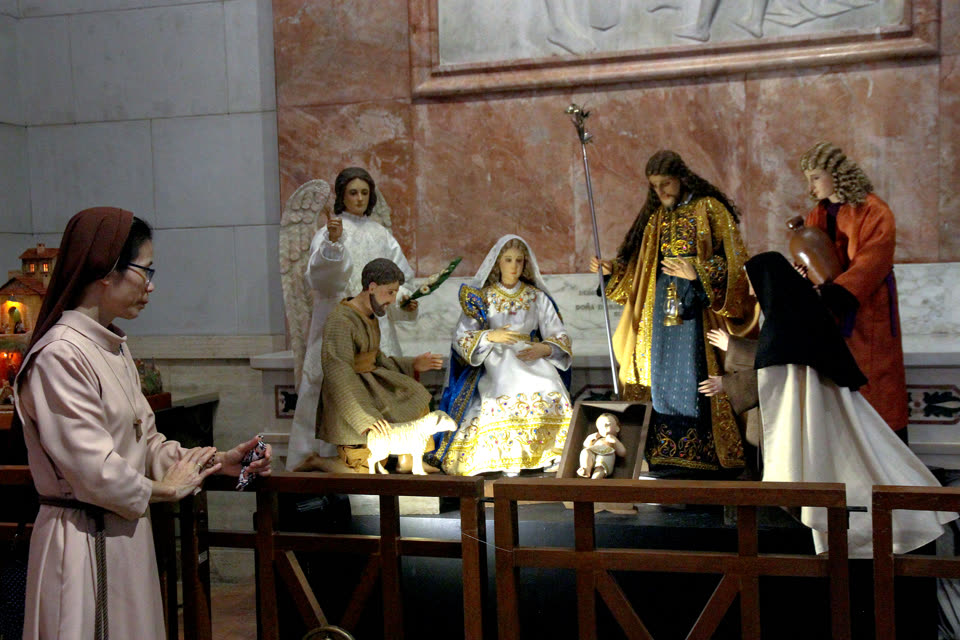
A nun in a pale habit and brown veil stands at a wooden rail inside a cathedral with her hands together, looking at the nativity figures beyond it. The figures are life-size and dressed in cloth: Mary in white and gold with her hands in her lap, Joseph kneeling in brown, a standing angel in white with its wings spread, a king in a gold cope holding a tall staff, another in orange carrying a jar, and a small bare infant lying in an open wooden box in front of them. A white lamb stands at Mary’s feet; behind them is the marble wall of the cathedral and a carved relief.
PNA photo by Yancy Lim · Public domain

The Filipino word for Christmas means Passover. Pasko is Spanish pascua, shortened from pascua de navidad; pascua is Latin pascha; pascha is Greek páskha, from Aramaic pasḥā and Hebrew pesaḥ — the Passover. The word travelled from Jerusalem to Manila through Rome and Madrid and kept its meaning the whole way without anyone noticing.

Pasko — Tagalog entry, etymology — Wiktionary

The state builds the season into the working calendar without ever calling it a season. In 2026 Christmas Day is a regular holiday, and 24 December, 31 December and 8 December — the Immaculate Conception — are special non-working days. Epiphany is not a holiday at all, although the season runs a fortnight past it.

Proclamation No. 1006 — Declaring the Regular Holidays and Special (Non-Working) Days for the Year 2026 — Office of the President of the Philippines, via LawPhil (Arellano Law Foundation)

The Giant Lantern Festival is being treated as heritage to be safeguarded rather than a show to be staged. The Intramuros Administration has run a public learning session on documenting the San Fernando lanterns and building a conservation strategy for them — an intangible-heritage framing for a competition that is, at bottom, thousands of light bulbs and a turning steel barrel.

Tala-Talaan: Documenting the Giant Lantern Festival of San Fernando — Intramuros Administration (Philippine government) — Intramuros Learning Sessions, episode 41, speaker Rafael Kalaw

Christmas here starts in the rain, and it starts hot. The Philippine weather service's thirty-year normals for Metro Manila put September at a mean maximum of 31.5 °C, with 500.3 mm of rain falling across twenty-one rainy days out of thirty, and seventeen days with thunderstorms. The carols begin on the first morning of the wettest month of the year.

Climatological Normals 1991–2020 — Science Garden, Quezon City — PAGASA — Philippine Atmospheric, Geophysical and Astronomical Services Administration, Department of Science and Technology

Seventy-nine per cent of the country is Roman Catholic — 85,645,362 people out of a household population of 108,667,043 at the 2020 census. In Albay province it is 96.2%. In the Bangsamoro Autonomous Region it is 5.3%, and Islam is 90.9%.

78.8% are Roman Catholics in PH population — PSA — DZRH News — Mhillen Nicole Borja, reporting the Philippine Statistics Authority

Sources

Every claim carries its own citation. They are collected below, so you can see what the page rests on and how much of it comes from where.

  1. 'The ber months': Christmas arrives early in the Philippines — Agence France-Presse, via the Bangkok Post. Retrieved 2026-09-19. archived 9 September 2026
  2. Filipinos kick off world's longest Christmas season with 'ber months' — Arab News — Ellie Aben. Retrieved 2026-09-19. archived 7 October 2025
  3. Why Filipino Christians Greet the December Dawn With Purple Rice — Atlas Obscura (Gastro Obscura) — Pam Casis. Retrieved 2026-09-19. archived 16 January 2026
  4. Misa de Aguinaldo: A Sacred Pilgrimage for the Birth of Christ — Basilica Minore del Santo Niño de Cebú (Order of St Augustine). Retrieved 2026-09-19. archived 8 June 2026
  5. Why is the Fiesta Señor held every third Sunday of January? — Basilica Minore del Santo Niño de Cebú (Order of St Augustine). Retrieved 2026-09-19. archived 10 May 2026
  6. Filipino Catholics reenact Christmas story on Noche Buena — Catholics & Cultures — Rev. Michael C. McFarland Center for Religion, Ethics and Culture, College of the Holy Cross. Retrieved 2026-09-19. archived 6 March 2026
  7. Instructions on the celebration of Aguinaldo Masses, Misa de Gallo or Simbang Gabi — CBCP News — Catholic Bishops' Conference of the Philippines, Media Office. Retrieved 2026-09-19. archived 27 December 2024
  8. Lubenas and Simbang Gabi: Kapampangan Christmas tradition — Daily Tribune (Philippines) — Jonas Reyes. Retrieved 2026-09-19. archived 30 July 2026
  9. 78.8% are Roman Catholics in PH population — PSA — DZRH News — Mhillen Nicole Borja, reporting the Philippine Statistics Authority. Retrieved 2026-09-19. archived 6 December 2025
  10. About — the festival’s own history — Giant Lantern Festival, City of San Fernando, Pampanga (official festival site). Retrieved 2026-09-19.
  11. What did the earliest parol look like? Kuya Kim sheds light on the origins of the Christmas lantern — GMA News Online (GMA Network). Retrieved 2026-09-19. archived 17 October 2025
  12. The Many Faces of Bibingka — IFEXConnect — CITEM, Center for International Trade Expositions and Missions, Philippine Department of Trade and Industry; Idge Mendiola. Retrieved 2026-09-19. archived 7 December 2025
  13. Tala-Talaan: Documenting the Giant Lantern Festival of San Fernando — Intramuros Administration (Philippine government) — Intramuros Learning Sessions, episode 41, speaker Rafael Kalaw. Retrieved 2026-09-19. archived 21 May 2026
  14. Aginaldo — Sagisag Kultura (2015) — National Commission for Culture and the Arts (NCCA), Philippine Cultural Education Program; ed. Virgilio S. Almario. Retrieved 2026-09-19. archived 17 May 2026
  15. Proclamation No. 1006 — Declaring the Regular Holidays and Special (Non-Working) Days for the Year 2026 — Office of the President of the Philippines, via LawPhil (Arellano Law Foundation). Retrieved 2026-09-19. archived 18 October 2025
  16. Climatological Normals 1991–2020 — Science Garden, Quezon City — PAGASA — Philippine Atmospheric, Geophysical and Astronomical Services Administration, Department of Science and Technology. Retrieved 2026-09-19. archived 9 February 2026
  17. San Fernando Giant Lantern Festival — Tourism Promotions Board Philippines (tpb.gov.ph). Retrieved 2026-09-19. archived 27 September 2023
  18. Pasko — Tagalog entry — Wiktionary. Retrieved 2026-09-19. archived 10 February 2026