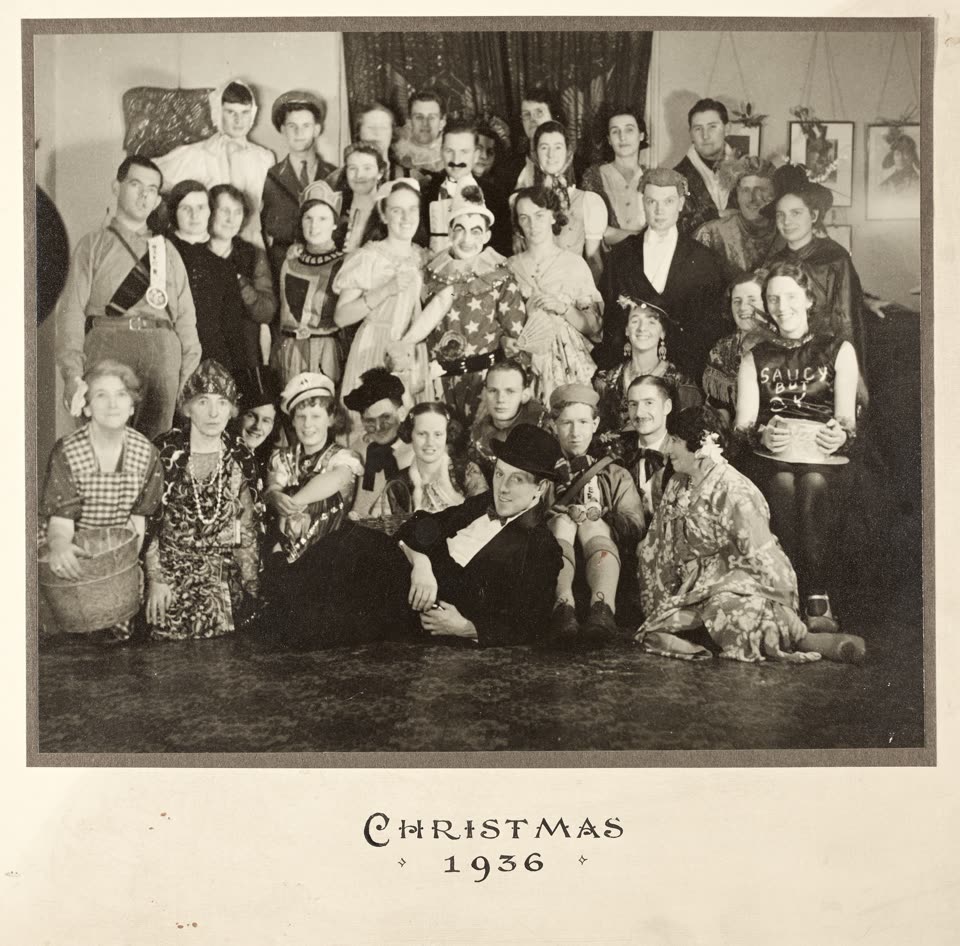
Christmas Day in Ireland is 25 December. It is a public holiday.
How to say it
Irish
Nollaig shona duit
Nollaig shona duit
say it: NULL-ig HUN-a dit
A synthesised voice — not a recording of a person — saying Nollaig shona duit
in ga-IE.
Literally «a happy Christmas to you», to one person; to more than one it is «Nollaig shona daoibh». The standard dictionary also carries the longer «Nollaig faoi shéan agus faoi shonas duit», a prosperous and happy Christmas to you, and the common «Nollaig faoi mhaise daoibh». Christmas Eve is Oíche Nollag, Christmas Day Lá Nollag, and Father Christmas is Daidí na Nollag.
A candle in the window on Christmas Eve, lit by the youngest in the house
Children writing down the customs of their own parishes for the Schools' Collection in the late 1930s describe the same evening across four counties. At nightfall a candle goes into every window of the house, the youngest child lights them, and they are left burning all night.
The reasons they give are not quite the same. A child in Drumbaragh, Co. Meath, wrote that the candles «are lighted in all the windows to light the Blessed Virgin and Saint Joseph on their way to Bethlehem when they were looking for a place on that first Christmas Eve of long ago». In Twomilehouse, Co. Kildare, the candle is «left lighting in the window until Christmas morning to give light to the travellers». In Grangegeeth, Co. Meath, the candles are lit by the youngest and left burning, turning «the countryside to one blaze of light».
The historian Diarmaid Ferriter, reading the same collection, adds the detail that holds the whole thing up: the candle was usually stood in a hole scooped out of a turnip, with the turnip wrapped in white or coloured paper.
One Kerry household did it entirely differently, and wrote that down too
Eilís Nic Mhuiris of Killacrim, Co. Kerry, set out her own family's Christmas Eve for the same collection, and almost nothing in it matches the version from Meath and Mayo.
The candles went up at half past six. They were stood in jam-pots with coloured paper wrapped round them — two half-pound candles on the kitchen window, one on each of the room windows. Her father lit them, not the youngest child. They burned until eight the next morning rather than all night. The same number went up again on New Year's Eve and on Little Christmas night.
The family's crib stood on the kitchen window with small coloured candles burning round it. It was bought in town and made of cardboard, it went up on Christmas Eve, and it stayed up until the day after Little Christmas.
The oldest written description of the Christmas candle is from 1827, and the priest had blessed it
The Limerick novelist Gerald Griffin printed a song in 1827 with the line «The Christmas light is burning bright / In many a village pane», and explained in a footnote what the light was: a candle blessed by the priest and lit at sunset on Christmas Eve in Irish houses, which it was «a kind of impiety to snuff, touch, or use ... for any profane purpose after».
More than a century later, the National Museum of Ireland quotes a folklore manuscript written down in Annascaul, Co. Kerry, in 1941, in which the candle is left burning on the table rather than in the window, because the Blessed Virgin passes every door that night and the light brings blessings for the coming year.
There is a light in the window of the President's house, and it is not only for Christmas
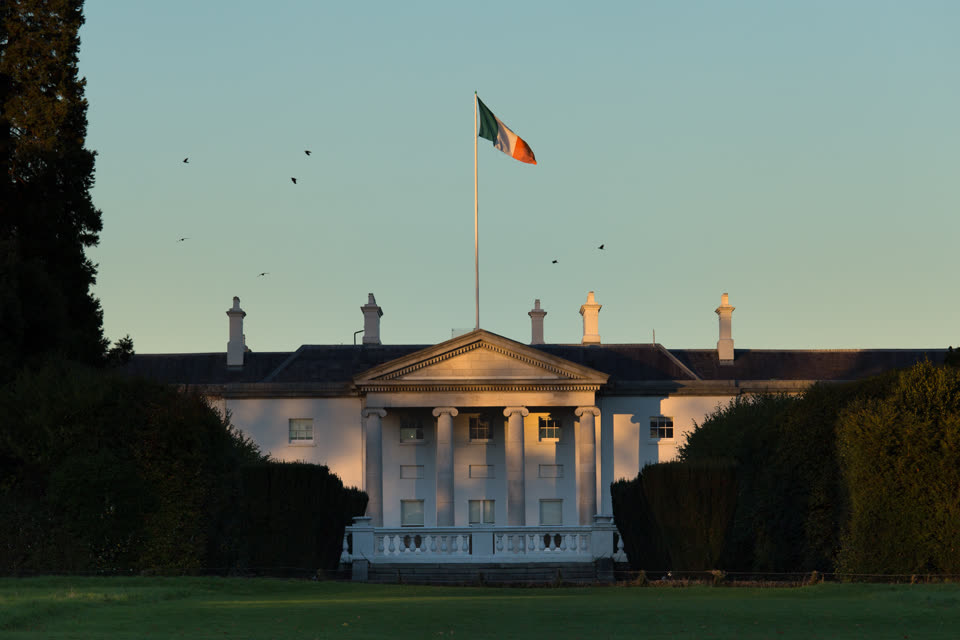
A light burns in an upstairs window of Áras an Uachtaráin, the President's residence in the Phoenix Park in Dublin, as a welcome to Irish emigrants and their descendants. Mary Robinson put it there, and told the Houses of the Oireachtas in 1995 that «the simple emblem of a light in the window ... signifies the inextinguishable nature of our love and remembrance on this island for those who leave it behind».
Her original lamp is now in the library in Ballina, her home town. A Tilley lamp given to Mary McAleese took its place, and Michael D. Higgins kept the tradition going. It burns all year rather than at Christmas alone — which is the point of it, since the custom it borrows from is the candle left in the window for a stranger on the road.
The eighth of December was the day the country came up to Dublin
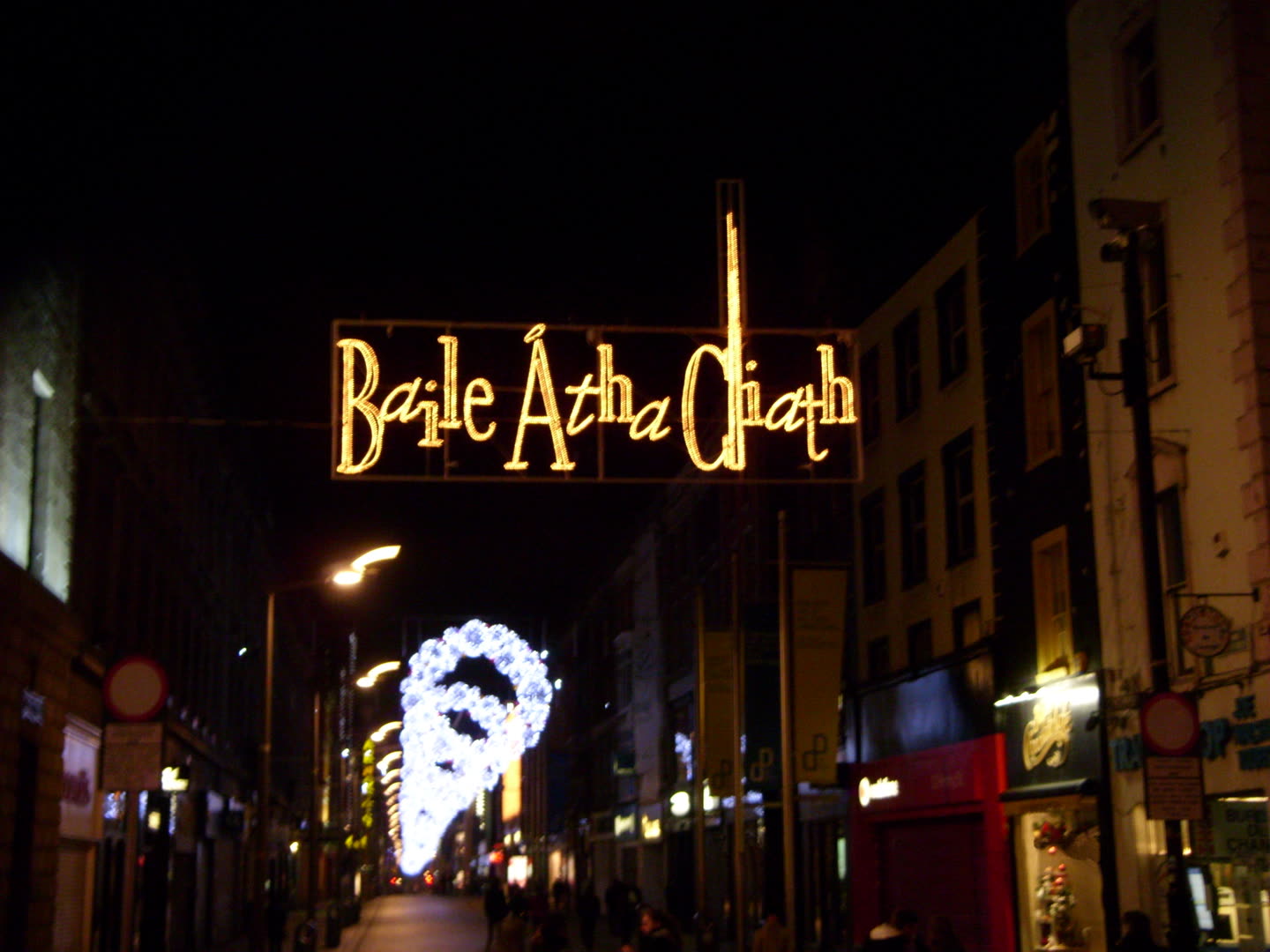
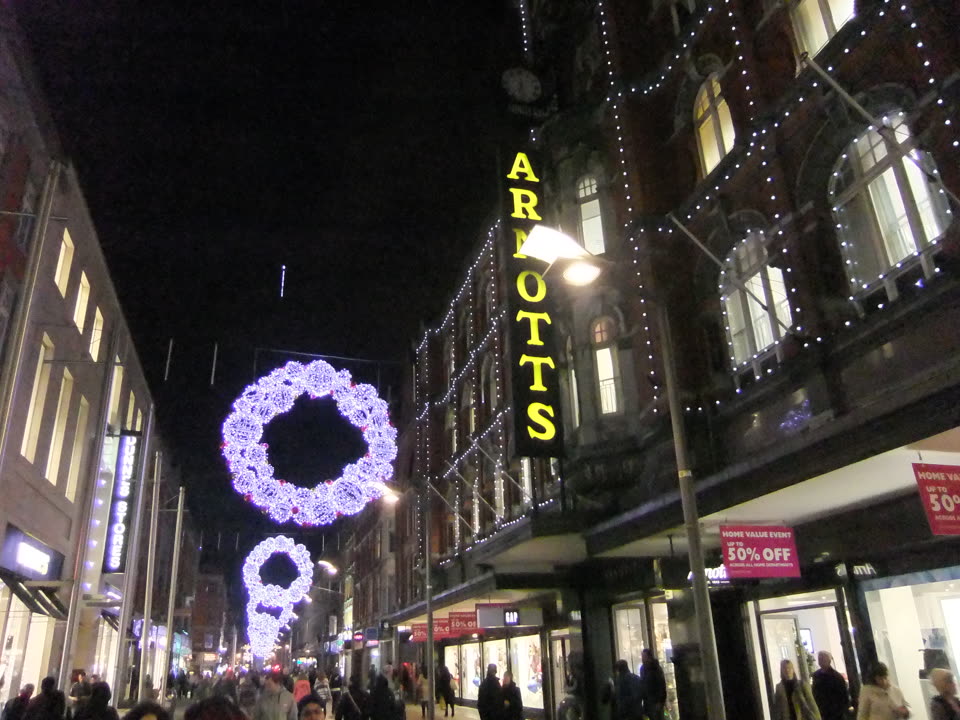
For decades the feast of the Immaculate Conception was the day families from outside Dublin took the train to the city to see the lights, queue for Santa in the department stores and start the Christmas shopping. Catholic schools closed for the holy day, which is what made it possible.
The Irish Times reported in December 1959 that the rush began in earnest on the 8th, «when thousands of country families take advantage of the holy day to see the decorations, the packed toy departments, the Santa Clauses in stores». RTÉ News put the 1986 crowd at an estimated quarter of a million, with city-centre trade up ten per cent on the day.
It was never a public holiday. The Act of 1997 lists 8 December as a Church holiday, which is a different thing entirely.
The Mass of Christmas Night is still called Midnight Mass almost everywhere in Ireland, including in places where it has not started at midnight for years.
The Irish Times, listing Dublin's Christmas Eve services in 2015, put it plainly: at St Mary's Pro-Cathedral the carols would be followed by the Mass of Christmas Night at ten o'clock, «which generally is known as Midnight Mass these days in churches across Ireland». Times vary by parish and by year; some advertise eleven or midnight still.
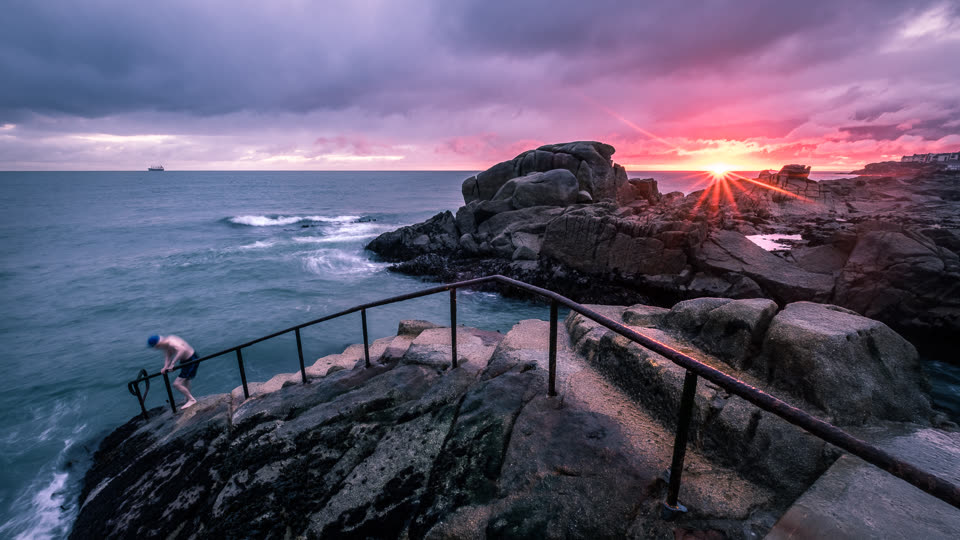
Swimming in the sea on Christmas morning, whatever the weather is doing, is a fixed point of the Irish Christmas — best known at the Forty Foot at Sandycove in south Co. Dublin, and kept at bathing places and lakes all round the coast. Much of it is done for charity.
RTÉ filmed it at the Forty Foot and at Clontarf in 1980, and has been back most years since. In 2023 it reported hundreds of swimmers going in at the Forty Foot in water described as nine or ten degrees.
St Stephen's Day is Wren Day, and the money is collected to bury the wren
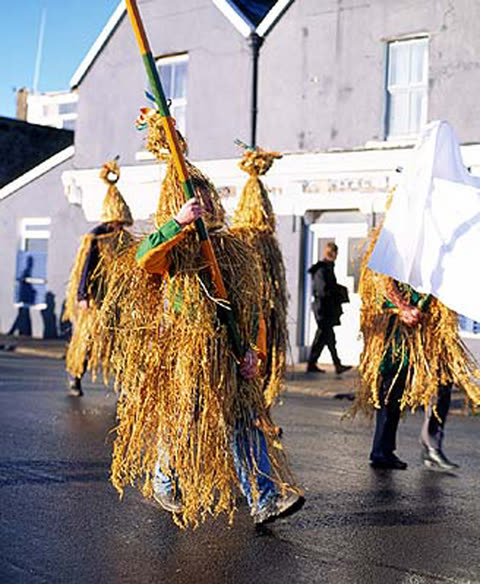
On 26 December groups of wren boys disguise themselves in straw suits and masks and go through the town or from house to house with music, carrying a wren on a decorated holly bush or pole and asking for money to bury it. The bird was once real and killed for the day; it is an effigy now. The money traditionally paid for a dance a few days later, and today it usually goes to charity.
In Dingle, Co. Kerry — where the day is called the Wran — the town divides into four Wrens: John Street, the Quay, Goat Street, and the Green and Gold. Each has a captain and a white hobby horse and its own band.
In August 2021 the Minister for Culture added Lá an Dreoilín, Wren's Day, to Ireland's National Inventory of Intangible Cultural Heritage.
The wren hunt was written down by visitors in 1864 and 1929
The French priest Emmanuel Domenech described the custom in 1864: a wren tied to a holly bush and carried from house to house by a party of children. The French Celtic scholar Marie-Louise Sjoestedt spent Christmas 1929 in west Kerry and described a troop of young local men bursting into the kitchen with an accordion and a tin whistle and a figure of a wren, dancing and collecting a few pence.
Why the wren at all is a question with several answers and no settled one. The stories told to explain it include a wren that betrayed St Stephen's hiding place, and a wren that woke enemy soldiers by pecking at a drum. They are legends, and they come in many versions.
In north Co. Dublin a mummers' play is still performed on the day
The Mummers of Fingal perform their Christmas play in pubs and clubs around Swords, Lusk and Skerries every St Stephen's Day. The characters include the Hero, the Fool, the Giant, the Wise Man and the Doctor. They are on the National Inventory of Intangible Cultural Heritage alongside Wren Day.
The sixth of January is Women's Christmas, and the decorations come down
6 January is the Epiphany, the twelfth day of Christmas. In Ireland it is also Little Christmas and, in Irish, Nollaig na mBan — Women's Christmas. The women of the house rested while the men did the housework, and women called on one another for tea and the last of the Christmas cake.
It was kept most strongly in the south and the west, and by the middle of the twentieth century it had largely gone. It is coming back, in homes and in hotels, cafés and bars.
The decorations and the tree stay up until that day, and it is considered unlucky to take them down any earlier.
Beef cured in a brine of salt and spices, then simmered and usually served cold in thin slices. It is a Cork speciality and it belongs to Christmas: by the 2010s it had faded so far that only a couple of shops in the city still sold it, and mostly at Christmas, before butchers including Tom Durcan of the English Market brought it back.
The method is «corning» — the same salt-cure that made Cork a salt-beef port in the eighteenth century. A culinary history of Irish corned beef by Máirtín Mac Con Iomaire and Pádraic Óg Gallagher sets out the trade behind it and, in its own summary, «presents evidence of corned beef consumption in Ireland as a festive food».
The Christmas cake maróg Nollag (the Christmas or plum pudding)
A dark fruit cake, heavy with fruit, spice and alcohol. Writing from the Main Manuscript Collection of the National Folklore Collection, the Cork food writer Kate Ryan records that households often baked three of them, and that each had its night: the first cut at midnight on Christmas Eve to end the Christmas fast, the second on New Year's Eve, and the third on Little Christmas, 6 January.
Beside the cake sits the pudding, which the standard Irish dictionary gives as maróg Nollag.
Widely repeated claims about Christmas in Ireland that do not survive
checking. Each one says what is actually the case, because a correction
with nothing in its place leaves you worse off than before.
Unsupported
The candle in the window began in Penal times as a secret signal that a priest could safely say Mass in the house.
What is actually the case. The oldest surviving descriptions say something else, and they do not agree with each other either.
Gerald Griffin, writing in 1827, called it a candle blessed by the priest and lit at sunset on Christmas Eve, which it was impious to snuff or put to any ordinary use afterwards. He gives no secret and no signal. The schoolchildren who wrote the custom down in the late 1930s give a reason of their own: the candle lights the way for Mary and Joseph on the road to Bethlehem, or for any traveller with nowhere to stay. A Kerry manuscript of 1941 says the Blessed Virgin passes every door that night.
Three accounts across a hundred and fourteen years, and the light is for the Holy Family, for strangers, or for a blessing on the house — never for a priest in hiding.
Mary Robinson promised the light in the window in her 1990 inaugural speech.
What is actually the case. The inaugural address of 1990 speaks of the seventy million people worldwide who can claim Irish descent. It does not mention a light, a lamp or a window.
The phrase everyone remembers is from five years later. Addressing the Houses of the Oireachtas on 2 February 1995, in a speech called Cherishing the Irish Diaspora, she looked back at the inaugural and then said: «Nevertheless the simple emblem of a light in the window, for me, and I hope for them, signifies the inextinguishable nature of our love and remembrance on this island for those who leave it behind.»
RTÉ's Late Late Toy Show began in 1975 as a half-hour slot at the end of The Late Late Show, meant to give parents gift ideas while their children were asleep. The broadcaster credits the researcher Pan Collins with the idea.
It is now a night of its own, broadcast in late November or early December, with children testing toys and performing. The December 2025 edition drew 1,590,200 viewers on RTÉ One — the consolidated audience measured by TAM Ireland and Nielsen — and was the most-watched programme in Ireland that year. Its appeal raised more than €4.6 million.
Ireland has ten public holidays a year, the tenth being St Brigid's Day, first observed in 2023. Christmas Day and St Stephen's Day are both on the list; in 2026 they fall on Friday the 25th and Saturday the 26th, and there is no Monday substitute.
Christmas Eve is not a public holiday, whatever the offices do. Neither is 8 December, the day the country used to come up to Dublin. Neither is 6 January, Women's Christmas. The Second Schedule of the Organisation of Working Time Act 1997 lists those last two in a paragraph of their own, as «Church holidays» — a category that is named in the statute and carries no day off with it.
Public holidays — Citizens Information, Citizens Information Board
In Census 2022 over 3.5 million people living in the State gave their religion as Roman Catholic — 69 per cent of the population. The number reporting no religion rose to 736,210, over 14 per cent. The Church of Ireland and Anglican grouping was the largest of the other religious groups at 124,749 people.
The census asks what religion people are, not whether they go.
In 1939, the year before A Christmas Childhood was first published, Patrick Kavanagh wrote a prose piece about finding his parish church wired for electricity: «On Christmas morning I noticed that the old country church was lighted with electricity. Three barefaced, glaring bulbs took the place of the three 40-candler chandelier that hung from the ceiling. One hundred and twenty candles stood there unlighted. They looked sorrowful as skilled workers whose work had been taken over by machinery.» Three chandeliers of forty candles each: 120, and he does the arithmetic himself. He goes on to remember one of them dropping hot grease on the bald head of the village grocer «until he looked like a man with a large wen on his skull», which is the half of the sentence that keeps it from being only an elegy.
Every claim carries its own citation. They are collected below, so you
can see what the page rests on and how much of it comes from where.
Foclóir Gaeilge–Béarla (Ó Dónaill, 1977), entry «Nollaig» — An Gúm / Foras na Gaeilge, via Teanglann.ie. Retrieved 2026-11-17.«Nollaig ... 1. Christmas. Lá, Oíche, Nollag (Mór), Christmas Day, Eve. (Greeting) ~ faoi shéan agus faoi shonas (duit), a prosperous and happy Christmas (to you).» The entry for «sona» gives «Nollaig shona, a happy Christmas», the entry for «do» gives «Nollaig faoi mhaise daoibh, a happy Christmas to you», and the entry for «daidí» gives «D~ na Nollag, Father Christmas».
A short history of mummers, straw boys and Wren Boys — Barry Houlihan, University of Galway, RTÉ Brainstorm, 18 December 2025. Retrieved 2026-11-17.«...stories of its origins range from the hiding place of St. Stephen or that of the Irish being betrayed by the wren to their would-be captors and invaders.»
Census of Population 2022 Profile 5 — Religion — Central Statistics Office, Ireland. Retrieved 2026-11-17.«In Census 2022, over 3.5 million people living in the State reported that their religion was Roman Catholic, accounting for 69% of the population. The number of people who reported having no religion increased to 736,210, over 14% of the population.»
Public holidays — Citizens Information, Citizens Information Board. Retrieved 2026-11-17.«There are 10 public holidays in Ireland each year (increased from 9 in 2022).» The list ends «Christmas Day (25 December) · Saint Stephen's Day (26 December)», and the 2026 column gives both dates.
Generations past — how Christmas was celebrated in years gone by — Clodagh Doyle, Curator, Irish Folklife Division, National Museum of Ireland. Retrieved 2026-11-17.O'Sullivan, Annascaul, 1941 (University College Dublin, Department of Irish Folklore, Ms. 782:257): «On Christmas night a candle is left lighting on the table. It is believed that the Blessed Virgin passes every door on Christmas Night...»
Festivals, Drumbaragh, Co. Meath — The Schools' Collection, Volume 0703, Page 516 — Dúchas.ie, National Folklore Collection, University College Dublin. Retrieved 2026-11-17.«A very nice old custom which is slowly dying out, is the lighting of candles on Christmas Eve. On that Eve candles are lighted in all the windows to light the Blessed Virgin and Saint Joseph on their way to Bethlehem when they were looking for a place on that first Christmas Eve of long ago.»
Local Christmas Customs, Cill Cruim / Killocrim, Co. Kerry — The Schools' Collection, Volume 0407D, Page 14_018 — Dúchas.ie, National Folklore Collection, University College Dublin. Retrieved 2026-11-17.«We light the candles on Christmas Eve at half past six. We put them into jam-pots, and put coloured paper around them. We place two half pound candles on the kitchen window and one on each of the room windows. My father that lights the candles and they are left lighting until eight o'clock the next morning. We also light them on New Years Eve and on Little Christmas night. We light the same number every night. We have a crib on the kitchen window and have small coloured candles lighting round it. We buy our crib in town and it is made of cardboard. The crib is put up on Christmas Eve and it is left up until the day after Little Christmas» — the page ends there, without a full stop, and is marked «continues on next page».
Festivals, Drumbaragh, Co. Meath — The Schools' Collection, Volume 0703, Page 516 — Dúchas.ie, National Folklore Collection, University College Dublin. Retrieved 2026-11-17.«...candles are lighted in all the windows to light the Blessed Virgin and Saint Joseph on their way to Bethlehem when they were looking for a place on that first Christmas Eve of long ago.»
Christmas Traditions in Fingal — Fingal County Council, Swords Library. Retrieved 2026-11-17.«Their plays consist of a range of characters such as the Hero, the Fool, the Giant, the Wise man and the Doctor.»
Holland-Tide; or, Irish Popular Tales, second edition (London: Saunders and Otley, 1827) — Gerald Griffin, 1827 — Internet Archive scan. Retrieved 2026-11-17.Griffin's own footnote: «The Christmas candle—a light, blest by the priest, and lighted at sunset on Christmas-eve, in Irish houses. It is a kind of impiety to snuff, touch, or use it for any profane purpose after.» The edition is the one actually read: this title field said «Munster Popular Tales» until 21 November 2026, which is the FIRST edition’s subtitle. The scan linked here is the second, whose title page reads «Holland-Tide; or, Irish Popular Tales — Second Edition — London: Saunders and Otley, 1827», and archive.org’s own metadata for the item agrees.
Organisation of Working Time Act 1997, Second Schedule — Irish Statute Book, Office of the Attorney General. Retrieved 2026-11-17.The Second Schedule opens: «Each of the following days shall ... be a public holiday for the purposes of this Act: (a) Christmas Day, (b) St. Stephen's Day, (c) St. Patrick's Day ...». A fourth paragraph of the same Schedule lists 6 January and 8 December, each «except when falling on a Sunday», as Church holidays — a separate category that carries no entitlement to the day off.
Not one, not two, but three cakes at Christmas time – here's some old traditions — Kate Ryan, The Echo (Cork), 4 December 2020. Retrieved 2026-11-17.«It was usual practice to make not one, but three, Christmas Cakes, rich with fruit, spices and alcohol... with the first cake cut at midnight on Christmas Eve to mark the ending of the Christmas fast... The second cake would be cut on New Years Eve, and the third cake at Epiphany, or Little Christmas.»
The roots and traditions of Nollaig na mBan — Marion McGarry, RTÉ Brainstorm, updated 6 January 2026. Retrieved 2026-11-17.«The custom was that women made social calls to the homes of their friends and neighbours and enjoyed tea and the last of the Christmas cake.» And: «By the mid 20th century, the tradition of Nollaig na mBan had largely died out, but is slowly undergoing a revival.»
On the woman's day of Christmas — Mary Carolan, The Irish Times, 6 January 1998. Retrieved 2026-11-17.Quoting the folklorist Kevin Danaher's The Year in Ireland for the explanation by fare — beef and whiskey for the men on Christmas Day, cake, tea and wine for the women on Little Christmas — and, on the candles lit again that night, «An old and formerly widespread custom still carried on in a few places is the lighting of candles on this night». Sources disagree about where the day was strongest: RTÉ News in January 2015 reported it «still very strong in parts of Cork and Kerry», while other accounts place it in the west and the Gaeltacht.
Hunting the wren in Dingle on St Stephen's Day 1929 — Oliver O'Hanlon, University College Cork, RTÉ Brainstorm, 20 December 2024. Retrieved 2026-11-17.On Domenech: «He explained that a wren would be attached to a holly bush and brought from house to house by a group of children.» On Sjoestedt's Christmas in west Kerry: «...the kitchen was invaded by a burlesque troop of local lads...»
Crowds expected to flock to Christmas Eve carol services — Patsy McGarry, The Irish Times, 24 December 2015. Retrieved 2026-11-17.«The carols will be followed by Mass of Christmas Night at 10pm, which generally is known as Midnight Mass these days in churches across Ireland.»
Cherishing the Irish Diaspora — address to the Houses of the Oireachtas, 2 February 1995 — President Mary Robinson, president.ie. Retrieved 2026-11-17.«At my inauguration I spoke of the seventy million people worldwide who can claim Irish descent. ... Nevertheless the simple emblem of a light in the window, for me, and I hope for them, signifies the inextinguishable nature of our love and remembrance on this island for those who leave it behind.»
Tilley Lamp — President of Ireland, president.ie. Retrieved 2026-11-17.«First placed there by President Mary Robinson, the light builds on an old Irish tradition of placing a light in the window to guide the way of strangers in the night.»
Christmas Shopping on the 8th 1986 — RTÉ Archives. Retrieved 2026-11-17.«It is also the Feast of the Immaculate Conception, which means the Catholic schools were closed... In 1986 business in the shops in Dublin's city centre was up 10% as an estimated quarter of a million people arrived in the city.»
Christmas Day Swim in Dublin 1980 — RTÉ Archives. Retrieved 2026-11-17.«People traditionally swim in the Irish Sea on Christmas Day regardless of the weather. A large mixed group of swimmers is shown in the Forty Foot, Sandycove Dublin.»
Lá an Dreoilín 1964 — RTÉ Archives. Retrieved 2026-11-17.«The wren boys dress in straw costumes with masks and parade the wren from house to house...»
Everything you need to know about The Late Late Toy Show 2025 — RTÉ Lifestyle, updated 5 December 2025. Retrieved 2026-11-17.The broadcaster's account of why the programme exists is also the plainest statement of the gift custom it serves: «The Late Late Toy Show began in 1975 as a half-hour slot at the end of The Late Late Show as a way to give parents across Ireland some Christmas gift ideas while their children were sleeping.»
Christmas Day in Ireland, 25 December 2023 — RTÉ News. Retrieved 2026-11-17.«At the Forty Foot in Sandycove, Dublin, hundreds of people took the plunge this morning in water temperatures described as being between 9 and 10 degrees.»
Dingle Celebrates the Wren 2006 — RTÉ News, 26 December 2006, reporter Paschal Sheehy — RTÉ Archives. Retrieved 2026-11-17.«The town divides into four Wrens on Saint Stephen's Day, representing John Street, The Quay, Goat Street and The Green and Gold, each one lead by a white hobby horse and a Captain.» The same report notes «Straw costumes for the Green and Gold Wren (pronounced ‘Wran’)».
Wrenboys take over Dingle to collect for charity — RTÉ News, 26 December 2019. Retrieved 2026-11-17.The Dingle groups collecting for the lifeboat that year: «Everything we collect is going to the lifeboat this year.»
Christmas story booklet, RTÉ Learn — RTÉ, December 2023. Retrieved 2026-11-17.The respelling is the broadcaster's own, printed for children learning to read the phrase aloud: «‘Nollaig Shona duit, a Thaisce,’ ... ‘Null-ig, hun-a dit, a hash-ka’».
Spiced beef is back on the menu – and it is not just for Christmas — Russ Parsons, The Irish Times, 11 December 2023. Retrieved 2026-11-17.«Spiced beef is a Cork speciality made by ‘corning’ beef in a salt and spice brine.» And: «...spiced beef had so faded from the Cork culinary scene that only a couple of shops sold it – and even then mostly at Christmas.»
December 8th: the day when people 'from the country' came to Dublin to shop — Una Mullally, The Irish Times (From the archive), 8 December 2019. Retrieved 2026-11-17.Quoting the paper's own report of 9 December 1959: «The Christmas shopping rush starts in earnest in Dublin on December 8th, the feast of the Immaculate Conception of the Blessed Virgin, when thousands of country families take advantage of the holy day to see the decorations, the packed toy departments, the Santa Clauses in stores...»