Christmas Elsewhere

A country-by-country atlas of how Christmas is actually kept

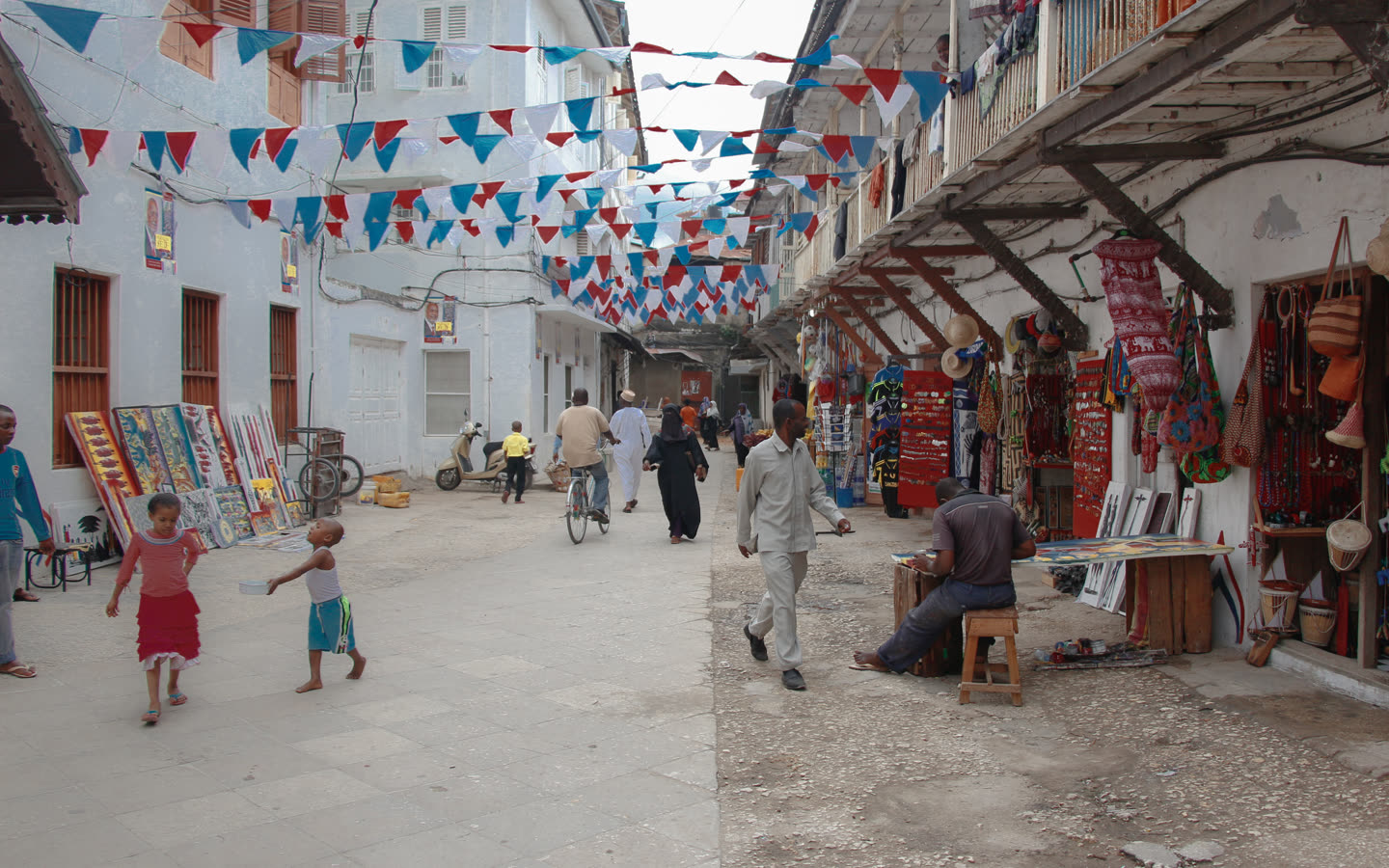
A narrow street in Stone Town, Zanzibar, strung overhead with rows of red, white and blue bunting. Whitewashed coral-rag houses with shuttered windows stand on the left; a curio market runs along the right under a timber verandah, hung with bags, drums and beadwork. People walk and cycle down the middle, and two children run across the foreground.
Mussi Katz from Israel · Public domain

All countries · Africa

Christmas in Tanzania

Christmas falls on
25 DecemberGregorian calendar
A public holiday
YesInternational Religious Freedom Report 2007: Tanzania — United States Department of State, Bureau of Democracy, Human Rights and Labor
—days
—hrs
—min
—sec

Next: Friday 25 December 2026

When is Christmas in Tanzania?

Christmas Day in Tanzania is 25 December. It is a public holiday.

How to say it

  • Swahili

    Krismasi njema

    Krismasi njema

    A synthesised voice — not a recording of a person — saying Krismasi njema in sw-TZ.

    The same greeting as Kenya, because the language is the same one: Kiswahili is Tanzania's national language, and it was made so deliberately - a language belonging to none of the country's hundred-odd groups, and therefore available to all of them.

    Krismasi njema — Wiktionary, the Swahili entry

How Christmas is kept

The calendar is split evenly between two faiths, by law

Tanzania's statutory holidays give the same number of days to Christians and to Muslims: Good Friday, Easter Monday, Christmas and Boxing Day on one side, and Eid al-Fitr over two days, Eid al-Haj and Maulid on the other. The balance runs through public life beyond the calendar - by convention the presidency alternates between a Christian and a Muslim.

International Religious Freedom Report 2007: Tanzania — United States Department of State, Bureau of Democracy, Human Rights and Labor

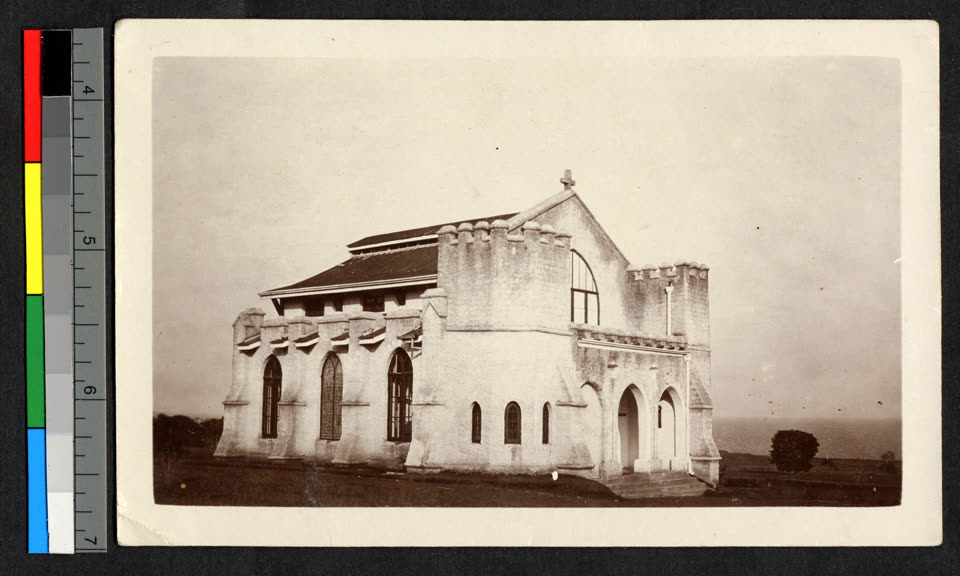
A mounted sepia photograph of a whitewashed stone church standing alone on open ground above the sea, its buttresses topped with battlements, tall arched windows down the side and a cross on the gable. The print is scanned on its card mount beside a photographic colour chart and ruler.
Unknown author · Public domain

Church, then rice, and in one account church again in the evening

Christmas Day is a church day first. Midnight Mass on the Eve in Catholic parishes, or a long morning service with the readings and hymns in Kiswahili, and then home to eat. Urban Tanzanians travel back to their parents' and grandparents' villages for it, as Kenyans do.

2023 Report on International Religious Freedom: Tanzania — United States Department of State, Office of International Religious Freedom

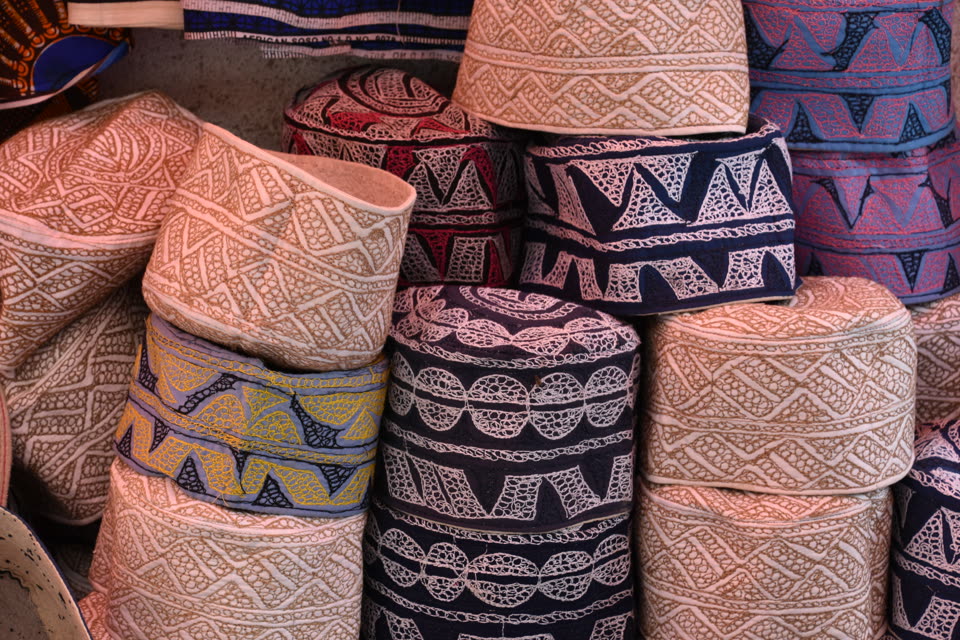
A dense stack of embroidered kofia, the stiff cylindrical caps worn by Swahili men, piled on a market stall. Each is worked in white or coloured thread in a different geometric pattern on cream, navy, red or pink cloth, and printed cotton hangs behind them.
Richard Mortel from Riyadh, Saudi Arabia · CC BY 2.0

Zanzibar North

Zanzibar is not having the same December

The archipelago is about 99 per cent Muslim and has its own semi-autonomous government, which appoints the islands' Muslim religious officials. The mainland coast is heavily Muslim too. So an account of Tanzanian Christmas describes the interior far better than it describes Stone Town, and the difference is not a detail - it is most of the coastline.

2023 Report on International Religious Freedom: Tanzania — United States Department of State, Office of International Religious Freedom

What is eaten

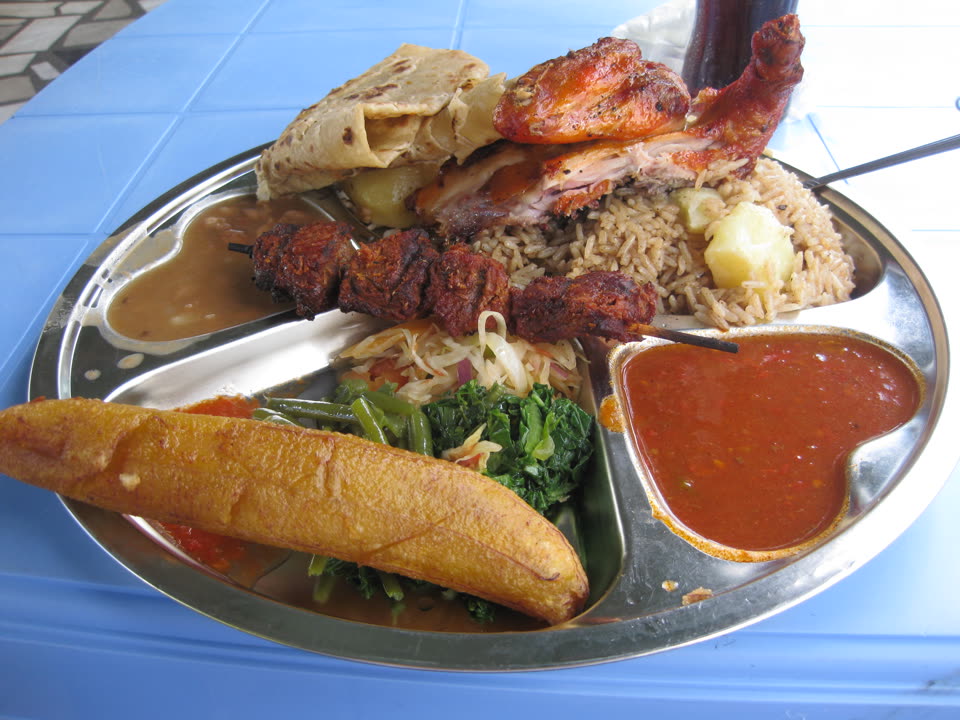
A stainless steel compartment tray on a blue tiled table, holding spiced pilau rice with pieces of potato, a quarter of roast chicken, two skewers of grilled beef mishkaki, a rolled chapati, a whole fried plantain, shredded kachumbari salad, cooked greens, a pool of brown gravy and a heart-shaped well of red chilli sauce.
Tcg1111 · CC BY-SA 4.0

Pilau

Pilau is the celebratory food in Tanzania and it is eaten on the days that matter. On Christmas morning the church bells ring, people go to the service, and afterwards — in one Mwanza writer's account of his own childhood — every house you pass has the smell of pilau coming out of it. It is built up in one pan: oil heated, onions browned in it, then pounded garlic, ginger, salt, pilau masala and peeled potatoes, and meat or chicken mixed through the rice. A kilo of rice feeds four or five.

Christmas in Tanzania: The Perfect Time for Reconnecting with Families — Andariya, 23 December 2022, by Philipo R. Florian

What people get wrong

Widely repeated claims about Christmas in Tanzania that do not survive checking. Each one says what is actually the case, because a correction with nothing in its place leaves you worse off than before.

Unsupported

Tanzania is about 60 per cent Christian.

What is actually the case. Every figure in circulation is a model and none is a count. The census stopped asking in 1967 and the government has refused to put the question back, most recently before the 2012 census. The published estimates run from 30 to 40 per cent at one end to about 63 at the other, and the US State Department has issued figures at both ends in its own reports sixteen years apart. The honest version is the range and the reason for it.

International Religious Freedom Report 2007: Tanzania — United States Department of State, Bureau of Democracy, Human Rights and Labor

National consciousness and identity in Tanzania — Peer-reviewed paper archived at ERIC, the US Department of Education's education research database
Oversimplified

Christmas in Tanzania looks like this: church, pilau, family, beach.

What is actually the case. That describes the mainland, and mostly the interior. Zanzibar's 1.5 million people are about 99 per cent Muslim and the mainland coast is heavily Muslim too. A description of a Tanzanian Christmas that does not say which Tanzania it means is averaging across a country whose islands and coast keep a different December altogether.

2023 Report on International Religious Freedom: Tanzania — United States Department of State, Office of International Religious Freedom

Worth knowing

Tanzania does not know how many Christians it has, and that is a decision rather than a failure. Religion was taken out of the national census after 1967, along with ethnicity, under Nyerere's policy of putting one national identity above both. Before the 2012 census, Muslim leaders asked for the question to be put back. The government refused, on the grounds that counting would undermine the peace.

National consciousness and identity in Tanzania — Peer-reviewed paper archived at ERIC, the US Department of Education's education research database
International Religious Freedom Report 2007: Tanzania — United States Department of State, Bureau of Democracy, Human Rights and Labor

Because nobody counts, the published figures disagree by thirty points - and the clearest way to see it is that one organisation has issued both ends of the range. The US State Department reported Tanzania's Christians at 30 to 40 per cent in 2007 and at about 63 per cent in 2023. Neither is wrong; they are different models of a thing nobody has measured since 1967.

International Religious Freedom Report 2007: Tanzania — United States Department of State, Bureau of Democracy, Human Rights and Labor

2023 Report on International Religious Freedom: Tanzania — United States Department of State, Office of International Religious Freedom

The balance is not decorative, and a president has said so on television. In March 2013, after a Catholic priest was murdered in Zanzibar, Jakaya Kikwete broke into the national conversation to tell Tanzanians that the country's reputation for Christians and Muslims living together was at risk and that they were heading for disaster if it broke. A country that will not count its religions is a country that knows exactly what counting could cost.

National consciousness and identity in Tanzania — Peer-reviewed paper archived at ERIC, the US Department of Education's education research database
Sources

Every claim carries its own citation. They are collected below, so you can see what the page rests on and how much of it comes from where.

  1. Christmas in Tanzania: The Perfect Time for Reconnecting with Families — Andariya, 23 December 2022, by Philipo R. Florian. Retrieved 2026-11-22.On the dish: «After the service, every house you pass by will have a mouthwatering aroma of pilau being cooked. In Tanzania, pilau is the celebratory food and it is usually eaten on special days.» The method and the quantity are his as well: «It is usually four to five people to one kilo of rice», and the pan starts with oil, onions «until they turn brownish», then «well-pounded garlic followed by other ingredients such as ginger, salt, pilau masala, and peeled Irish potatoes».
  2. National consciousness and identity in Tanzania — Peer-reviewed paper archived at ERIC, the US Department of Education's education research database. Retrieved 2026-11-14.The 2012 request and the refusal, as the paper records them: «Before the national census in 2012, ‘Muslim leaders had requested that the National Bureau of Statistics (NBS) should include in the questionnaire an item on religious affiliation with a view to identify and establish accurate religious divide and strength of the populace’. The Minister rightly objected and rejected the request saying that it would undermine the unity, peace and tranquility of the country.» And the reason the statistics office gave: «The NBS director explained that items on ethnic affiliation and religion would not be included in the questionnaire because the government policies are not hosted on or premised around religious beliefs or tribal affinity.»
  3. International Religious Freedom Report 2007: Tanzania — United States Department of State, Bureau of Democracy, Human Rights and Labor. Retrieved 2026-11-14.Christmas is one of eight religious public holidays, and the eight are split evenly: «The Constitution does not establish any official religion and recognizes eight days as religious holidays, four Christian and four Muslim.»
  4. 2023 Report on International Religious Freedom: Tanzania — United States Department of State, Office of International Religious Freedom. Retrieved 2026-11-14.The scale of the Christian population this describes is itself an estimate rather than a count: «A 2020 Pew Forum survey estimates approximately 63 percent of the population identifies as Christian, 34 percent as Muslim, and the remainder are practitioners of other religions or are unaffiliated.»
  5. Krismasi njema — Wiktionary, the Swahili entry. Retrieved 2026-11-14.The entry gives the phrase and its gloss directly: «Krismasi njema ! merry Christmas !» with one synonym, «heri ya Krismasi».