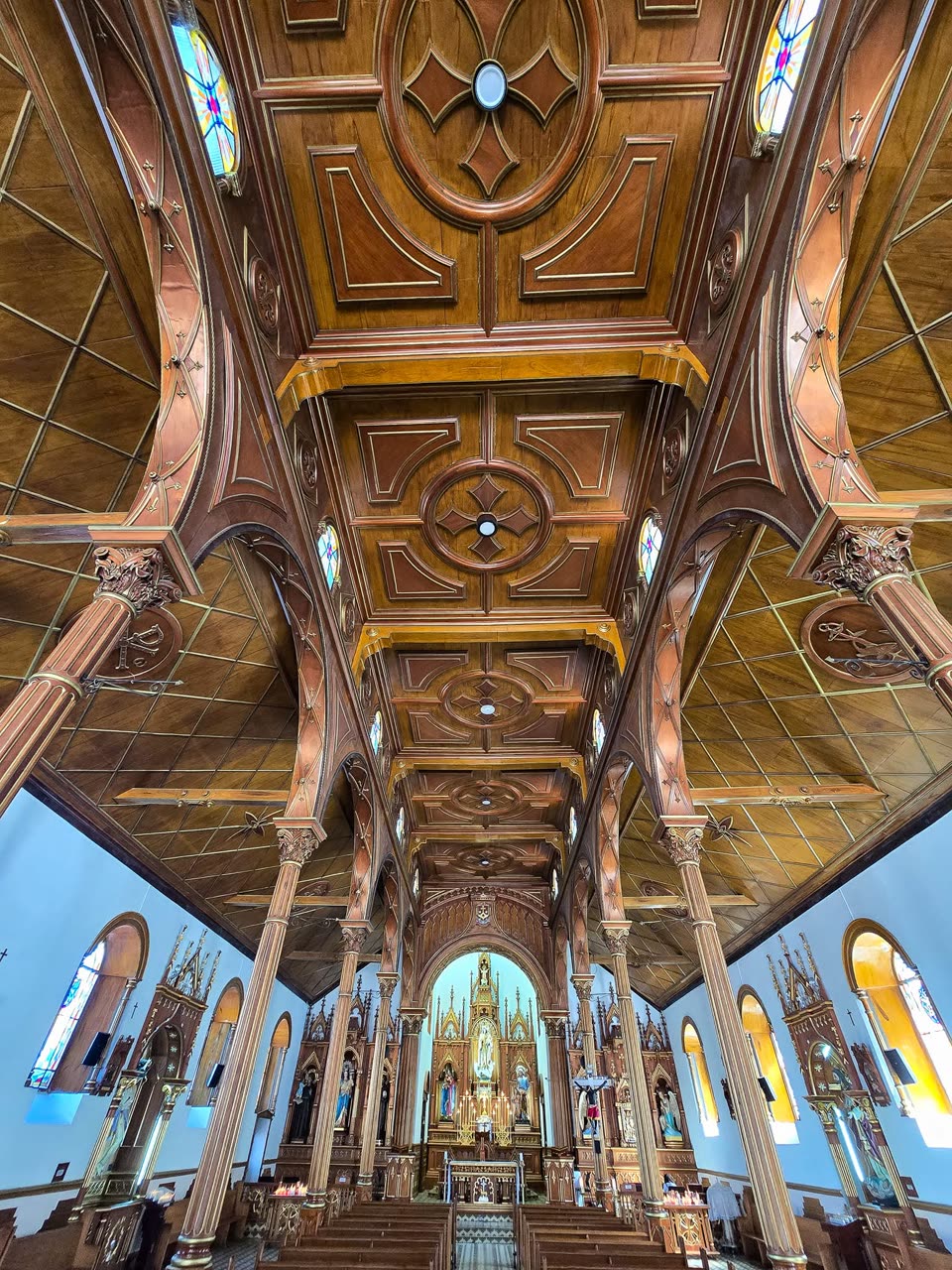
Christmas Day in Colombia is 25 December. It is a public holiday.
How to say it
Spanish
Feliz Navidad
say it: feh-LEESS nah-vee-DAHD
A synthesised voice — not a recording of a person — saying Feliz Navidad
in es-CO.
The ordinary Spanish greeting, with no Colombian form of its own.
The Colombian word that does carry weight is aguinaldo, and in a Colombian December it means three different things at once: the novena is the Novena de Aguinaldos, the fortnight of small betting games is los aguinaldos, and the aguinaldo is also the forfeit you hand over when you lose one of them.
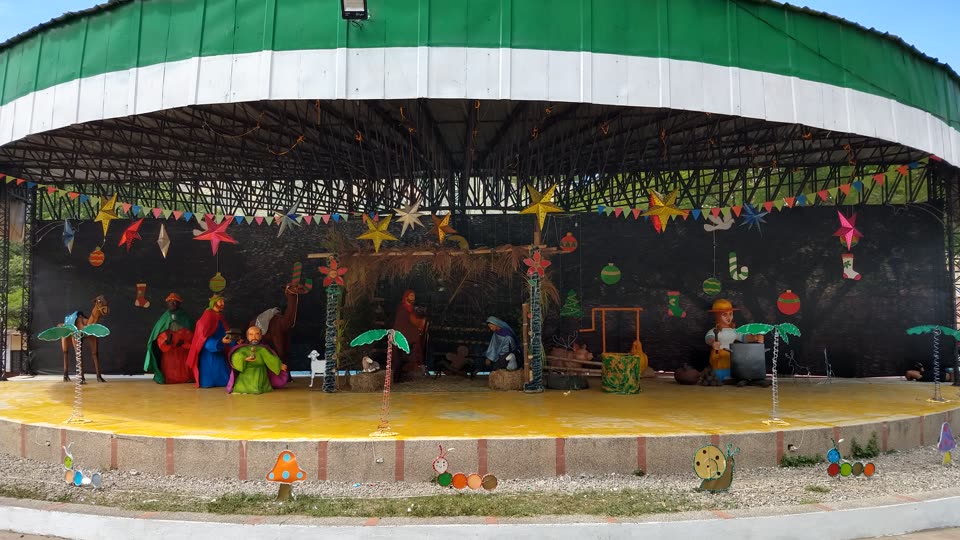
The presents come from the Christ child, at midnight on 24 December, at the same moment the figure of the infant is laid in the family's pesebre. The two events are the same event.
Papá Noel is present and has been complained about in the Colombian press since at least 1993. How many households now keep each of them has not been counted. Three Kings' Day is a public holiday in Colombia — moved to the following Monday by law — and no Colombian source describes presents arriving on 6 January.
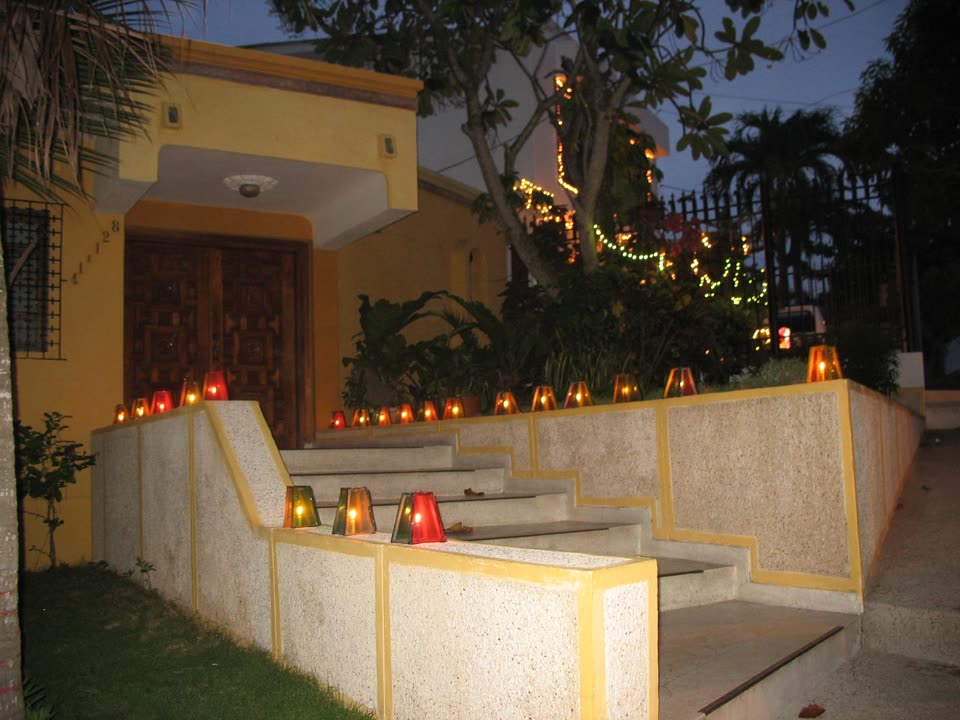
La noche de las velitas: the country lights candles on 7 December, and the law makes the next day a holiday
The Colombian Christmas starts on the evening of 7 December, when candles and paper lanterns go out along the pavements, on windowsills, on balconies and across doorways. The Vatican's own Spanish news service describes it as both the custom and the opening of the season: «durante la noche del 7 y la mañana del 8 de diciembre, las casas y las calles del país, en una atmosfera de alegría y fiesta, son iluminadas con velas y luces multicolores, en honor de la Inmaculada Concepción. A esta tradición se le conoce como “la noche de las velitas”. Esta noche, marca también el inicio de las festividades navideñas.»
The candles are lit on the eve of the Immaculate Conception, and the origin usually given is the proclamation of the dogma itself: «El 8 de diciembre de 1854 el Papa Pío IX proclamó mediante la bula Ineffabilis Deus, la Inmaculada Concepción de la Virgen María. Como respuesta, miles de personas a lo largo de todo el mundo salieron a las calles y encendieron velas para celebrar la decisión.» The same Colombian newspaper that prints that account also prints the limit on it, in a single sentence: «No hay una fecha exacta que indique desde cuándo se celebra el Día de las Velitas.» The custom is traced to 1854; it is not dated to it.
The hour is not the same everywhere. Most of the country lights up on the night of the 7th, and on the Caribbean coast it is more usual to do it in the small hours of the 8th: «La gran mayoría lo hace en la noche del 7 de diciembre, pero hay incluso regiones como la costa caribe donde se acostumbra hacerlo durante las horas de la madrugada del 8 de diciembre.» The towns that have made the night into a visitor event are named in the same article — Villa de Leyva, Medellín and Corrales in Boyacá among them.
And the night sits against a fixed point in the statute book. Under Ley 51 de 1983 the 8th of December is a paid rest day, and it is one of the dates the law does not move to the following Monday. Whatever else shifts in a Colombian calendar, the morning after the candles is a holiday on its own date.
La Novena de Aguinaldos: nine nights of one text, and two sources disagree about when it was first printed
From 16 to 24 December, Colombian families, parishes, offices and classrooms read the same nine-night devotion aloud in front of a nativity scene, one evening at a time. The bishops' conference describes where it is prayed in a single list — «en los hogares, comunidades, espacios académicos, empresariales y parroquias de nuestro país» — and the best-known edition is named with its date: «La edición más célebre es la publicada y aprobada por el arzobispo Bernardo Herrera Restrepo, en noviembre de 1910, bajo el título ‘Novena del Niño Dios’.»
The text is not Colombian in authorship. It was written by an Ecuadorian Franciscan: «El autor de la Novena de Navidad fue el místico y lingüista ecuatoriano Fernando de Jesús Larrea, OFM. Nacido en Quito (Ecuador), en 1700 y fallecido en Cali (Colombia), el 3 de noviembre 1773.» He wrote it at the request of María Clemencia Caycedo, a Bogotá laywoman of the Franciscan Third Order who founded the Colegio de La Enseñanza, and the manuscript he gave her has never been found — the bishops' own page says so: «Se ignora la fecha de tal obsequio, porque el documento original se encuentra aún extraviado.»
What Colombians actually recite is a later rewrite. At the end of the nineteenth century a nun of La Enseñanza in Bogotá, Madre María Ignacia — born Bertilda Samper Acosta in 1856 — replaced Larrea's daily Consideraciones with nine of her own, taken from two books: «Ella sustituyó las Consideraciones por dos sacadas del libro Interior de Jesús y de María del padre jesuita francés Jean Grou y las siete restantes del libro Belén o el Misterio de la Santa Infancia.» She also translated the Oración al Niño Jesús from French. An academic study of the novena puts the result plainly: apart from some changes of language, hers is the text the faithful now recite almost from memory.
When it was first printed is genuinely disputed, and the two accounts never meet. A peer-reviewed article in Historia Crítica, the history journal of the Universidad de los Andes, opens on the 1784 Bogotá edition: «En 1784 la Imprenta Real de don Antonio Espinosa de Los Monteros editó en Santafé de Bogotá la Novena para el Aguinaldo por el P. F. Fernando de Jesús», printed by the most important press in the Viceroyalty of New Granada, eleven years after Larrea's death, and its abstract calls that the first edition of the modern Colombian novena. The bishops' conference gives a different oldest reference, in a different city and four years later: «Como referencia más antigua se tiene el primer texto impreso en Lima, en 1788. Esta edición se conoció en Bogotá gracias a la edición preparada por la Imprenta Patriótica, en 1807.»
Neither source mentions the other. The academic article does not contain the word Lima anywhere in its twenty-two pages, and the bishops' page does not contain the year 1784. A Medellín daily gives the 1784 date too, with a detail neither of the others has — the first edition ran to 52 pages, and the Banco de la República holds a copy of an 1843 Bogotá printing from the century in which the devotion spread.
Los aguinaldos: a fortnight of small bets, and the winner has to shout to collect
For the same nine days as the novena, Colombians play a set of forfeits against each other called aguinaldos. Bogotá's culture department puts the window and the wager in one sentence: «en Bogotá y en todo Colombia, existen diferentes costumbres para celebrar la Navidad y una de ellas es el juego de “Aguinaldos” que se practica a partir del 16 y hasta el 24 de Diciembre.»
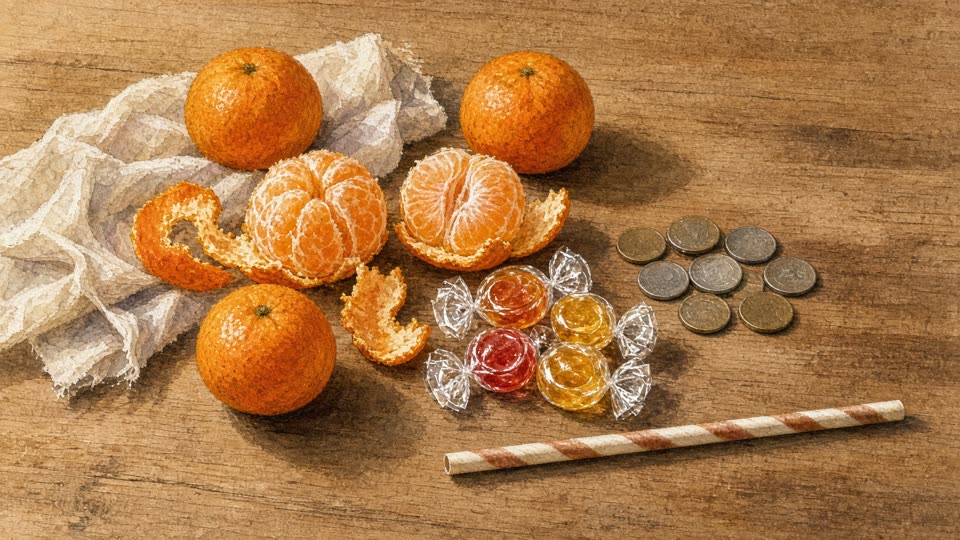
The best known is tres pies, and it is as small as it sounds: «si uno está de pié y se descuida, el oponente viene con sigilo y le pone su pié entre los de uno, a la vez que grita “¡Tres pies, mis aguinaldos!”». The stake is usually fruit, sweets or coins. The others are a list of ways to catch somebody out — pajita en boca, where both players have to be carrying a straw in their mouth every single time they meet; dar y no recibir, where you lose the moment you accept anything handed to you directly; and el sí y el no, where the forbidden word is the answer.
The national broadcaster records the rule that makes the whole thing a game rather than a habit: a win does not count unless it is claimed out loud. «En todos los juegos anteriores, cada vez que alguien pierde, la otra persona debe gritar “¡Mis aguinaldos!”, que significa: dame mi aguinaldo, mi regalo de Navidad, lo que hayamos apostado. Si no lo dice, la pérdida no es válida.»
The same page marks one of them as older than the rest — pajita en boca was played «sobre todo en zonas veredales», in the rural districts — and notes that the office Secret Santa has displaced some of the old games in Colombia.
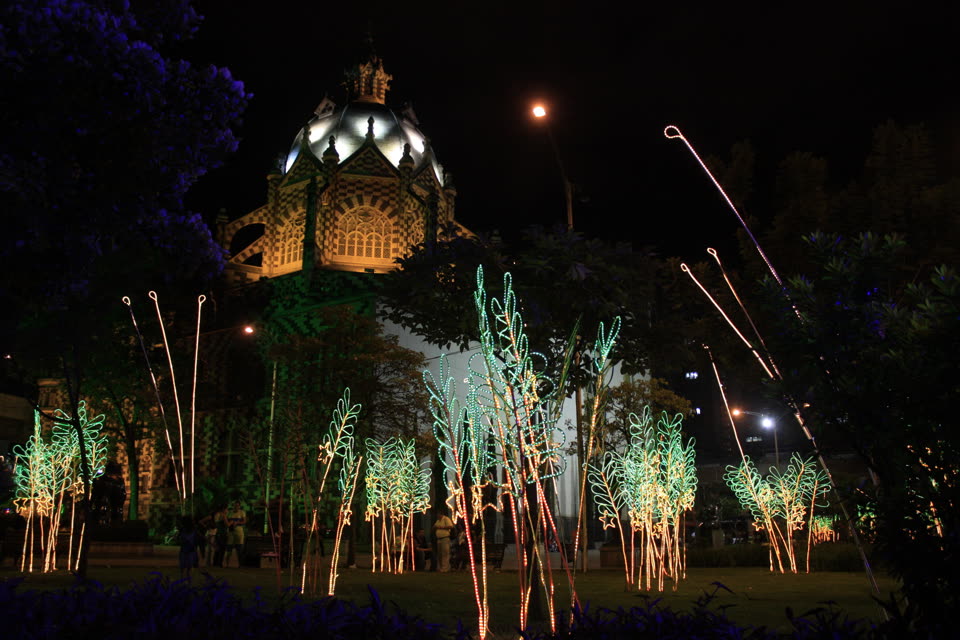
Los alumbrados de Medellín: eight million bulbs, put up by the electricity company
Medellín's Christmas lights are run by the city's own utility, Empresas Públicas de Medellín, and they are large enough to be reported in units of distance. The 2025 display — the 58th by the organisers' own count — was described by the city's public broadcaster as «ocho millones de bombillas, 600 kilómetros de manguera luminosa y 25 mil figuras que dan vida a “En Navidad, Medellín te quiere”, un homenaje a los 350 años de fundación de la capital antioqueña y los 70 años de servicio de EPM».
Six hundred kilometres of lit hose is roughly the road distance from Medellín to Bogotá and most of the way back. The lights were switched on on the evening of 28 November 2025 and stayed up until 12 January 2026, open every night from six in the evening until midnight, with the main run of about 1.5 kilometres between the Guayaquil bridge and Parques del Río.
The figures above belong to the 2025 edition. The switch-on date moves each year and the following year's scheme is announced in the autumn, so a Colombian looking for this year's dates is looking for a new announcement rather than a fixed date.
El Niño Dios brings the presents, and has been losing ground to Papá Noel since at least 1993
In Colombia the presents traditionally come from the Christ child, and they arrive at midnight on 24 December, the moment the infant figure is laid in the family's nativity scene. The public broadcaster's explanation is careful about how much it can claim: «Aunque es difícil determinar exactamente porqué en Colombia elegimos el Niño Dios como el repartidor oficial de los regalos navideños, es probable que tuviera sus inicios en la tradición de hacer el pesebre para representar el nacimiento de Jesús, el cual se fijó para la medianoche del 24 de diciembre, y el comienzo del 25 de diciembre.»
The competition is old enough to have been complained about in print for more than thirty years. A column in El Tiempo in 1993 put it as a straight replacement: «Ahora el Niño Dios ha sido reemplazado por el Papá Noel que nos trajeron los gringos con sus barbas nevadas y su vestido rojo.»
That is an opinion from one columnist rather than a measurement, and no published figure gives how many Colombian households now keep one, the other, or both.
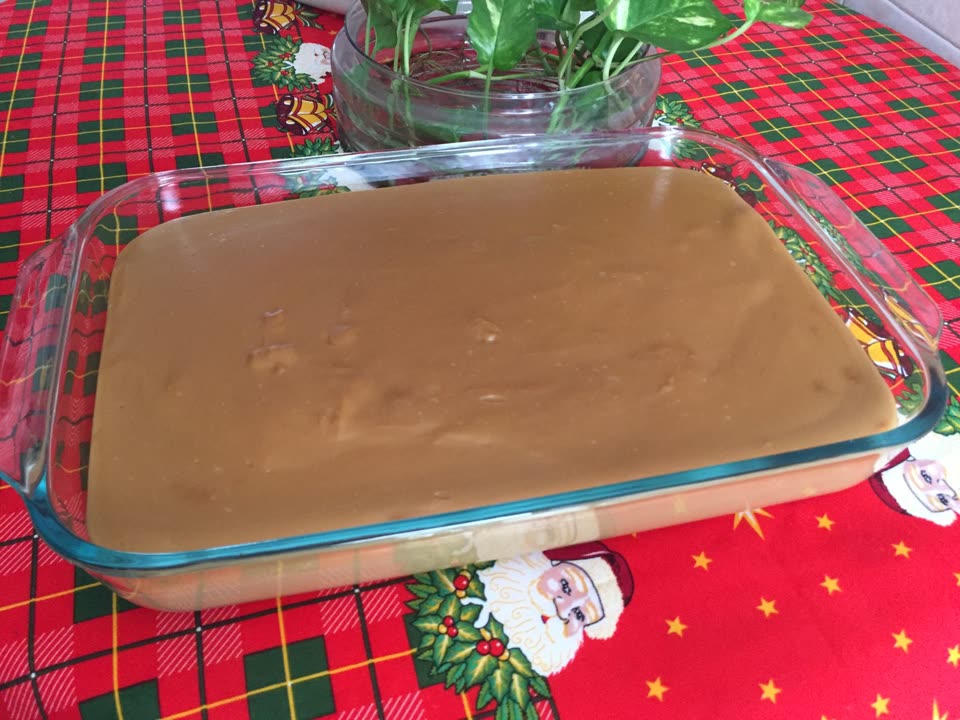
A set custard of maize, eaten in squares with a buñuelo beside it, and in most of Colombia it is made and eaten only in December.
It arrived from Spain and changed its grain. The public media archive of the national broadcaster puts the substitution exactly: «La versión que conocemos de este plato reemplazó la harina de trigo por maíz molido o harina de maíz, la cual se cuece con leche, canela y clavo, azúcar o panela, y puede llevar adiciones como queso, coco o arequipe.» Cinnamon and clove, sweetened with sugar or with panela, and sometimes finished with cheese, coconut or caramel.
Its link to Christmas is later than the dish. According to the historian Lucía Rojas de Perdomo, both the natilla and the buñuelo were brought to what is now Colombia during the colonial period and «su consumo no estaba necesariamente relacionado con la Nochebuena». The pairing with Christmas Eve came afterwards.
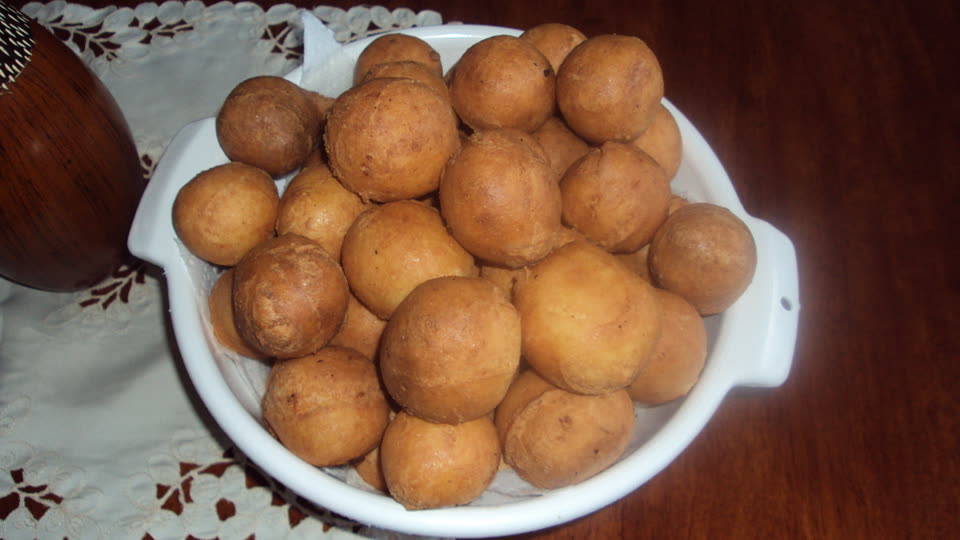
Cheese fritters: a dough of cuajada or a salty white cheese with maize starch, rolled into balls and fried until they are round and hollow and dark gold. They are a Christmas food in the way natilla is, and the two are eaten together.
The modern version is not the historical one. «Los buñuelos referidos en escritos y recetarios de los siglos XVIII y XIX estaban hechos de harina de trigo, no llevaban queso y, en algunos casos, eran sumergidos en almíbar» — wheat flour, no cheese, and sometimes steeped in syrup. The cheese-and-starch buñuelo that an Antioqueño would recognise is the later one.
They were being handed round at Christmas long before that change. Eighteenth-century archives and nineteenth-century writing — the source names José Manuel Groot — show buñuelos «en las bandejas y amasijos que se compartían entre vecinos en dichas festividades», on the trays of baking that neighbours shared at the festivities. The thing that made them a weeknight possibility was industrial: from the 1930s, as cities grew and more women went out to work, pre-mixed flours spread and cut the time the dough takes.
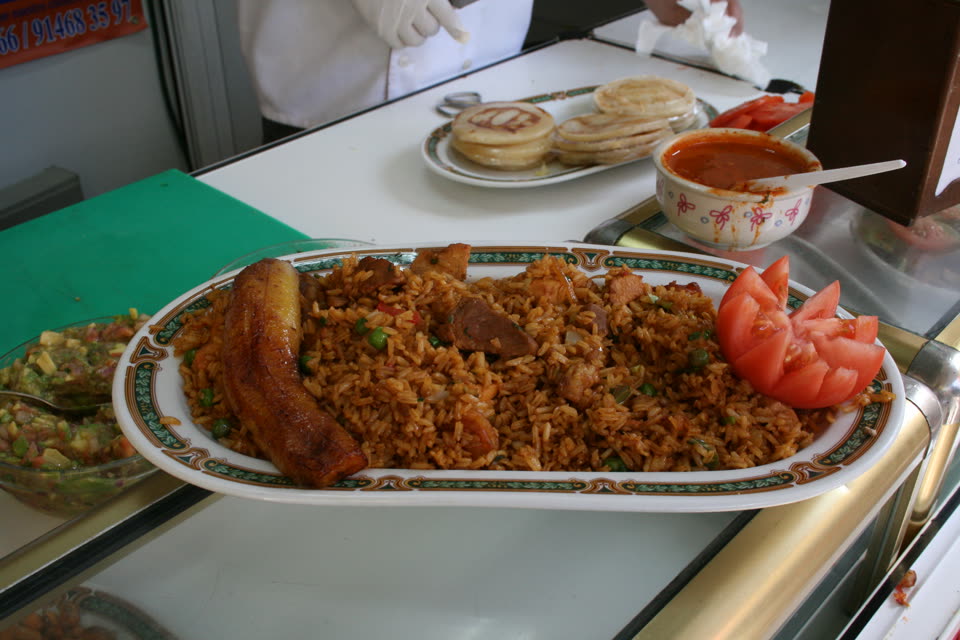
A whole pig, boned, stuffed with its own meat and with rice or peas and spices, and roasted for hours until the skin is hard and crisp. It belongs to the Tolima Grande region and it turns up wherever a Colombian December is being fed in numbers.
The national broadcaster calls it «un emblema de la región del Tolima Grande que nos antoja a todos los colombianos» and reports the argument that comes with it: «No exenta de polémica, esta preparación despierta acaloradas discusiones entre los partidarios de ponerle arroz y los tradicionalistas que la prefieren sólo con arveja.» Rice or peas, and strong feelings either way.
What both camps agree on is the skin — «lo importante, en todo caso, es que la piel del cerdo esté bien crocante y dorada» — which is also why it is a party dish rather than a household one: the oven has to take the whole animal and brown it evenly.
Widely repeated claims about Christmas in Colombia that do not survive
checking. Each one says what is actually the case, because a correction
with nothing in its place leaves you worse off than before.
Contradicted
The Day of the Little Candles commemorates the angel Gabriel telling Mary she would be the mother of Jesus
What is actually the case. The candles are lit on the eve of the Immaculate Conception, which is a different doctrine about a different event. The Immaculate Conception concerns Mary's own conception — that she was conceived free of original sin — and the feast is 8 December. The Annunciation is the angel Gabriel's visit to Mary, and it has its own feast on 25 March, nine months before Christmas.
The confusion is in the Colombian press rather than in folklore. An El Tiempo article on the origin of the Velitas states it directly: «Esta tradición, conocida popularmente como el Día de Velitas, está relacionada con el momento en el que el Arcángel Gabriel se le acercó a María para informarle que fue la elegida por Dios para que fuera la madre de Jesús», and then quotes Luke 1:26–31 at length in support.
What the night is actually for is stated by the church's own news service: the houses and streets are lit «en honor de la Inmaculada Concepción». The usual origin story attaches the candles to the proclamation of that dogma by Pius IX in the bull Ineffabilis Deus on 8 December 1854.
In Colombia Santa Claus brings the children their presents
What is actually the case. The traditional Colombian gift bringer is the Niño Dios, the Christ child, and the presents arrive at midnight on 24 December as the infant figure is laid in the nativity scene. The national cultural broadcaster calls him «el repartidor oficial de los regalos navideños».
Papá Noel is genuinely present, and has been for long enough to be complained about: a 1993 column in El Tiempo described the Christ child as having already been replaced by «el Papá Noel que nos trajeron los gringos». So the claim is not invented — it is a real competitor stated as though it were the only one.
Neither has been measured. No published figure gives how many Colombian households keep the Niño Dios, how many keep Papá Noel, or how many keep both.
The Colombian Christmas novena was first printed in Bogotá in 1784
What is actually the case. Two chains of sources give two different first printings, and neither engages the other.
A peer-reviewed article in Historia Crítica, the history journal of the Universidad de los Andes, opens on the 1784 Bogotá edition of the Novena para el Aguinaldo, printed by the Imprenta Real of Antonio Espinosa de los Monteros, and calls it the first edition of the modern Colombian novena; it rests the date on the Biblioteca Virtual Luis Ángel Arango's catalogue of Bogotá incunabula. A Medellín daily gives the same year and adds that the first edition ran to 52 pages.
The Conferencia Episcopal de Colombia gives a different oldest reference: «el primer texto impreso en Lima, en 1788», reaching Bogotá through an Imprenta Patriótica edition of 1807. The national broadcaster repeats that version.
The twenty-two pages of the academic article do not contain the word Lima. The bishops' page does not contain the year 1784. Both dates stand, and the library catalogue the academic article cites is where a single answer would have to come from.
Colombian law moves Three Kings' Day to a Monday and leaves the Christmas dates alone. Ley 51 de 1983 lists the country's paid holidays and then, in its second clause, slides ten of them to the Monday after whenever they do not already fall on one — «el seis de enero, diecinueve de marzo, veintinueve de junio, quince de agosto, doce de octubre, primero de noviembre, once de noviembre, Ascensión del Señor, Corpus Christi y Sagrado Corazón de Jesús». Epiphany is the first name on that list. The two December holidays, 8 December and 25 December, are not on it at all. So the candles on the night of the 7th are always followed by a holiday on the 8th, Christmas Day is always Christmas Day, and the Three Kings arrive on a long weekend.
In a Colombian December the word aguinaldo means three different things at once, and all three are in play in the same fortnight. It is the nine-night devotion — the Novena de Aguinaldos, read in front of the nativity from 16 to 24 December. It is also the name of the betting games played across those same days. And it is the forfeit itself: the national broadcaster glosses the shout a winner has to make, «¡Mis aguinaldos!», as «dame mi aguinaldo, mi regalo de Navidad, lo que hayamos apostado» — give me my aguinaldo, my Christmas present, whatever we staked. The prayer, the game and the prize share one word.
The text Colombians recite almost from memory each December was written by an Ecuadorian, commissioned by a woman, and half-rewritten by a nun out of a French Jesuit's book. Fray Fernando de Jesús Larrea was born in Quito in 1700 and died in Cali in 1773; he wrote the novena at the request of María Clemencia Caycedo, a Bogotá laywoman of the Franciscan Third Order, and the manuscript he handed her has never been found. At the end of the nineteenth century Madre María Ignacia, born Bertilda Samper Acosta, replaced his nine daily readings with two taken from Jean Grou's Interior de Jesús y de María and seven from Belén o el Misterio de la Santa Infancia, and translated the prayer to the Christ Child from French. A study of the devotion concludes that, apart from some changes of language, hers is the text still in use.
Every claim carries its own citation. They are collected below, so you
can see what the page rests on and how much of it comes from where.
«Es tiempo de crear una Colombia que sea casa y patria para todos», señala obispo — ACI Prensa / EWTN Noticias, 23 December 2019. Retrieved 2026-10-28.Monsignor Óscar Urbina Ortega, Archbishop of Villavicencio and then president of the Conferencia Episcopal de Colombia, closes his Christmas message with it: «A todos les deseo una feliz Navidad, y que en el nuevo año el Señor guíe nuestros pasos por el camino de la paz».
Episcopado invita a rezar la novena de Navidad — Conferencia Episcopal de Colombia. Retrieved 2026-10-28.For the 1910 edition approved by Archbishop Bernardo Herrera Restrepo under the title «Novena del Niño Dios», and for where the novena is prayed.
Ley 51 de 1983, «Por la cual se traslada el descanso remunerado de algunos días festivos» — Departamento Administrativo de la Función Pública — Gestor Normativo. Retrieved 2026-10-28. archived 13 October 2026Article 1 lists the paid rest days: «primero de enero, seis de enero, diecinueve de marzo, primero de mayo, veintinueve de junio, veinte de julio, siete de agosto, quince de agosto, doce de octubre, primero de noviembre, once de noviembre, ocho de diciembre y veinticinco de diciembre», plus Maundy Thursday, Good Friday, Ascension, Corpus Christi and the Sacred Heart.Clause 2 then moves ten of those to the Monday after: «el descanso remunerado del seis de enero, diecinueve de marzo, veintinueve de junio, quince de agosto, doce de octubre, primero de noviembre, once de noviembre, Ascensión del Señor, Corpus Christi y Sagrado Corazón de Jesús cuando no caigan en día lunes se trasladarán al lunes siguiente a dicho día.»
El Dulce Jesús Mío suena hace 200 años — El Colombiano (Medellín), Ronal Castañeda, 15 December 2020. Retrieved 2026-10-28. archived 22 January 2026A third source on the printing history, and it agrees with the academic one: «La primera edición del texto se publicó en 1784, de 52 páginas; posteriormente llegaron más. El Banco de la República conserva una copia publicada en 1843, impresa en Bogotá, siglo en el que el ritual se popularizó en Colombia.»
¿Por qué se celebra el Día de las Velitas el 7 de diciembre? — El Espectador (Redacción Colombia), 7 December 2020. Retrieved 2026-10-28.Both sentences are in the same article: the bull Ineffabilis Deus proclaimed by Pius IX on 8 December 1854, and «No hay una fecha exacta que indique desde cuándo se celebra el Día de las Velitas.»
La novena de aguinaldos fue escrita por un cura ecuatoriano — El Tiempo (archivo). Retrieved 2026-10-28.For Madre María Ignacia: her baptismal name, her birth year, her profession in the Orden de la Enseñanza in 1896, and the two books she drew the nine new Consideraciones from — Jean Grou's «Interior de Jesús y de María» and «Belén o el Misterio de la Santa Infancia».
«Con total desprecio de todo lo terreno». El contexto de producción de la Novena para el Aguinaldo (1784) — Felipe Arias Escobar, Historia Crítica núm. 50, Universidad de los Andes, Bogotá, mayo–agosto 2013, pp. 37–57. Retrieved 2026-10-28. archived 10 September 2024It gives the 1784 Bogotá edition, the printer, the commission by María Clemencia Caycedo and the eleven-year gap after Larrea's death, and it rests the date on the Biblioteca Virtual Luis Ángel Arango's catalogue «Incunables bogotanos: siglo XVIII».The word «Lima» does not occur anywhere in it.
Juegos navideños para compartir en familia — Radio Nacional de Colombia (RTVC). Retrieved 2026-10-28. archived 26 July 2026The national public broadcaster, for the shout that validates a win and for the rules of «pajita en boca», «dar y no recibir» and «el beso robado». The sentence about «¡Mis aguinaldos!» is split across bold tags in the page source; the words were rejoined without being changed.