A synthesised voice — not a recording of a person — saying 圣诞快乐
in zh-CN.
Four characters: the holy birth, 圣诞, and happiness, 快乐. The Catholic Diocese of Shanghai signs off its own account of the 2024 Christmas Masses with it — «圣诞快乐!» — which is as good an attestation as a greeting gets, because it is the church using it rather than a phrasebook.
The same two characters start the name of the festival, 圣诞节, and the name of Father Christmas, 圣诞老人.
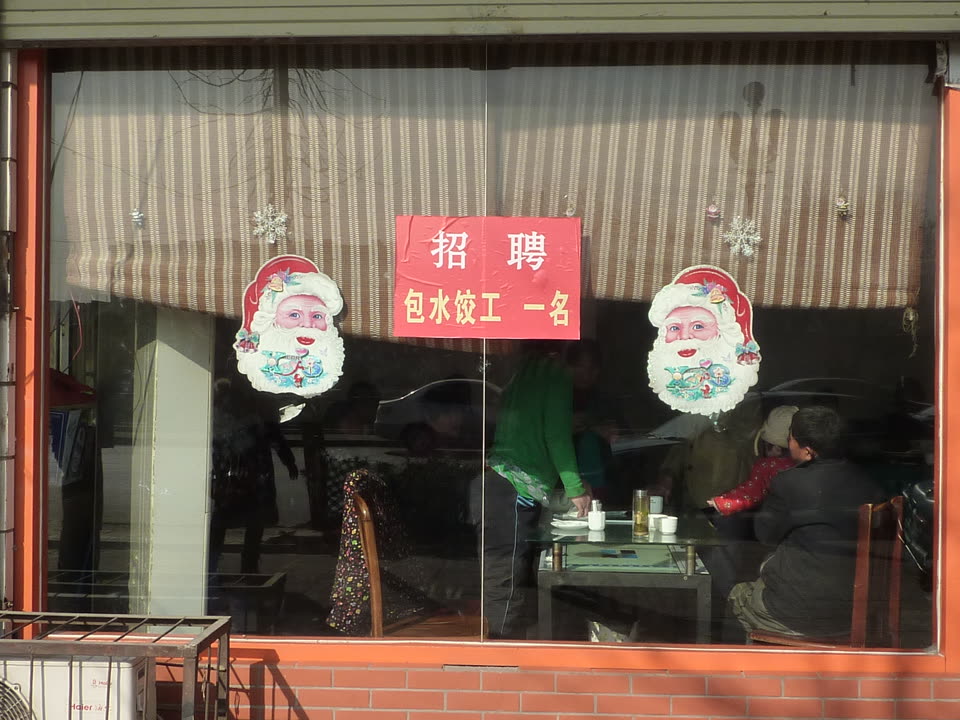
Shèngdàn Lǎorén — the old man of the holy birth 圣诞老人
Shèngdàn Lǎorén, literally the old man of the holy birth, and the name is a translation rather than a local figure. A cultural institute's explainer puts it plainly: «Santa Claus is known as 圣诞老人 (Shèngdàn Lǎorén, literally meaning old Christmas man) in Chinese and his gift giving is well known in China.»
He is in the malls and on the street decorations that some towns have ordered removed. What is given between people on the night is an apple.
Christmas Eve is for giving somebody an apple, and the reason is that the words rhyme
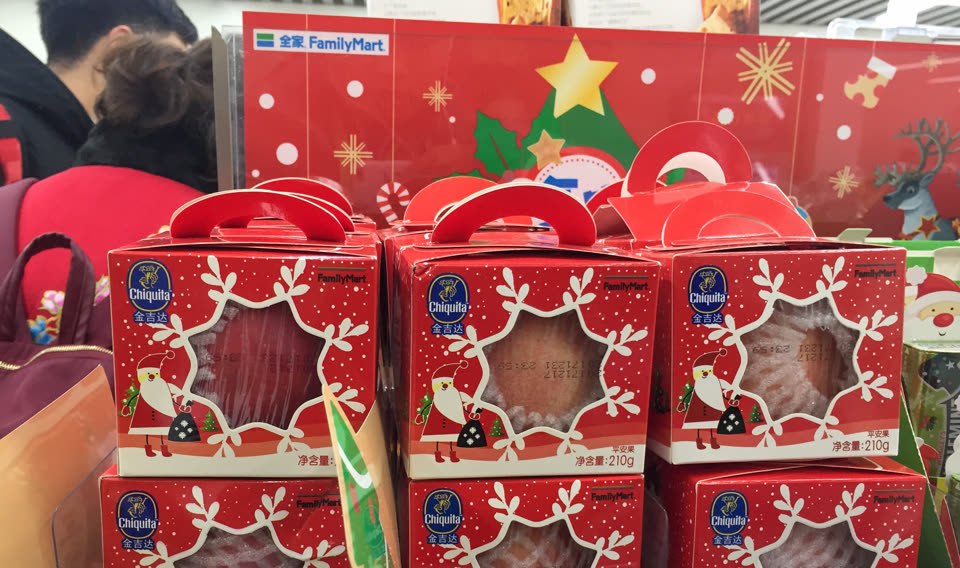
The one Christmas custom that is China's own is a fruit. On 平安夜, píng'ān yè, the peaceful night — which is what Christmas Eve is called — young people give each other an apple, 苹果, píngguǒ, because the first syllable of the apple is the first syllable of the peace.
A Beijing paper's shopping column puts the whole thing in two sentences: «平安夜和圣诞节虽然是来自西方的舶来品,平安果确实土生土长的中国货» — Christmas Eve and Christmas may be imports from the West, but the peace apple is homegrown Chinese goods — and then «于是就有了平安夜送苹果的新习俗», and so there came to be a new custom of giving apples on Christmas Eve.
What it costs is part of it. A Beijing report in 2013 found ordinary apples in a box or in coloured paper, some stencilled with Merry Christmas, and «they're more than twice as expensive as a regular apple».
Chinese readers know perfectly well that nobody does this anywhere else. A Beijing weekly noted the year it trended: «平安夜送苹果» went round as «咱们玩的谐音梗», a homophone joke of ours, and «人家西方人根本没那个习俗», they in the West have no such custom at all.
The folklorists do not agree about where the apple came from
Two Chinese folklorists, asked about the apple by a Beijing paper, gave answers that do not fit together.
Ai Jun said it is an invention: «the Christmas apple is a 100 percent Chinese phenomenon», made out of the sound of the words.
Tian Zhaoyuan, who heads the folklore department at East China Normal University, said it is a sales technique: «It seems like a business plan to sell apples and oranges, which lacks a deep cultural foundation.»
A third account, from a cultural institute in Scotland, says the traders did the work: the similar sounds «bring the „pingguo” and „ping'anye” together and clever traders have branded pingguo as ping'an guo». That one is asserted rather than evidenced.
Shanghai's cathedral filled twice over on Christmas Eve, and the diocese counted
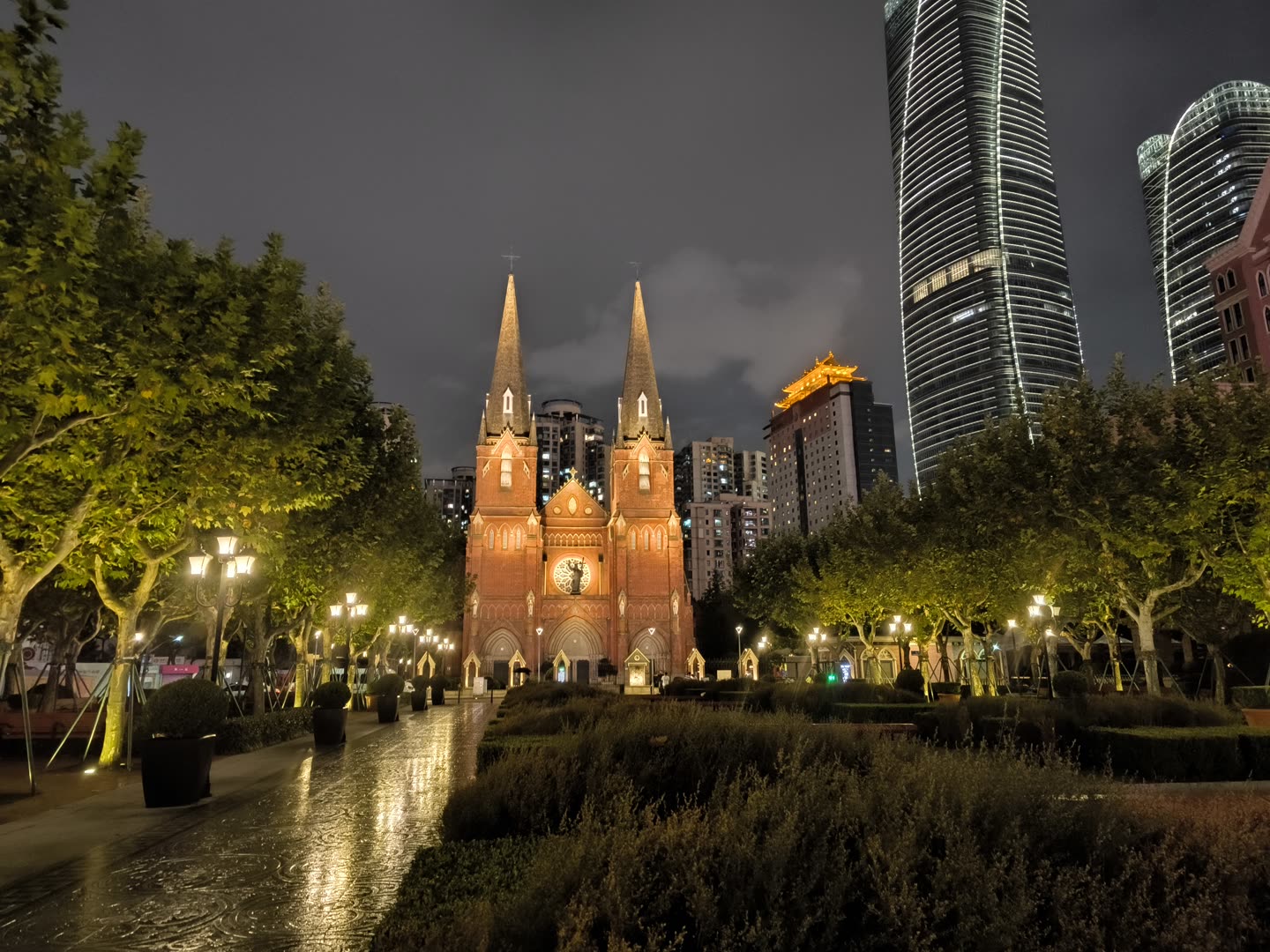
The Christian half of this is not the mall. At Xujiahui, the Cathedral of St Ignatius in Shanghai, Bishop Shen Bin led the midnight Mass on Christmas Eve 2024 — it began at seven in the evening — and the diocese's own report says «堂内座无虚席», not a seat left in the church, with nearly two thousand people waiting through the choir's singing.
The afternoon of the 24th had three more Masses in the same church, and the diocese gives a total for the two days: «两日来,陆续有一万余名天主的儿女前来徐家汇天主堂参礼» — more than ten thousand came to Xujiahui to take part.
These are the church's own figures and nobody else counted. The church is also part of the state-sanctioned structure, and its report of the night includes prayers for the country and for the party and the government.
In a Miao village outside Kunming, Christmas is the biggest day of the year, and the choir is older than the church building
Xiaoshuijing, in Fumin county above Kunming, is a Miao village where church singing goes back to a missionary visit in 1937. The choir itself has a date: «In 1982, following the resumption of church gatherings, 63 devout Miao Christians formed the Xiaoshuijing Farmers' Choir.»
What it is now, in a visiting reporter's words: «The annual Christmas celebration is the village's most important festival.» The one it describes was held on a Saturday in the middle of December rather than on 25 December.
Further west, among the Lisu of Nujiang, the shape is different again. At Tuozizuo in Fugong county six surrounding villages come together for a four-day celebration, with choirs singing through the Christmas Eve service and a communal meal of beef-broth soup and rice — and an observer who spent it there says the part everybody is there for is the sport: «The annual basketball tournament is central to Tuozizuo's Christmas celebration.»
Harbin keeps Christmas on 7 January, and one year the Orthodox kept it in the Catholic cathedral
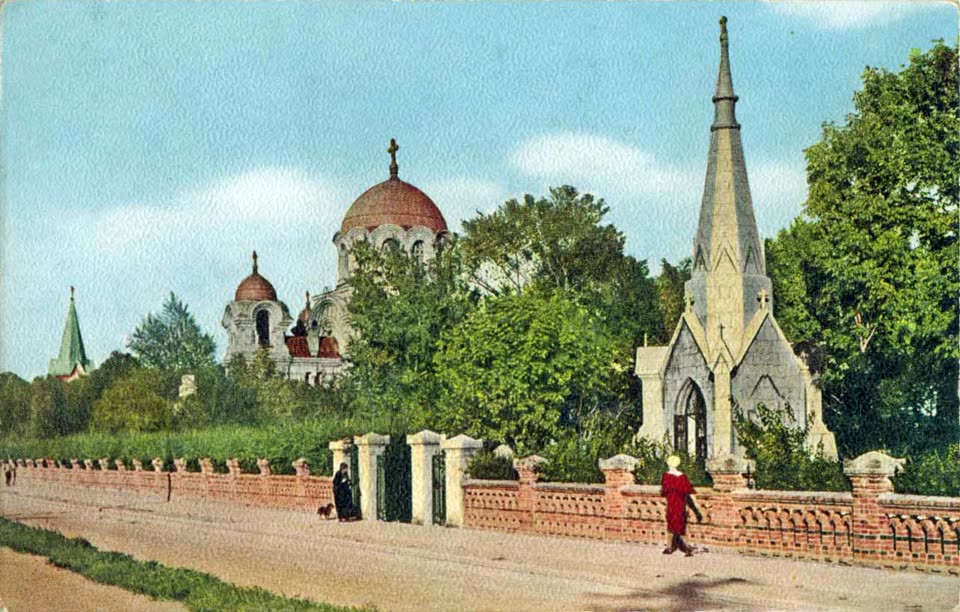
Harbin was built around a Russian railway and still has an Orthodox congregation. It keeps Christmas on 7 January, and in 2016 it kept it next door: «Ввиду того, что православный Покровский храм Харбина сейчас закрыт на ремонт» — because the Orthodox church of the Protection was closed for repairs — the Nativity liturgy was sung «в расположенном возле него католическом кафедральном соборе», in the Catholic cathedral standing beside it.
How many people that is, nobody agrees. A provincial official told a Beijing paper in 2018: «There are now about 100 Orthodox believers in Harbin, with one priest and one church.» For the whole country the same article prints two numbers side by side and leaves them there — «There are 15,000 Orthodox Christians in China today, according to a Russian Orthodox Church report», while Chinese scholars put it at a few thousand.
Orthodoxy is not one of the five religions the Chinese state recognises.
Some places have cleared Christmas off the street, in some years, and the order was local every time
In December 2018 the urban management bureau of Langfang, in Hebei, was reported to have told its officers to take Christmas off the streets: «河北省廊坊市城管局要求执法人员全面取缔沿街摆放的圣诞树、圣诞老人等物品» — to remove entirely the Christmas trees, Santa figures and the rest from the street, along with window stickers, banners and light boxes. The bureau, asked by the BBC's Chinese service, said it knew nothing about it, while several Langfang businesses said the ban was real.
The same week a primary school in Si county, Anhui, held a lesson whose title was «抵制洋节,从我做起», resist foreign festivals, starting with me. In Nanyang in Henan a newspaper found a 27-storey shopping and office complex stripped overnight: «It took less than 24 hours for all the Christmas trees, lights and bells to disappear.»
Four years earlier it was schools. Wenzhou's education authorities told schools and kindergartens that «Primary schools and kindergartens should not hold any Christmas-related events on campus», and an official explained it as proportion rather than prohibition: «We are not suppressing Western festivals, but we hope schools can be more balanced on this.»
None of this was national, and the contrast was in the same reports. The BBC opened its 2018 piece on the other side of it: «闪闪发光的圣诞树,商场循环播放的圣诞歌,这样的场景在中国上海街头随处可见» — glittering Christmas trees and Christmas songs on a loop in the malls, everywhere on the streets of Shanghai. And in Hengyang in Hunan, whose party committee told cadres and their families in 2017 not to follow foreign festivals, the Christmas Eve of 2015 had drawn, in the BBC's caption, tens of thousands of local people.
An ordinary apple, boxed or wrapped in coloured paper, sometimes stencilled with a greeting, and sold on 24 December for more than twice what an apple costs. It is the only thing anybody eats in China because it is Christmas, and the reason is a pun: 平安 is peace and 苹果 is apple, and they start with the same sound.
No traditional Christmas dish has grown up around it. No reliable account of a Chinese Christmas dinner has been published.
Widely repeated claims about Christmas in China that do not survive
checking. Each one says what is actually the case, because a correction
with nothing in its place leaves you worse off than before.
Oversimplified
China has banned Christmas.
What is actually the case. What is reported, repeatedly, is local and dated. A city bureau in Hebei clearing decorations off the street in 2018; a school in Anhui holding an anti-foreign-festival lesson the same week; Wenzhou's education office telling schools not to hold Christmas events in 2014; a complex in Henan stripped overnight. None of the sources describes a national prohibition, and the Langfang bureau denied knowing about its own order when asked.
The same reports carry the other half. The BBC's 2018 piece opens on Shanghai streets full of lit trees and looping Christmas songs, and a Hong Kong paper describes Christmas continuing as a shopping festival across most of the country, with big trees in Shanghai and Beijing malls. Scholars quoted by the BBC think local officials were guessing at what Beijing wanted rather than carrying out an instruction.
What is true everywhere is narrower and is not a ban: 25 December is a working day, because the statutory holiday list has seven occasions on it and Christmas is not one.
Giving apples on Christmas Eve is a Western custom the Chinese picked up.
What is actually the case. It is the other way round. The custom exists because two Chinese words sound alike — 平安, peace, and 苹果, apple — and a Beijing paper says so in as many words: Christmas Eve and Christmas are imports, «平安果确实土生土长的中国货», the peace apple is homegrown Chinese goods.
Chinese readers have made the same point about the West. When it trended on social media, a Beijing weekly reported the line being passed around: this is «咱们玩的谐音梗», a homophone joke of ours, and «人家西方人根本没那个习俗», they in the West have no such custom at all.
Where the folklorists differ is on whether it is a youth invention or a fruit-seller's idea, and both views are published above.
What is actually the case. The figure depends entirely on which question is asked, and the range runs from twenty million to eighty-odd. Asked to name a religion, about 2% of Chinese adults say Christian — roughly 20 million, about 18 million of them Protestant. Asked instead whether they believe in Jesus or Tianzhu, about 7% say yes, which is about 81 million.
Both are from the same research centre and the same page. It also notes that Christians in unregistered house churches have reason not to tell a surveyor, so the lower figure is a floor rather than a count.
China's statutory holidays are a closed list of seven, and the list was last reopened in November 2024 to add two days — New Year's Eve to the Spring Festival, and 2 May to Labour Day. That brought the total to thirteen days a year.
25 December is not among them and never has been. Nine further commemorations are named in the same measure with the words «均不放假», no holiday at all.
About 2% of Chinese adults say they are Christian — roughly 20 million people — and about nine in ten of them are Protestant: «Protestants account for roughly 90% of Chinese Christians, or about 18 million adults, while the remainder are mostly Catholics.»
The Catholics are not spread evenly. Roughly a quarter of them live in one northern province, Hebei, clustered in villages where almost everybody is Catholic.
Public religious worship stopped altogether during the Cultural Revolution: «All religious activities were banned, and religious personnel were persecuted.» What followed is the reason there are Christmas services to report at all — churches that had been closed or confiscated «were allowed to reopen», and some that had been damaged were rebuilt with government money.
The turn is dated to a 1982 party document, and it is the same year that sixty-three Miao farmers in a Yunnan village got their choir going again.
How is Christmas Celebrated in China? — Confucius Institute for Scotland, University of Edinburgh. Retrieved 2026-10-29. archived 14 July 2026An explainer from a cultural institute rather than research, cited for the name and for the observation that Christmas «is not a traditional festival in China» while «many Chinese people like the idea of celebrating Christmas».
Wenzhou bans Christmas in schools — Global Times (Beijing, state-owned), 25 December 2014. Retrieved 2026-10-29. archived 15 July 2026Also the source for Wenzhou as a centre of Christianity: «The city is home for roughly a million Christians, according to previous reports» — a second-hand estimate, and the article does not separate Protestants from Catholics.
全国年节及纪念日放假办法, as republished after the fourth revision (国务院令第795号) — 人民日报 (People's Daily), 13 November 2024, page 3, carrying the Xinhua text of the State Council decision. Retrieved 2026-10-29. archived 13 October 2025Article 2, the holidays on which all citizens are off work, is a closed list of seven: «(一)元旦,放假1天(1月1日)», New Year's Day; Spring Festival, four days, from New Year's Eve to the third day of the first lunar month; Qingming, one day; Labour Day, two; the Dragon Boat festival, one; Mid-Autumn, one; and «(七)国庆节,放假3天(10月1日至3日)», National Day, three.Article 5 names nine further commemorations and says of them «均不放假», no holiday at all.Article 4: «少数民族习惯的节日,由各少数民族聚居地区的地方人民政府,按照各该民族习惯,规定放假日期» — the customary festivals of minority nationalities have their holiday dates set by the local governments of the areas where those nationalities live.