Christmas Elsewhere

A country-by-country atlas of how Christmas is actually kept

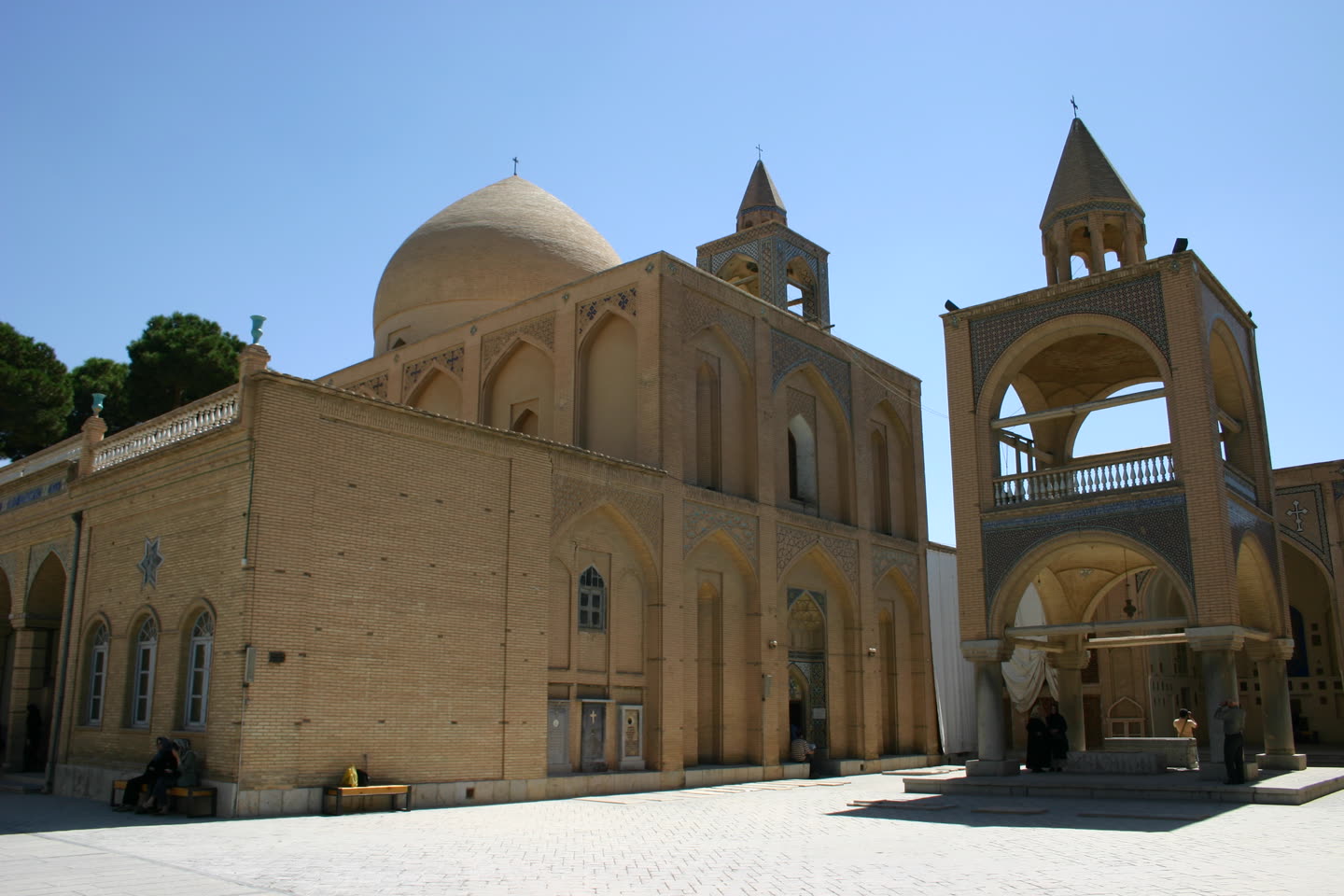
The Armenian cathedral of Vank in the Jolfa quarter of Isfahan, photographed from the courtyard in hard noon sun against a cloudless blue sky. The whole group is built of pale buff brick. On the left the church itself: a plain brick box with a stone balustrade along its roofline, rows of tall pointed arches cut into the wall, small arched windows with white frames, a six-pointed star inlaid in blue tile, and above it a low round dome of the kind an Iranian mosque has — smooth, shallow, slightly bulging at the base — with a small iron cross on top of it. A square bell tower rises beside the dome, its open upper stage arcaded on all sides under a steep conical cap and another cross. To the right, standing free of the church, a second and larger belfry: a tall brick box on piers with great open arches through it, a white balustrade across the middle, panels of blue, white and ochre tile set into the brickwork in geometric bands, and the same conical cap and cross. Dark cypresses show over the roof on the far left. The paved courtyard below is almost empty: two women in dark headscarves sit on a bench at the left, a few small figures stand under the far belfry, and the shadows are short and black.
Mike Gadd · CC BY 2.0

All countries · Southern Asia

Christmas in Iran

Christmas falls on
6 JanuaryGregorian calendar
How it is kept
Kept by minority communities
A public holiday
Noالزام به اعطای مرخصی به اقليت های دينی — وکلای دیوان, a Tehran practice before the Court of Administrative Justice
—days
—hrs
—min
—sec

Next: Wednesday 6 January 2027

When is Christmas in Iran?

Christmas in Iran falls on two dates: 6 January for the Armenian majority and 25 December for Assyrian and Chaldean Christians. Neither is a public holiday; recognised Christians get leave.

Is Christmas a public holiday in Iran?

No. 6 January is an ordinary working day in Iran. It is kept by minority communities. الزام به اعطای مرخصی به اقليت های دينی — وکلای دیوان, a Tehran practice before the Court of Administrative Justice

How to say it

  • Armenian

    Քրիստոս ծնաւ եւ յայտնեցաւ

    Krisdos dznav yev haydnetsav

    say it: krees-DOSS dzuh-NAHV yev hide-net-SAHV

    Classical Armenian, and not a wish but a statement: «Christ is born and revealed». The other person answers «Օրհնեալ է յայտնութիւնն Քրիստոսի», Orhnyal e haydnootyunn Krisdosi, «Blessed is the revelation of Christ».

    Both halves say «REVEALED», which is the whole reason Armenians are on 6 January rather than 25 December. The exchange is used at the kiss of peace and for forty days afterwards.

    The romanisation is Western Armenian, which is how Iran's Armenians say it — Krisdos with a d. The same letters are read Kristos tsnav in Eastern Armenian.

    Blessed is the Revelation of Christ! — Armenian Prelacy (Eastern Prelacy of the Armenian Apostolic Church of America)

  • Persian

    میلاد حضرت عیسی مسیح مبارک

    Milād-e Hazrat-e Isā Masih mobārak

    say it: mee-LAAD-eh haz-RAT-eh ee-SAA ma-SEEH mo-baa-RAK

    A synthesised voice — not a recording of a person — saying میلاد حضرت عیسی مسیح مبارک in fa-IR.

    Persian, and the register the Iranian state itself uses. The presidency's Christmas messages congratulate «میلاد حضرت عیسی بن مریم (ع)» — the birth of Jesus son of Mary, with the Islamic honorific — rather than «کریسمس», Christmas.

    In the street «کریسمس مبارک», Krismas mobārak, is ordinary, and it is what the shop windows on Mirza-ye Shirazi Street say.

    پیام مسعود پزشکیان خطاب به پاپ و مسیحیان جهان به مناسبت سال نو میلادی — خبرآنلاین (Khabar Online), Tehran

How Christmas is kept

the Armenian community

The country keeps two Christmases, twelve days apart

Iran's Armenians, who are most of its Christians, keep 6 January. Its Assyrians and Chaldeans keep 25 December. Both are in the same country, both are constitutionally recognised, and the two dates are twelve days apart. The Tehran Times puts the Armenian side plainly: they «follow the Oriental Orthodox denomination of Christianity and accordingly, celebrate Christmas on January 6, concurrent with the Epiphany». For the other side: «Like most Christians around the world, Assyrians in Iran celebrate December 25 as the birth anniversary of Jesus Christ.»

Iran hosting Christmas celebrations for centuries — Tehran Times

The civil service's own leave schedule has the two dates built into it

Iran's Administrative and Employment Affairs Organisation publishes a list of each recognised minority's feast days, so that employers know which days to grant leave for. On the Assyrian list the birth and the baptism of Christ are two separate entries — «عید میلاد مسیح (ع)» and «عید تعمید حضرت مسیح (ع)». On the Armenian Apostolic list they are one entry: «تولد و غسل تعمید مسیح (ع)», the birth AND baptism of Christ. The oldest argument in the Church about what 6 January is for, settled in a civil service circular about days off. Note the «(ع)» in both: the state's schedule of Christian feasts gives Jesus the Islamic honorific.

الزام به اعطای مرخصی به اقليت های دينی (Compelling the grant of leave to religious minorities) — وکلای دیوان, a Tehran practice before the Court of Administrative Justice

the Armenian community

Christmas Eve is a church full of candles, and everyone takes one home

The Armenian Christmas begins on the evening of 5 January with the Jrakalooyts, Ճրագալոյց — the Candlelight Divine Liturgy, named for the lamp. The faithful light candles during the service for the star that brought the wise men to the manger, and then carry fire out of the building: «the faithful take home a number of candles from the church equal to the number of family members and, in the past, shared a candlelit Christmas Eve dinner.» One candle per person, counted at the door.

Blessed is the Revelation of Christ! — Armenian Prelacy (Eastern Prelacy of the Armenian Apostolic Church of America)

the Armenian community

The Armenian Christmas dish turned out to be Iranian, and nobody knew until the border opened

Iranian Armenians eat rice, fish and vegetable kuku on Christmas Eve — the herb rice and fish that Iranians eat at Nowruz, and a Persian herb omelette. They took it for an Armenian tradition. Then the Soviet border opened and they went to Armenia. The writer and documentary film-maker Robert Safarian: «Since childhood we thought that this was a Christmas tradition until the borders to Armenia opened and we learned that there is no dish in Armenia called vegetable kuku. It is an Iranian dish that has become an Armenian tradition.» Four centuries in Isfahan, and the Christmas table had quietly become Persian without anyone noticing.

An Armenian Christmas Feast — IranWire

the Assyrian and Chaldean community

The congregation calls on the clergy, and the next day the clergy call back

Assyrian Christmas in Iran is built around a two-way visit. «On December 25, Assyrian people go to church to visit Assyrian clergies and wish them a happy Christmas, and the next day, it is the clergies who go to visit their fellow believers.» It comes at the end of a long fast: twenty-five days without meat or dairy, broken after the 25th with Communion at church.

Iran hosting Christmas celebrations for centuries — Tehran Times

Most of the people buying Christmas trees in Tehran are Muslims

From mid-December the shops on Mirza-ye Shirazi Street in Tehran — a street with an Armenian church on it and few Armenians left — fill with trees, ornaments and Santa dolls, and the trade is not mainly Christian. «There have been numerous reports in Iranian media in recent years that quote owners of businesses in the area saying most of the shoppers who buy the trees, accessories, and gifts are Muslims.» The clergy have noticed. In 2014 Grand Ayatollah Naser Makarem-Shirazi ruled that «Celebrations and activities related to Christmas are not admissible unless necessary because they promote the non-Islamic culture», adding that necessity «means harm to familial relations and friendships [with Christians] if these activities are not performed».

Christmas gains traction in Iran despite official disfavor — Iran International

the Armenian community

The wine is home-made, because the law lets Christians make it and nobody sell it

Wine has a place at the Christmas table and no place in an Iranian shop. «Under the Islamic Republic of Iran, trade in alcoholic beverages is forbidden, so the Armenian community makes its own wine and other alcoholic drinks. The law allows religious minorities to make wine for religious purposes.» A recognised minority may produce what it may not buy.

An Armenian Christmas Feast — IranWire
What is eaten

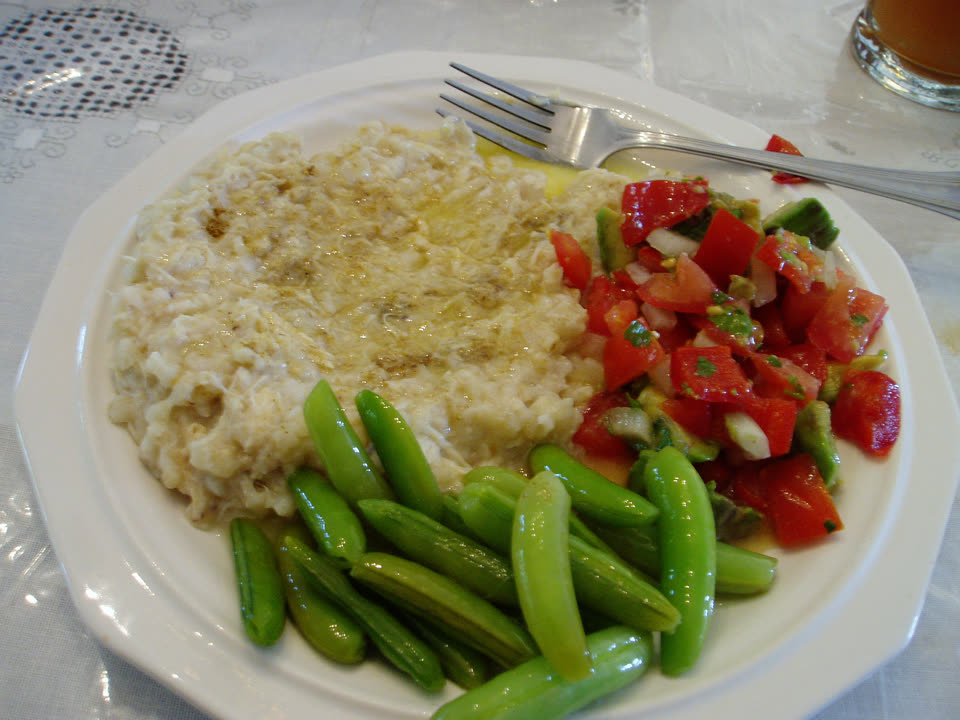
A plate of harissa on an embroidered white cloth, seen from above and close. The dish itself is a thick pale porridge of wheat and chicken beaten together until the meat has gone to strands in the grain, spread across half the plate, with melted butter pooling yellow in the hollows and a dusting of dark spice over the top. Beside it are boiled green beans, glossy with the same butter, and a chopped salad of tomato, cucumber and spring onion. A fork lies across the rim and a glass of tea stands at the top right corner.
Augustgrahl at English Wikipedia · Public domain

the Armenian community

Harissa

The Armenian Christmas Day dish: a thick stew of wheat and chicken, beaten until the meat comes apart into the grain. Herand Baghdasarian, an Iranian Armenian, describes the table: «On Christmas Day, which falls on January 6th, Christians celebrate Jesus Christ's birthday by feasting on a traditional chicken stew called 'harissa', or on a roast turkey.» The turkey is the newer option and the harissa is the old one.

A peek into Christmas celebration in Iran — Tehran Times

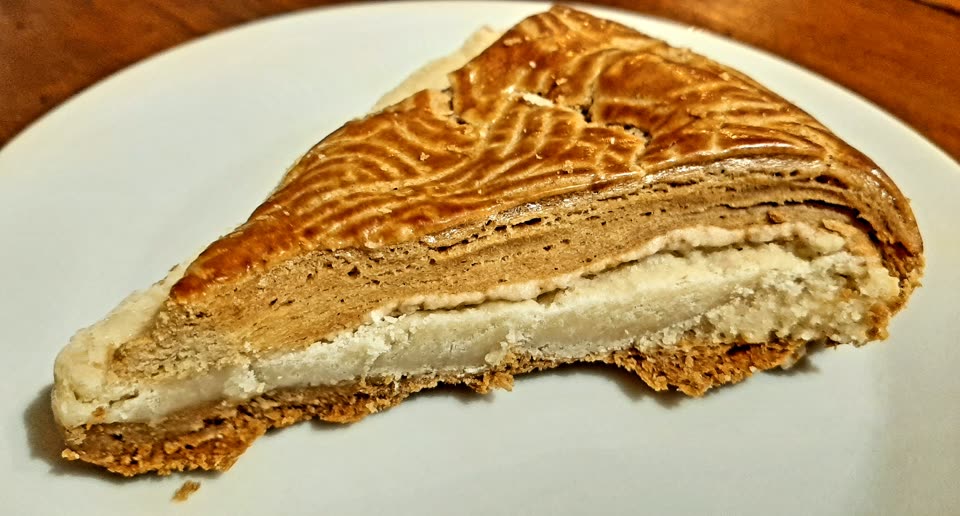
A single wedge of gata on a white plate on a dark wooden table, filling the frame and seen almost at eye level so the cut face is square on. The top is glazed a deep golden brown and scored all over in close parallel waves, the marks of a comb drawn across the dough before baking, and the pastry has split along one of them. The cut side shows what is inside: four or five thin fawn layers of baked dough running the width of the slice, and between them broad bands of a pale, dense, crumbly cream-coloured filling that looks like butter and sugar worked together. The crust is thicker and darker along the back edge, and a few crumbs lie on the plate at the front.
Combrian · CC0

the Armenian community

Gata

A layered sweet bread of flour, butter, sugar and eggs, sometimes with walnuts, sometimes scented with rosewater or cardamom — and sometimes with a coin pushed into the middle of it. «Sometimes a coin is hidden at the center of the gata and the belief is that fortune will smile on whoever finds the coin in her or his gata.» It is sold beside perok, a marmalade cake, and both have left the Armenian quarter: «In the past, these two dishes were only popular among Armenians but now they are among the highest-selling pastries in Tehran confectionaries.»

An Armenian Christmas Feast — IranWire
What people get wrong

Widely repeated claims about Christmas in Iran that do not survive checking. Each one says what is actually the case, because a correction with nothing in its place leaves you worse off than before.

Contradicted

Armenians celebrate Christmas in January because they use the old calendar, like the Russians

What is actually the case. Two different mechanisms land near each other and get confused. Russians, Serbs and the other Julian-calendar churches keep 25 December on a calendar now thirteen days behind, which falls on 7 January. Armenians keep 6 January on the ordinary Gregorian calendar, and they are not commemorating the birth alone: 6 January is the original single feast of the Nativity and the Baptism together, which most of the Church split in the fourth century and the Armenians never did. The greeting says so out loud — «Քրիստոս ծնաւ եւ յայտնեցաւ», Christ is born AND REVEALED — and so does the Iranian civil service's leave schedule, which lists the birth and the baptism as one entry for Armenians and two for Assyrians.

The test that separates them: a calendar shift moves with the calendar. Armenians of the Patriarchate of Jerusalem, who do use the Julian calendar, keep the same 6 January feast on 19 January. Same church, same feast, thirteen days apart — which is exactly the gap that is NOT present in Iran.

Blessed is the Revelation of Christ! — Armenian Prelacy (Eastern Prelacy of the Armenian Apostolic Church of America)

Oversimplified

Christmas is banned, or has to be hidden, in Iran

What is actually the case. For the recognised minorities it is open and constitutional. Churches hold the liturgy, Armenian schools close, the civil service grants leave for the feast by name, three Christians sit in parliament, and from mid-December the trees and lights are in shop windows on a main Tehran street, bought mostly by Muslims. Christmas is not a public holiday, which is a different thing from being forbidden.

What is true is narrower and sharper. Article 13 recognises three minorities and no more, and the protection runs to those communities rather than to the practice in general: Persian-speaking converts from Islam are outside it and have been prosecuted, and their congregations meet in houses. A senior cleric has ruled that Muslims joining in are «not admissible unless necessary». So Iran protects Christmas for people born Christian and does not extend it to people who become Christian.

Christmas gains traction in Iran despite official disfavor — Iran International

Worth knowing

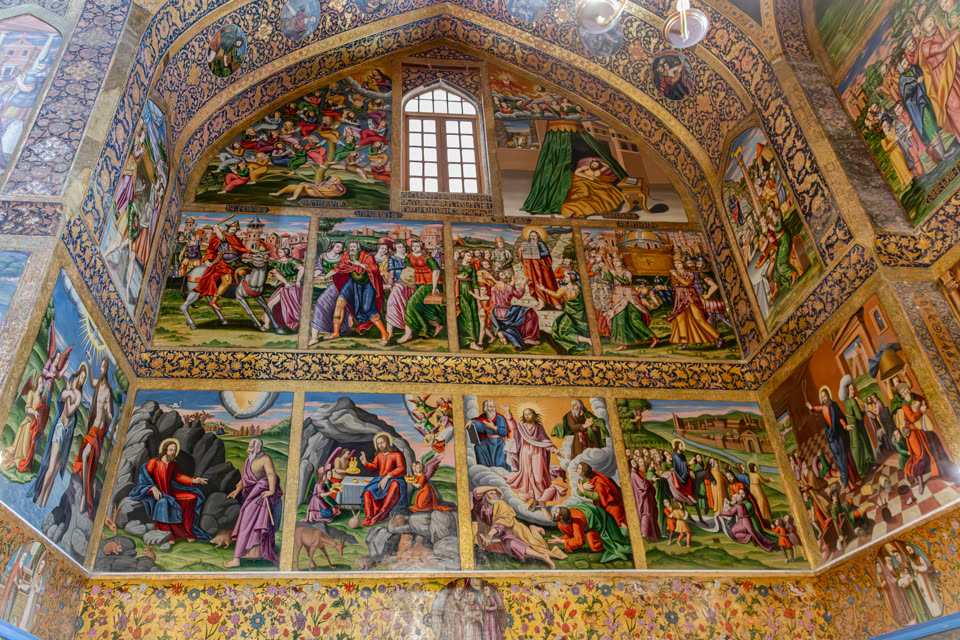
The painted interior of Vank Cathedral in Isfahan, looking up into a corner where two walls meet under a vault. Every surface is covered. At the top, framed in a broad band of gold arabesque on deep blue, are two large scenes either side of a tall window with a pointed Persian arch and white glazing bars: a crowd of naked and half-dressed figures tumbling down a hillside on the left, and on the right a man lying on a bed in a curtained room. Below them runs a register of five square panels with lines of Armenian script between them, showing a rider in red on a grey horse before a walled city, groups of robed figures meeting, a table of seated diners, and a funeral procession carrying a gold coffin. A second register beneath holds more scenes of Christ among crowds, among them a bearded figure in a cave and a hillside meal, each divided by gold pilasters. The gold frames are filled edge to edge with fine blue and red floral scrollwork of the kind used on Persian tilework, and at the bottom of the wall a dado of scattered flowers on a gold ground runs behind a small carved figure. Nothing in the frame is left plain.
Ninara · CC BY 2.0

Iran's constitution names its recognised religious minorities, and there are three. Article 13: «ایرانیان زرتشتی، کلیمی و مسیحی تنها اقلیتهای دینی شناخته می شوند که در حدود قانون در انجام مراسم دینی خود آزادند» — Zoroastrian, Jewish and Christian Iranians are the ONLY recognised religious minorities, free within the limits of the law to perform their own rites and to follow their own canon in personal status and religious education. The word doing the work is «تنها», only.

قانون اساسی جمهوری اسلامی ایران — اصل سیزدهم — Islamic Parliament Research Centre of Iran

Three of the 290 seats in Iran's parliament belong to Christians, and two of those three are Armenian. Article 64 of the constitution: «زرتشتیان و کلیمیان هر کدام یک نماینده و مسیحیان آشوری و کلدانی مجموعآ یک نماینده و مسیحیان ارمنی جنوب و شمال هر کدام یک نماینده انتخاب می کنند» — Zoroastrians and Jews elect one member each; Assyrian and Chaldean Christians elect one between them; and Armenian Christians of the south and of the north elect one each. One community, two constituencies, drawn as a line across the country.

قانون اساسی جمهوری اسلامی ایران — اصل شصت و چهارم — Islamic Parliament Research Centre of Iran

Iran's Christians are a very old community and a very small one. Estimates put them at «Around 300,000 to 370,000», and the 2016 census counted the recognised denominations — mainly Armenians and Assyro-Chaldeans — at «around 0.15 percent of the population». The Armenians of Isfahan have been there since Shah Abbas moved them from Jolfa on the Aras to the bank of the Zayandeh-Rud in 1014 AH, where they named their new quarter Jolfa after the old one.

Iran hosting Christmas celebrations for centuries — Tehran Times

Sources

Every claim carries its own citation. They are collected below, so you can see what the page rests on and how much of it comes from where.

  1. Blessed is the Revelation of Christ! — Armenian Prelacy (Eastern Prelacy of the Armenian Apostolic Church of America). Retrieved 2026-10-25.«It is customary to exchange greetings in Armenian, saying "Christ is born and revealed," («Քրիստոս ծնաւ եւ յայտնեցաւ») to which the other person responds, "Blessed is the revelation of Christ" («Օրհնեալ է յայտնութիւնն Քրիստոսի»).» The same page gives the Christmas Eve service its Armenian name: «the Candlelight Divine Liturgy, known in Armenian as Jrakalooyts or, in classical transliteration, Jragalooyts (Ճրագալոյց)».
  2. Christmas gains traction in Iran despite official disfavor — Iran International. Retrieved 2026-10-25. archived 21 September 2026One thing in it is simply wrong and is not repeated: it calls the Armenian 6 January date the tradition «of Eastern Orthodox Christians», which it is not — see the correction below.
  3. An Armenian Christmas Feast — IranWire. Retrieved 2026-10-25. archived 21 August 2025«"On their Christmas eve, Iranian Armenians often dine on rice, fish and vegetable kuku," writes the Iranian Armenian writer and documentary filmmaker Robert Safarian.»
  4. قانون اساسی جمهوری اسلامی ایران — اصل سیزدهم — Islamic Parliament Research Centre of Iran. Retrieved 2026-10-25. archived 30 August 2026
  5. Iran hosting Christmas celebrations for centuries — Tehran Times. Retrieved 2026-10-25. archived 4 February 2026«Like most Christians around the world, Assyrians in Iran celebrate December 25 as the birth anniversary of Jesus Christ.»
  6. A peek into Christmas celebration in Iran — Tehran Times. Retrieved 2026-10-25. archived 4 February 2026Herand Baghdasarian, an Iranian Armenian on the paper's own staff of twenty-one years, quoted directly: «Christians in Iran have their own peculiar Christmas festivities and rituals. On Christmas Day, which falls on January 6th, Christians celebrate Jesus Christ's birthday by feasting on a traditional chicken stew called 'harissa', or on a roast turkey.»
  7. پیام مسعود پزشکیان خطاب به پاپ و مسیحیان جهان به مناسبت سال نو میلادی — خبرآنلاین (Khabar Online), Tehran. Retrieved 2026-10-25.Reporting the Iranian president's message to the Pope and to Christians worldwide, congratulating «میلاد فرخنده حضرت عیسی بن مریم (ع)» and the start of the new Christian year.
  8. الزام به اعطای مرخصی به اقليت های دينی — وکلای دیوان, a Tehran practice before the Court of Administrative Justice. Retrieved 2026-10-25.Neither 25 December nor 6 January is on Iran's official calendar, and the mechanism that fills the gap is leave rather than a holiday: «کارگران اقلیت های دینی نیزهمانند سایرکارگران از تعطیلات رسمی کارگری بهره مند بوده و تعطیل خاصی برای آنها درمقررات پیش بینی نشده است» — minority workers get the same official holidays as everyone else and no special holiday is provided for them in the regulations — and for their own feasts they «می توانند از ایام مرخصی استحقاقی سالیانه خود استفاده نمایند», may draw on their annual paid leave, with employers obliged to assist.