Christmas Elsewhere

A country-by-country atlas of how Christmas is actually kept

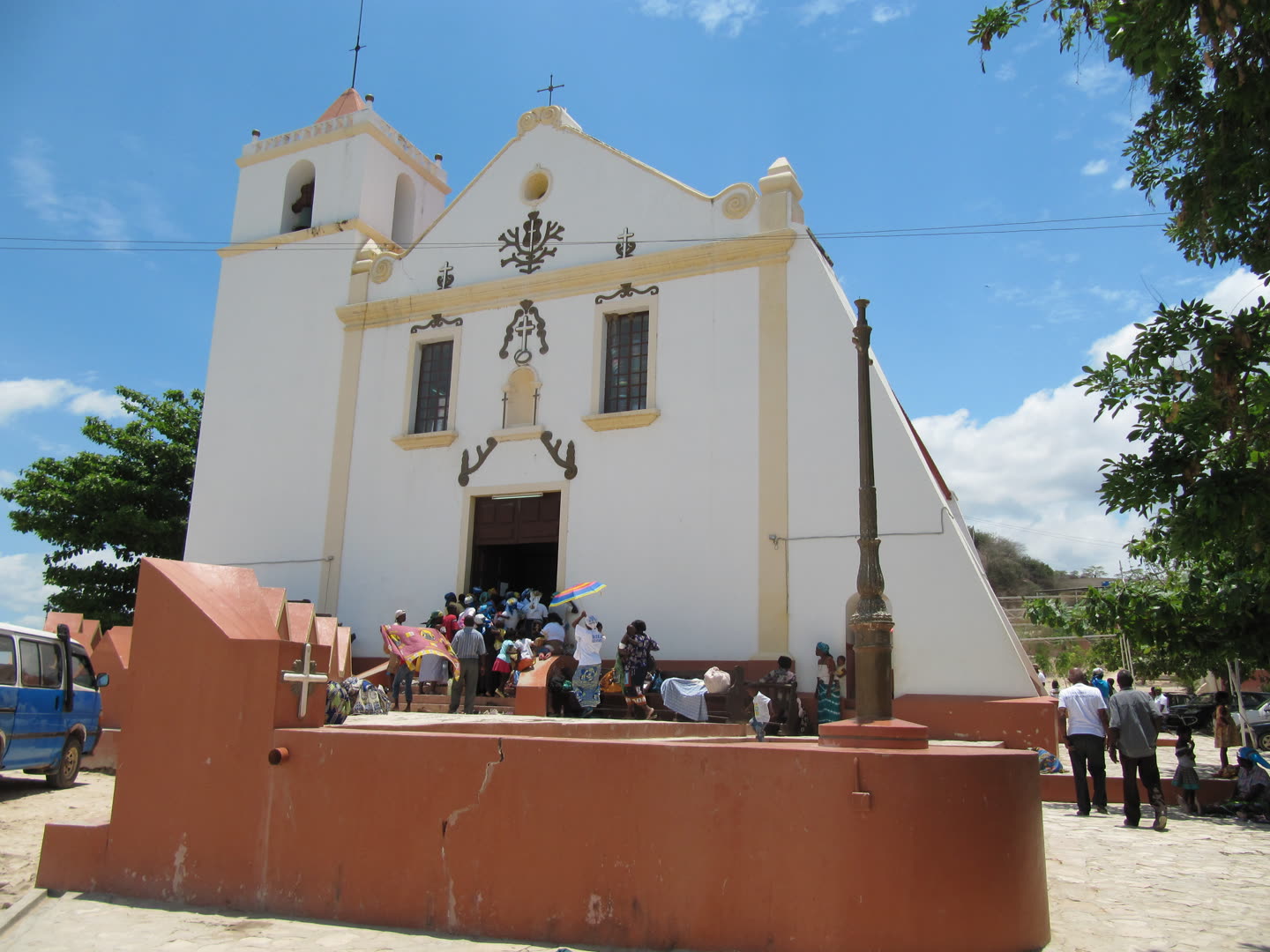
The church of Nossa Senhora da Conceição da Muxima under a hard blue sky with high white cloud. The front is whitewashed with ochre-yellow mouldings: a scrolled gable carrying a stone cross at its apex and an oval recess below it, with three wrought-iron crosses and curling iron scrollwork fixed flat to the plaster around two tall barred windows and the plain timber doorway. To the left stands a square bell tower with a red-tiled cap, its bell visible through one of two round-headed openings. Down the right flank a single enormous buttress slopes from the roofline almost to the ground. A crowd is pressed into the doorway and spilling down the steps, in bright printed cloth, with one person holding up a rainbow-striped umbrella. A red-painted terrace wall with a white cross set into it crosses the foreground, a blue minibus stands at the left edge, and a tall cast-iron lamp column rises in front of the buttress. Trees frame both sides.
Paulo César Santos · CC0

All countries · Africa

Christmas in Angola

Christmas falls on
25 DecemberGregorian calendar
A public holiday
YesLei n.º 10/11, de 16 de Fevereiro — Lei dos Feriados Nacionais e Locais e Datas de Celebração Nacional, artigo 2.º — Assembleia Nacional de Angola; published in the Diário da República, I Série n.º 31, 16 February 2011, p. 571
—days
—hrs
—min
—sec

Next: Friday 25 December 2026

When is Christmas in Angola?

Christmas Day in Angola is 25 December. It is a public holiday.

How to say it

  • Portuguese

    Feliz Natal

    say it: feh-LEESH nah-TAHL

    A synthesised voice — not a recording of a person — saying Feliz Natal in pt-PT.

    Portuguese, which is Angola's official language. The respelling is for an Angolan or European mouth rather than a Brazilian one: the final -s of «feliz» is said as a sh, and «Natal» keeps its l where Brazil closes it to a w.

    Um gesto solidário é o que João Lourenço pediu nesta Quadra-festiva — Rádio Ecclesia, the Catholic radio station in Luanda

How Christmas is kept

The Midnight Mass belongs to the cathedrals, and not to the whole country

Rádio Ecclesia calls it «a tradicional missa do galo» and reports it from the cathedral in one provincial capital after another: Lubango in 2014, Mbanza Kongo in 2019, Huambo in 2024. Away from them it is not kept. Writing from the diocese of Sumbe in December 2025, the Portuguese bishop Manuel Felício said of the communities around him «Eles não têm Missa do Galo» — they have no Midnight Mass — and listed it among the things that are simply absent there, beside the Christmas Eve supper and the street lights.

Natal celebrado em todo mundo católico — Rádio Ecclesia, the Catholic radio station in Luanda

Christmas Day is one Mass in the square, and it runs at least four hours

Where there is no Midnight Mass there is a single celebration on the day itself, held outdoors. Dom Manuel Felício, writing from the diocese of Sumbe in December 2025, expected thousands of people and a minimum of four hours, and gave the reason in a sentence: «As pessoas aqui não olham para o relógio quando estão a celebrar pontos essenciais» — people here do not look at the clock when they are celebrating something that matters. He set it against the European habit of running three or four short Masses through the day.

Angola: «Será um Natal diferente, mas talvez o essencial esteja mais presente» – D. Manuel Felício — Agência ECCLESIA, the Portuguese Catholic news agency, with Rádio Renascença; interview by Henrique Cunha and Octávio Carmo

The Christmas novena opens at half past five in the morning

Nine days of prayer run up to Christmas, and in the communities of the Sumbe diocese they begin before dawn. Dom Manuel Felício opened one at 5.30 a.m. on 21 December 2025 and found the church «bastante cheia» — quite full. He had just walked through the same town and found almost nothing of Christmas in the street.

Angola: «Será um Natal diferente, mas talvez o essencial esteja mais presente» – D. Manuel Felício — Agência ECCLESIA, the Portuguese Catholic news agency, with Rádio Renascença

In the villages the catechist runs Christmas and the priest comes the Sunday after

There are more villages than priests, so the Christmas celebration in an Angolan village is normally led by the catechist, and the children act out the birth. Frei Afonso Nteka, the Angolan head of the Capuchin custody, grew up in Quimazebo in the Damba municipality of Uíge province and remembers Christmas there as «beber uma gasosa, estar com o grupo de meninos e ir à igreja fazer teatros» — a fizzy drink, the other boys, and going to church to put on plays. The priest arrived the following Sunday to say the Mass, with singing, dancing and folklore in it.

Vida Consagrada: O Natal no interior de Angola e no nordeste Brasileiro — Agência ECCLESIA, the Portuguese Catholic news agency

The bishops say a Christmas Mass inside the prisons

Angolan dioceses hold a Christmas Mass in the provincial gaol, and Rádio Ecclesia describes the visit as one that «já se tornou tradicional». At Cacanda in Lunda Norte in December 2024 the bishop of Dundo said it and left donations for the prison community; at the Huíla prison on 23 December 2025 the archbishop of Lubango said the «missa do natal do recluso» with the provincial prison director and the inmates' families present, and stayed for lunch with the prisoners and the staff afterwards.

Dom Chindecassi leva mensagem de esperança a reclusos na cadeia de Cacanda — Rádio Ecclesia, the Catholic radio station in Luanda
What is eaten

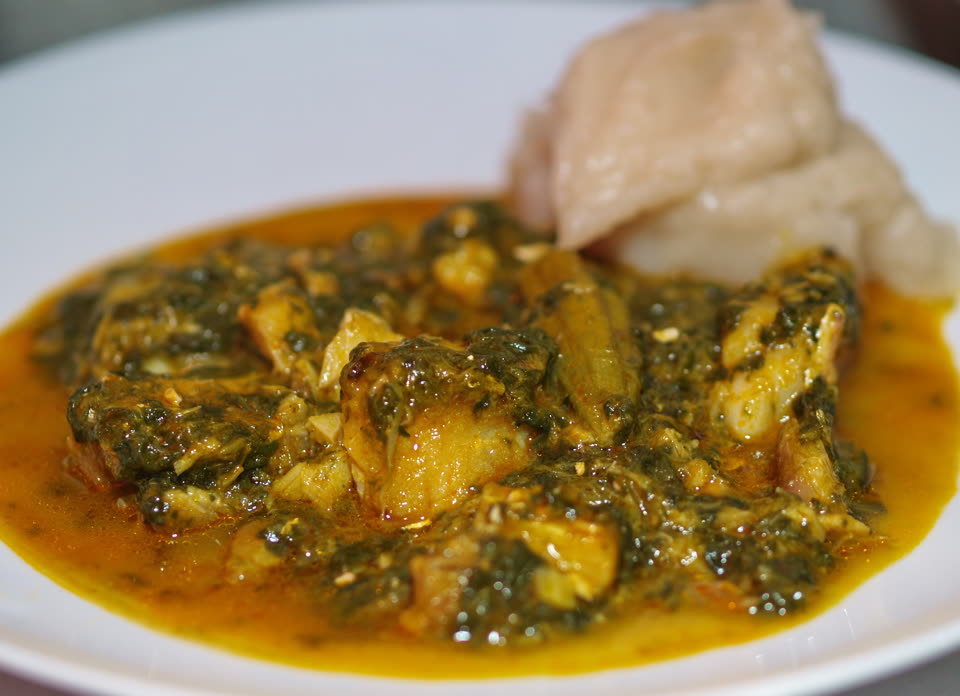
A white plate holding a mound of funge beside a serving of calulu, shot close and from low down. The funge is at the back right: a smooth, pale, slightly glossy heap of cooked flour paste, stiff enough to hold the shape it was spooned into. The rest of the plate is calulu — chunks of white fish and pale vegetable in a thick dark-green sauce of chopped leaves, sitting in a shallow pool of orange-gold palm oil that has separated out and run to the rim. The light is daylight and the depth of field is shallow, with the far edge of the plate soft.
elingunnur · CC BY 3.0

Funge

Funge is not a Christmas dish. It is what Angolans eat the rest of the year, and it is a stiff cooked paste of maize or cassava flour, and Portuguese Wikipedia calls it plainly the most popular dish in the country. It goes with meat or with fish, and with moamba.

Culinária de Angola — Wikipédia (Portuguese)

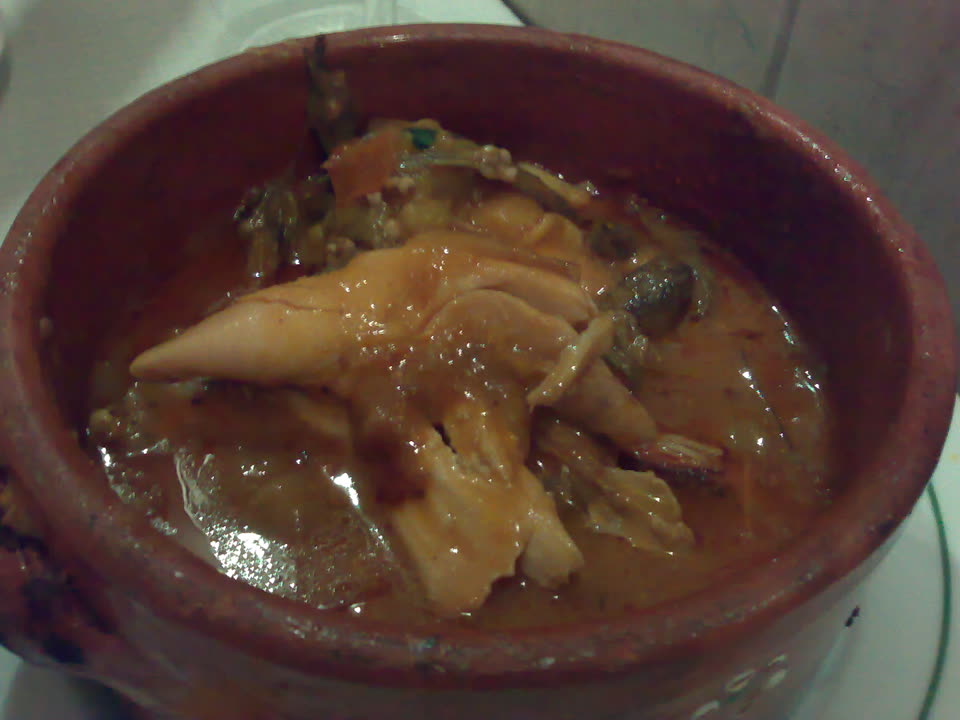
Chicken pieces in a thick orange palm-oil sauce filling a round red clay pot, photographed from above on a white tiled surface. The sauce catches the light, and tomato and a little greenery show at the back of the pot.
Adriao · CC BY 3.0

Moamba de galinha

Chicken cooked with palm oil or groundnuts, okra, onion, garlic and gindungo — the Angolan chilli — and served with funge or pirão. One of the country's best-known dishes.

Moamba de galinha — Wikipédia (Portuguese)

Worth knowing

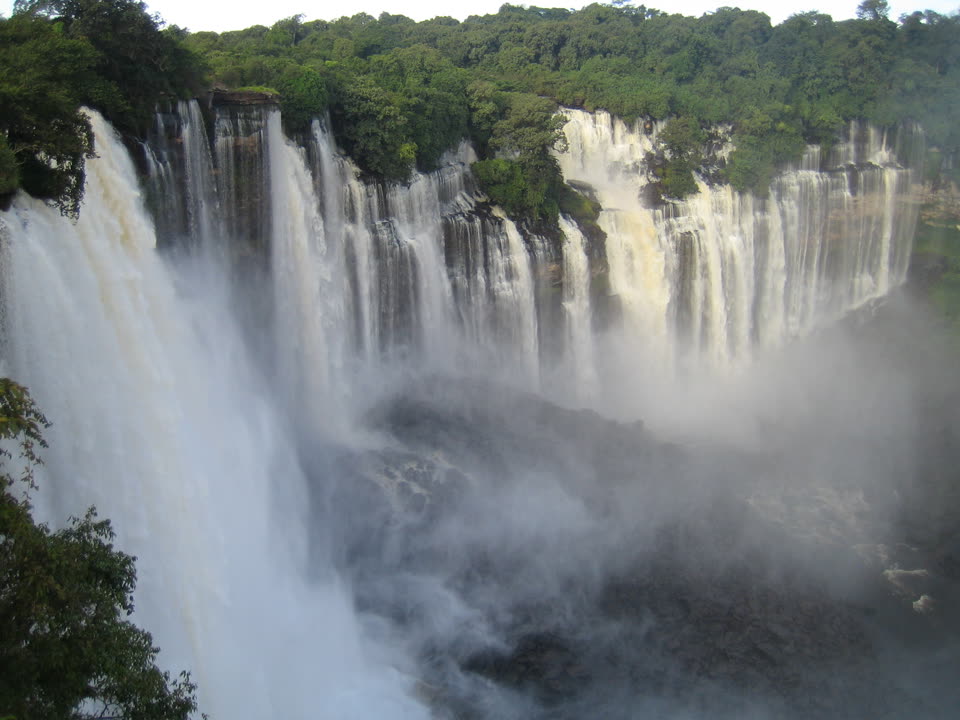
The Kalandula falls on the Lucala river in Malanje province, photographed from a viewpoint level with the lip. The river comes over a broad curving escarpment in a continuous horseshoe of white water, hundreds of separate threads dropping down a dark rock face that is stepped and buttressed and tufted with green where plants have taken hold. Thick forest runs along the whole top of the cliff and crowds the near edge of the frame. Spray rises off the plunge pool and blurs the whole lower right of the picture, with wet black boulders showing through it. The sky above the trees is white and overcast.
Paulo César Santos · CC0

An Angolan word is on the Brazilian Christmas table. Farofa — toasted cassava flour, which goes beside almost everything at a Brazilian Christmas supper — takes its name from the Kimbundu falofa. Kimbundu is spoken by about 3.7 million Angolans, mostly around Luanda, and it was the language of the old Kingdom of Ndongo. Portuguese Wikipedia says the borrowing happened twice over: during the Portuguese colonisation of Angola, and through Angolans who were enslaved and taken to Brazil.

How the word travelled is the encyclopaedia’s own account rather than an established one: the clause giving the two routes carries a citation-needed tag in the article itself.

Língua quimbundo — Wikipédia (Portuguese)

Angola's holiday law was rewritten because the war had ended. The preamble to the 2011 Lei dos Feriados does not begin with holidays. It begins: with the attainment of peace the country has entered a new era and is carrying out a broad programme of national reconciliation and of rebuilding the basic infrastructure that sustained development depends on — and it is therefore urgent to reconsider the legal discipline of holidays. Angola's civil war ran from 1975 to 2002. The calendar of days off is one of the things a country has to decide again afterwards.

Lei n.º 10/11, de 16 de Fevereiro — preâmbulo — Assembleia Nacional de Angola; Diário da República, I Série n.º 31, 16 February 2011

A bishop went looking for Christmas in an Angolan street and found one star. Walking through Gabela in the diocese of Sumbe on the morning of 21 December 2025, Dom Manuel Felício found «uma estrela de Natal, de resto mais nada» — one Christmas star and nothing else — and two advertisements for New Year's Eve. He had expected to spend the season «sem luzes na rua, sem pais Natal por aí a passear, sem reclames de comerciais»: no lights in the street, no Father Christmases walking about, no commercial advertising. The same morning he opened a dawn novena to a full church.

Angola: «Será um Natal diferente, mas talvez o essencial esteja mais presente» – D. Manuel Felício — Agência ECCLESIA, the Portuguese Catholic news agency, with Rádio Renascença

Sources

Every claim carries its own citation. They are collected below, so you can see what the page rests on and how much of it comes from where.

  1. Vida Consagrada: O Natal no interior de Angola e no nordeste Brasileiro — Agência ECCLESIA, the Portuguese Catholic news agency. Retrieved 2026-10-23.Frei Afonso Nteka is named as «custódio da angolana da Ordem dos Frades Menores Capuchinhos» and as «natural da aldeia de Quimazebo, Município da Damba e Província do Uíge». On who leads it: the celebration before Christmas Day «“normalmente” era orientada pelo catequista», and the children «teatralizavam “o nascimento do Menino Jesus”». On the priest: «No domingo seguinte, o sacerdote passava pela aldeia para “celebrar o Natal do Senhor”» in a celebration that included «cânticos, danças, um folclore». He is recalling his own childhood rather than the present, and says so: the Christmas of the villages then is «muito diferente do de hoje».
  2. Angola: «Será um Natal diferente, mas talvez o essencial esteja mais presente» – D. Manuel Felício — Agência ECCLESIA, the Portuguese Catholic news agency, with Rádio Renascença; interview by Henrique Cunha and Octávio Carmo. Retrieved 2026-10-23. archived 14 January 2026«Eles não têm Missa do Galo. Mas, repare, no dia de Natal, o que se prevê é que a celebração única na praça pública tenha milhares de pessoas e no mínimo quatro horas. As pessoas aqui não olham para o relógio quando estão a celebrar pontos essenciais.»
  3. Lei n.º 10/11, de 16 de Fevereiro — Lei dos Feriados Nacionais e Locais e Datas de Celebração Nacional, artigo 2.º — Assembleia Nacional de Angola; published in the Diário da República, I Série n.º 31, 16 February 2011, p. 571. Retrieved 2026-10-11. archived 17 June 2026And the preamble explains why the holiday calendar was being rewritten at all: «Com o alcance da paz o País começou uma nova era e está a implementar um amplo programa de reconciliação nacional e de reconstrução das infra-estruturas básicas de suporte ao desenvolvimento sustentado.»
  4. Um gesto solidário é o que João Lourenço pediu nesta Quadra-festiva — Rádio Ecclesia, the Catholic radio station in Luanda. Retrieved 2026-10-23. archived 15 July 2026An Angolan broadcaster, reporting the Angolan head of state on 25 December 2025: «O Presidente da República desejou, igualmente, a todos os angolanos Feliz Natal e um Novo Ano pleno de realizações e de satisfação dos sonhos e metas ainda não alcançados.»
  5. Natal celebrado em todo mundo católico — Rádio Ecclesia, the Catholic radio station in Luanda. Retrieved 2026-10-23.Of Dom Gabriel Mbilingi, then archbishop of Lubango and president of the Angolan bishops, the station writes that he «celebra a tradicional missa do galo na sé catedral», and again that he «esta noite celebra a missa do Galo junto dos seus fiéis na Sé Catedral do Lubango». The same station carries it from two more cathedrals: Mbanza Kongo in 2019, where «A celebração da vigília do natal na Sé C atedral de Mbanza Kongo» took place «com a participação da comunidade cristã e das autoridades locais»; and Huambo in 2024, where the archbishop preached «na noite da missa de Galo». The sentence on the other side is Dom Manuel Felício's, in an interview given from Angola on 21 December 2025: «Aqui não há consoada, aqui não há Missa do Galo, aqui não há luzes, não há pais Natais» and «Eles não têm Missa do Galo».
  6. Dom Chindecassi leva mensagem de esperança a reclusos na cadeia de Cacanda — Rádio Ecclesia, the Catholic radio station in Luanda. Retrieved 2026-10-23. archived 10 April 2026«A igreja católica celebrou o natal com reclusos na cadeia de Cacanda na Lunda Norte», and of the visit: «Essa visita que já se tornou tradicional». It ended with donations — «A Celebração Eucarística Natalícia terminou com a entrega de donativos à comunidade penitenciária». The second diocese is in the same station's report of 25 December 2025: the archbishop of Lubango presided on 23 December at «a missa do natal do recluso na Comarca dos Serviços Prisionais da Huíla», and «No final da missa teve um almoço de confraternização com os detentos, e os efectivos que nele trabalham».
  7. Culinária de Angola — Wikipédia (Portuguese). Retrieved 2026-10-11. archived 24 September 2026«O prato mais popular em Angola é o funge, uma massa cozida de farinha de milho ou de mandioca. Pode acompanhar carne ou peixe.»
  8. Moamba de galinha — Wikipédia (Portuguese). Retrieved 2026-10-11. archived 14 July 2026«Moamba de galinha (grafa-se também muamba) é um prato típico da culinária angolana. Constitui um dos pratos mais populares do país. A sua confecção envolve, para além da galinha, amendoim ou, óleo de palma, quiabos, gindungo, cebola, e alho… A moamba é servida com pirão ou funge.»
  9. Língua quimbundo — Wikipédia (Portuguese). Retrieved 2026-10-11. archived 10 October 2026«O português tem muitos empréstimos lexicais desta língua obtidos durante a colonização portuguesa do território angolano e através dos angolanos escravizados levados para o Brasil… É o idioma nativo de 3 728 001 de pessoas em Angola (2024), principalmente nas províncias de Bengo, Luanda, Ícolo e Bengo, Cuanza Norte, Cuanza Sul.» The clause about the two routes of borrowing carries a «[carece de fontes]» tag — citation needed — in the article itself. The etymology of farofa is separately given as «do quimbundo falofa» in pt:Farofa and is not tagged.