Christmas Elsewhere

A country-by-country atlas of how Christmas is actually kept

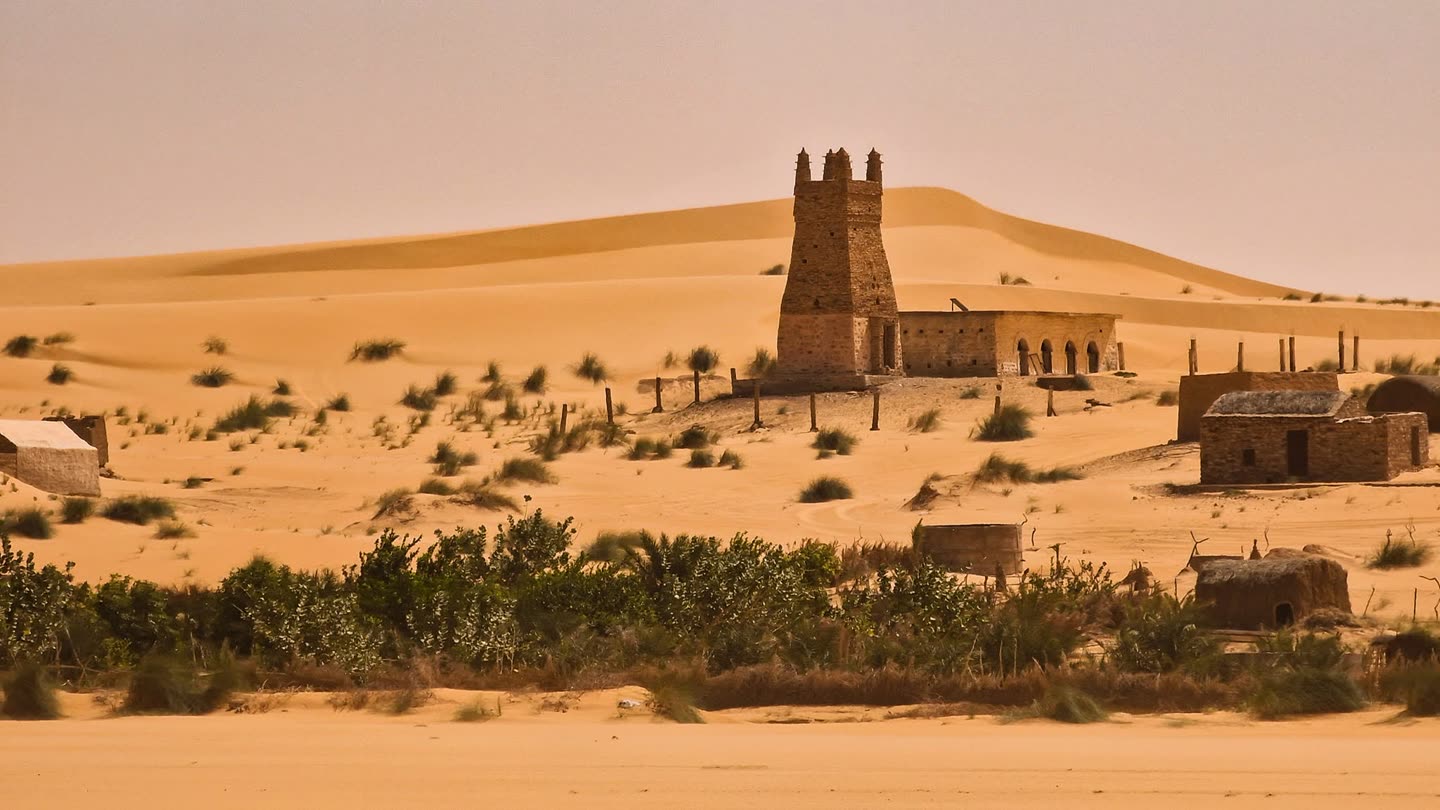
A square dry-stone minaret standing at the edge of the desert with a dune rising directly behind it. The tower tapers slightly as it goes up and is topped by five short pointed finials along its parapet; its stonework is unplastered and the same sand colour as the ground. Attached to its right is a low mosque wall with a row of five round-arched openings, and beyond that, scattered across the sand, are flat-roofed stone houses, one or two with pale rendered walls and one with a corrugated roof. Wooden fence posts stand in a broken line across the middle of the frame, a dark hedge of scrub runs along the bottom, and tufts of desert grass dot the sand. The light is flat and the whole picture is the colour of sand, with a thin band of hazy sky above the dune.
Gino Pop / Endemik Expeditions · Used by permission

All countries · Western Africa

Christmas in Mauritania

Christmas falls on
25 DecemberGregorian calendar
How it is kept
Observance is restricted
A public holiday
NoLoi n° 2004-017 portant Code du travail, Article 176 : Détermination par la loi — Principes — République Islamique de Mauritanie, published by the Ministère des Finances
—days
—hrs
—min
—sec

Next: Friday 25 December 2026

When is Christmas in Mauritania?

Christmas Day in Mauritania is 25 December.

Is Christmas a public holiday in Mauritania?

No. 25 December is an ordinary working day in Mauritania. Observance of it is restricted. Loi n° 2004-017 portant Code du travail, Article 176 : Détermination par la loi — Principes — République Islamique de Mauritanie, published by the Ministère des Finances

How Christmas is kept

The one public Christmas in the country is a craft market, and it is twenty-five years old

From the start of December the Institut Français de Mauritanie in Nouakchott holds a marché de Noël, open until 24 December — «un rituel de plus de 25 ans», as Le360 Afrique put it in 2025. What is sold is Mauritanian: cushions, beads, woven mats and camel gear, from co-operatives with, in the words of the initiative's president Tfeila Seyid, «une forte présence des femmes». In a country where public expression of any religion but Islam is banned, the Christmas that happens in public is a French cultural institute selling Mauritanian handicraft, run by Mauritanian women, to anyone who comes.

Nouakchott. «C’est le pire de toutes ces années»: au marché de Noël, les guirlandes s’éteignent avant la fête — Le360 Afrique, by Amadou Seck, Nouakchott correspondent, 16 December 2025
The services are legal, and a Mauritanian may not attend one

There are Roman Catholic and other Christian churches in five towns — Nouakchott, Kaédi, Atar, Nouadhibou and Rosso — and authorised churches «were able to conduct services within their premises but could not proselytize». The limit is on who may be in the room: «Non-Islamic religious services remained open only to foreigners, and citizens could not attend.» The State Department records that requirement as an unofficial one rather than a written rule, which makes it no less effective. Christmas Mass in Mauritania is therefore a service for foreign residents by law as well as by demography.

2023 Report on International Religious Freedom: Mauritania — United States Department of State

A Christmas gathering in a private house needs the Interior Ministry's permission in advance

The law «requires the MOI to authorize in advance all group meetings, including non-Islamic religious gatherings and those held in private homes». In practice the churches report tolerance rather than enforcement: non-Muslim religious leaders said the government «typically did not prevent such groups from holding religious gatherings as long as they were held “discretely” and in private spaces». So the rule and the practice differ: a family Christmas is a group meeting requiring prior authorisation, and a quiet one is left alone.

2023 Report on International Religious Freedom: Mauritania — United States Department of State

The wafers and the communion wine have to clear customs

Among the practical frictions the religious-freedom report lists, this is the one that lands on the liturgy itself: «Established churches sometimes faced difficulties importing religious materials for use during church services (i.e., Bibles, religious education books, and wafers and wine for communion).» Mauritania is a country where alcohol is prohibited, and the Mass needs wine.

2023 Report on International Religious Freedom: Mauritania — United States Department of State

What people get wrong

Widely repeated claims about Christmas in Mauritania that do not survive checking. Each one says what is actually the case, because a correction with nothing in its place leaves you worse off than before.

Oversimplified

Mauritania bans Christmas.

What is actually the case. What is banned is PUBLIC EXPRESSION of any religion other than Islam, and the effect on Christmas is severe without being a ban on it. Authorised churches hold their services legally inside their own premises; the restriction is that those services are open only to foreigners and that Mauritanian citizens may not attend, which the State Department describes as an unofficial requirement rather than a written rule. A gathering in a private home legally needs the Interior Ministry's prior authorisation, and church leaders say a discreet one is tolerated in practice. Meanwhile a marché de Noël has run publicly at the Institut Français de Mauritanie in Nouakchott every December for more than twenty-five years. The strongest statement available for the «ban» reading is attributed and not asserted: a local NGO told the State Department that authorities «had banned some religious practices, including the celebration of Christmas and other non-Islamic holidays». That is one organisation's account, carried in a report that elsewhere records legal services and a public market. So: not banned, not free, and the line runs between who may attend rather than between whether it happens.

2023 Report on International Religious Freedom: Mauritania — United States Department of State

Nouakchott. «C’est le pire de toutes ces années»: au marché de Noël, les guirlandes s’éteignent avant la fête — Le360 Afrique, by Amadou Seck, Nouakchott correspondent, 16 December 2025

Worth knowing

Mauritanian government estimates put Sunni Muslims at approximately 99 per cent of a population of about 4.2 million. Unofficial estimates give Sunnis 98 per cent, Shia 1 per cent, and non-Muslims — «mostly Christians and a small group of Jews» — the remaining 1 per cent. The sentence that decides what Christmas can be there follows: «Almost all non-Muslims are noncitizen residents.» Le360 Afrique's Nouakchott correspondent counted about 5,000 Christians in December 2025, almost all of them foreign.

2023 Report on International Religious Freedom: Mauritania — United States Department of State

Nouakchott. «C’est le pire de toutes ces années»: au marché de Noël, les guirlandes s’éteignent avant la fête — Le360 Afrique, by Amadou Seck, Nouakchott correspondent, 16 December 2025

Non-Muslim religious groups may apply to register through both the Interior Ministry and the Ministry of Islamic Affairs and Traditional Education — and «there were no such groups registered as of year's end». Some Christian groups, particularly from the local Protestant community, could not obtain authorisation; for want of it, some churches could not open a bank account in their own name. Proselytising by non-Muslim groups is prohibited.

2023 Report on International Religious Freedom: Mauritania — United States Department of State

The criminal code mandates death for any Muslim convicted of apostasy or blasphemy, and «the government has never applied capital punishment for apostasy or blasphemy». The context this sets for a Christian minority is not abstract: a Christian NGO reported that converts from Islam «faced extreme societal and family pressure», and in July 2023 a nineteen-year-old student was arrested over answers written in a baccalaureate exam, with religious groups publicly pressing for the death penalty.

2023 Report on International Religious Freedom: Mauritania — United States Department of State

The Catholic Church in Mauritania is a single jurisdiction, the Diocese of Nouakchott, with Saint-Joseph as its cathedral church — «une Église Saint-Joseph structurée autour du diocèse de Nouakchott», in Le360's description. The churches are in Nouakchott, Kaédi, Atar, Nouadhibou and Rosso: a capital, two river towns, the mining and fishing port of the north, and the oasis town of Atar.

Nouakchott. «C’est le pire de toutes ces années»: au marché de Noël, les guirlandes s’éteignent avant la fête — Le360 Afrique, by Amadou Seck, Nouakchott correspondent, 16 December 2025

2023 Report on International Religious Freedom: Mauritania — United States Department of State

The list of goods at the Nouakchott marché de Noël is worth reading as it stands: «Les objets exposés sont des coussins, des perles, des nattes, des outils liés à l'usage du chameau.» Nothing on that list is Christmas and the whole of it is Mauritania. The 2025 edition was the quietest in twenty-five years — Leila Sy, who has exhibited since the start: «Celle de 2025 est pire de toutes les éditions précédentes.»

Nouakchott. «C’est le pire de toutes ces années»: au marché de Noël, les guirlandes s’éteignent avant la fête — Le360 Afrique, by Amadou Seck, Nouakchott correspondent, 16 December 2025

Sources

Every claim carries its own citation. They are collected below, so you can see what the page rests on and how much of it comes from where.

  1. Nouakchott. «C’est le pire de toutes ces années»: au marché de Noël, les guirlandes s’éteignent avant la fête — Le360 Afrique, by Amadou Seck, Nouakchott correspondent, 16 December 2025. Retrieved 2026-11-23.The frame: «Sacrifiant à un rituel de plus de 25 ans, l’Institut Français de Mauritanie abrite depuis le début de décembre, un marché de Noël de moins en moins fréquenté», and «Pays à 100% musulman, la Mauritanie compte quelque 5.000 chrétiens presque exclusivement étrangers, avec une Église Saint-Joseph structurée autour du diocèse de Nouakchott.» What is on the stalls, from Tfeila Seyid, president of the Marché de Noël initiative: «Il y a différentes coopératives qui participent à cette exposition, avec une forte présence des femmes. Les objets exposés sont des coussins, des perles, des nattes, des outils liés à l’usage du chameau.» Leila Sy, an exhibitor of twenty-five years: «je participe à cette exposition depuis 25 ans... Celle de 2025 est pire de toutes les éditions précédentes.»
  2. Loi n° 2004-017 portant Code du travail, Article 176 : Détermination par la loi — Principes — République Islamique de Mauritanie, published by the Ministère des Finances. Retrieved 2026-11-23.Article 176 sets the regime and names no day: «Les jours fériés chômés ainsi que ceux qui sont chômés et payés sont déterminés par la loi.»
  3. 2023 Report on International Religious Freedom: Mauritania — United States Department of State. Retrieved 2026-11-23.«The constitution defines the country as an Islamic republic and recognizes Islam as the sole religion of its citizenry and the state.» On numbers: «According to Mauritanian government estimates, Sunni Muslims constitute approximately 99 percent of the population», unofficial estimates give non-Muslims «a further 1 percent», and «Almost all non-Muslims are noncitizen residents.» On worship: «The government continued to ban any public expression of religion except that of Islam. Authorized churches were able to conduct services within their premises but could not proselytize... There were Roman Catholic and other Christian churches in Nouakchott, Kaedi, Atar, Nouadhibou, and Rosso. Non-Islamic religious services remained open only to foreigners, and citizens could not attend.» On meetings: «The law requires the MOI to authorize in advance all group meetings, including non-Islamic religious gatherings and those held in private homes», while «Non-Muslim religious leaders, however, stated the government typically did not prevent such groups from holding religious gatherings as long as they were held “discretely” and in private spaces.» On supplies: «Established churches sometimes faced difficulties importing religious materials for use during church services (i.e., Bibles, religious education books, and wafers and wine for communion).» And, attributed to a local NGO and not asserted by the report: the NGO «said authorities had banned some religious practices, including the celebration of Christmas and other non-Islamic holidays».