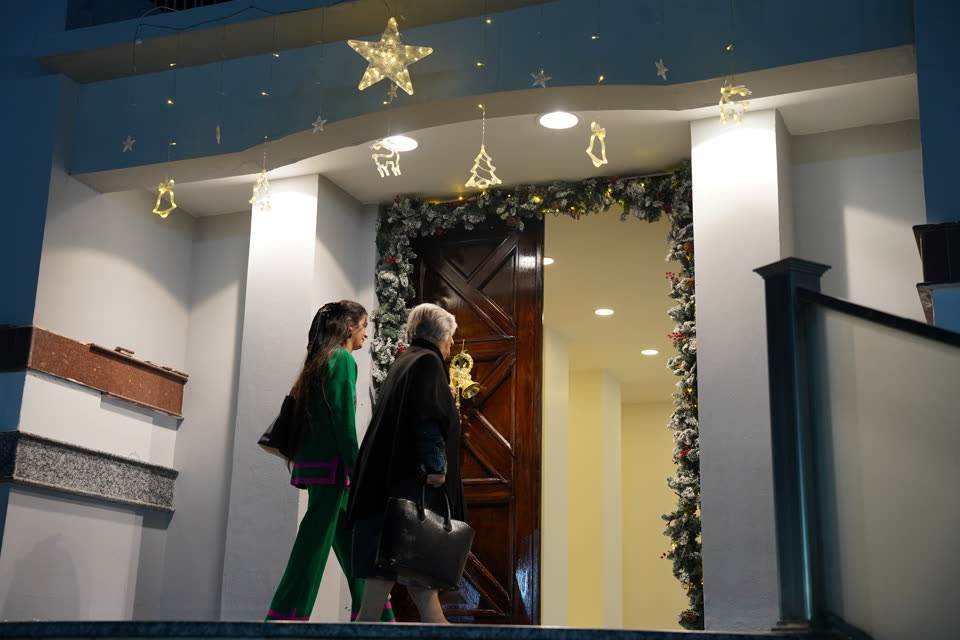
Christmas Day in Iraq is 25 December. It is a public holiday.
How to say it
Arabic
أعياد الميلاد المجيد
aʿyād al-mīlād al-majīd
say it: ah-YAAD al-mee-LAAD al-ma-JEED
A synthesised voice — not a recording of a person — saying أعياد الميلاد المجيد
in ar-IQ.
The glorious Nativity feasts — the phrase Iraqi officials and Iraqi papers use for the season, and the one the Prime Minister used to greet Christians by name.
Arabic is the language the greeting is exchanged in, and it is not the language most of the people exchanging it pray in. The liturgy of the Chaldean and Assyrian churches, which between them account for about seven Iraqi Christians in eight, is in Syriac.
Father Christmas, in Arabic, and the Iraqi version of him arrives without the furniture. Children were not given wrapped toys: the present was a new outfit, and in better-off houses money to spend on chocolate and ice cream.
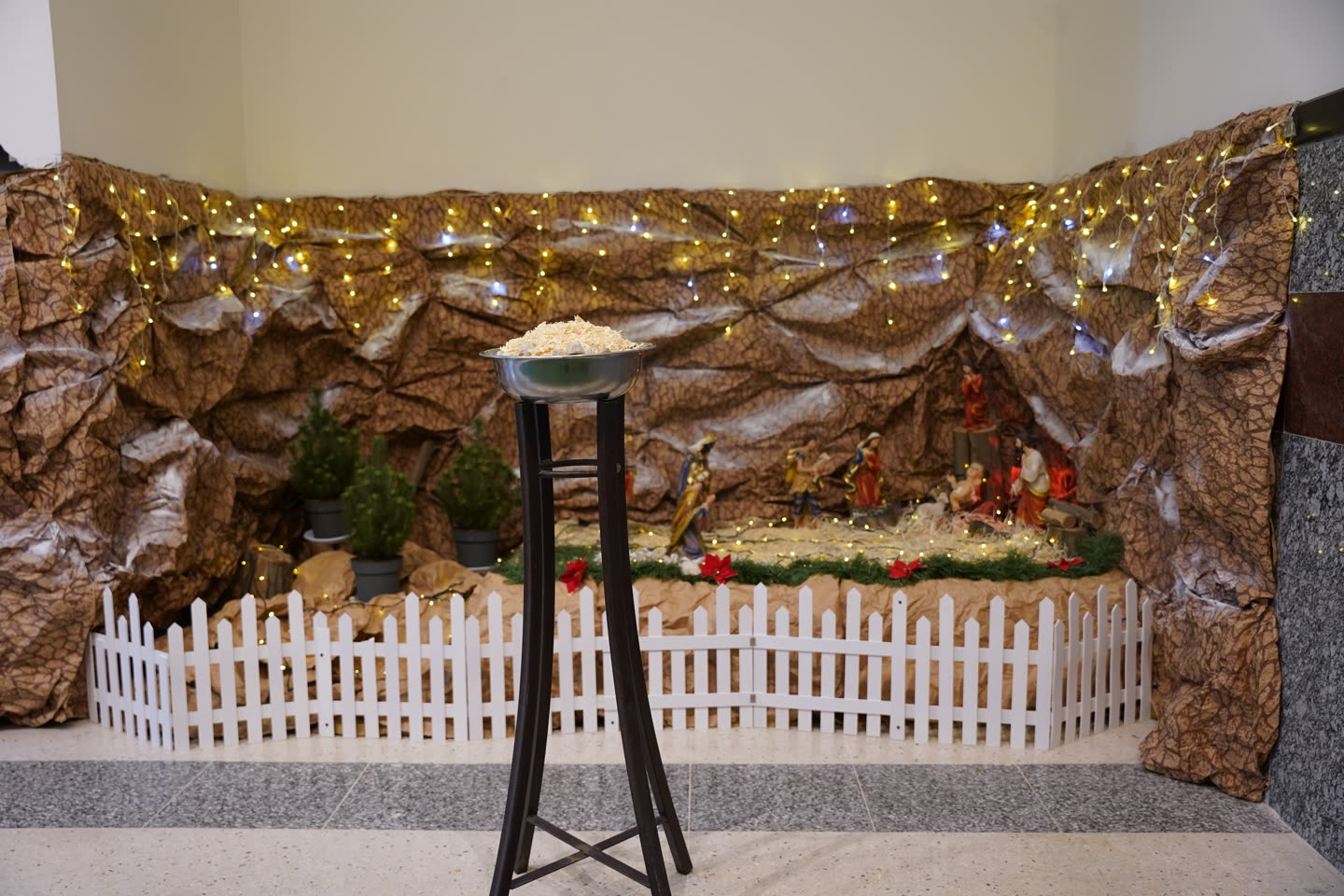
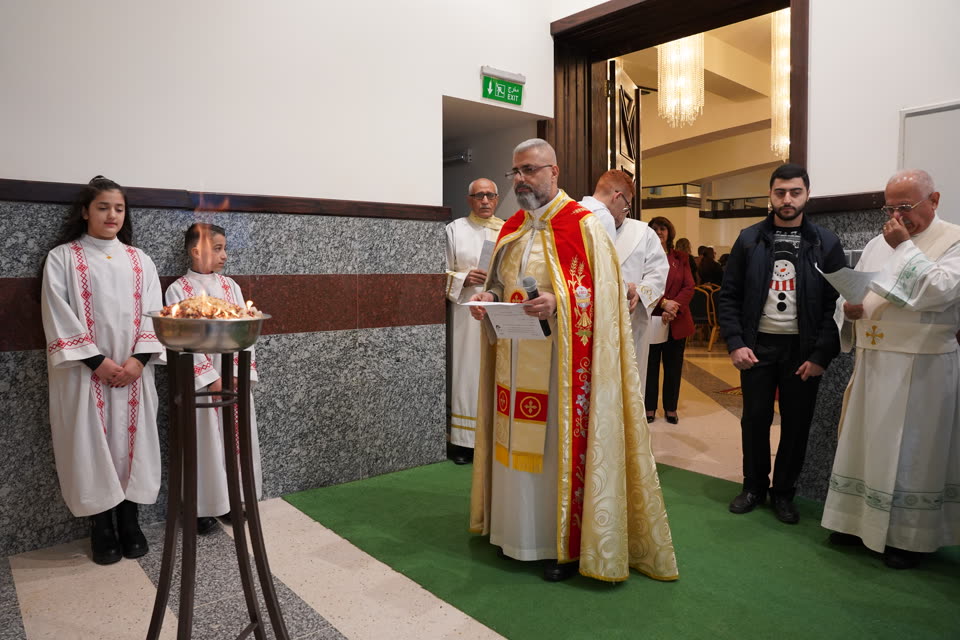
A bonfire is lit on Christmas Eve, and how it burns is read
The Iraqi Christmas Eve has a fire in it. In the Nineveh Plains towns it is lit in the church courtyard; in houses it was lit in a corner of the yard, and it came with a reading and a reckoning.
The Chaldean News describes the house version: «On that special night, Iraqi Christian families would gather and, following tradition, one of the children in the family would read the Nativity story from the Arabic Bible while other family members held lighted candles. Once the story is over, a bonfire made of dried thorns would be lit in one corner of the house.»
Then the fire is read. «According to the Iraqi people, they can predict the future of their household in the coming year by just watching the way the fire burns in the bonfire. For them, if the dried thorns burn to ashes, the family will be blessed with good fortune.» A psalm is sung while it burns, and when the thorns are ash the family leap over it three times and make a wish.
The church version was photographed in 2017, when the Nineveh towns kept their first Christmas after Islamic State. In Teleskof the town «will mark Christmas Eve with large bonfires and evening mass at church», and in Qaraqosh the priest «later lit the traditional bonfire in the church's courtyard, a symbol of renewal he said».
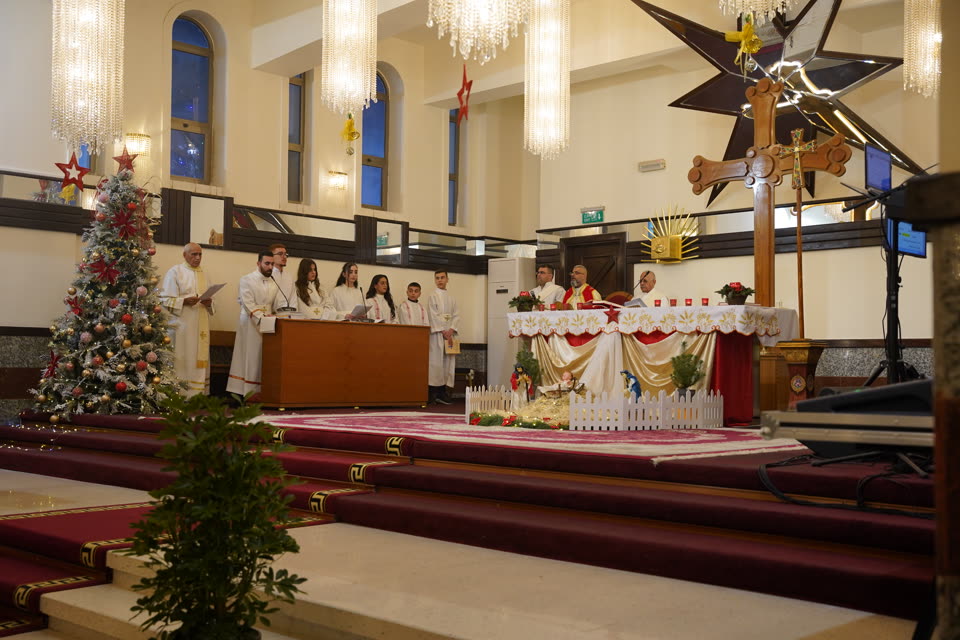
Midnight Mass in Qaraqosh was said among burned walls
Qaraqosh — Baghdeda to the people who live there — was held by Islamic State from 2014 until October 2016, and its churches were burned. At Christmas 2017 the returnees held the midnight Mass in one of them anyway.
The Guardian, from the Syriac Catholic Church of the Immaculate: «congregants gathered for midnight mass on Sunday surrounded by scorched and blackened walls, still tagged with Isis graffiti. They also sat on donated plastic chairs - the church has not yet been able to replace the wooden pews the militants used to fuel the massive fire which engulfed the church.»
The congregation came «dressed in their finest», and the priest, Father Salar Bodagh, lit the courtyard bonfire afterwards.
Children go out in new clothes, and the day is spent visiting
Christmas Day in an Iraqi Christian town is a street and a sequence of houses. In Teleskof in 2017: «If the weather is fine on Christmas day, families will gather outside after attending church. Boys and girls will parade in the streets in their new clothes. The women will prepare feasts of traditional sausages, rice-stuffed vegetables, cakes, sweets and coffee.»
The visiting has an order to it. The Chaldean News describes families beginning with the grandfather's house and working outwards, with somebody staying behind in each house to receive callers, and every household visited handing over a gift — usually a box of chocolate or a bottle. Visitors were given vermouth with winter citrus jam.
The Touch of Peace is passed from the bishop, hand to hand
In the villages and towns the Christmas Day service had a procession in it, and at the end of the procession a gesture that moves through the whole church.
The Chaldean News: «In the villages and towns, a bonfire was lit inside the main church, followed by a procession. Church officials would march along with the bishop, who would be carrying a figure of the infant Jesus Christ, which was placed on a red cushion. After the procession, the bishop touched the hand of one person and the touch was passed on to all those present in the ceremony. This custom is known as the "Touch of Peace."»
One touch, passed along until everybody in the building has had it.
The Prime Minister goes to Mass, and the church he chooses is the point
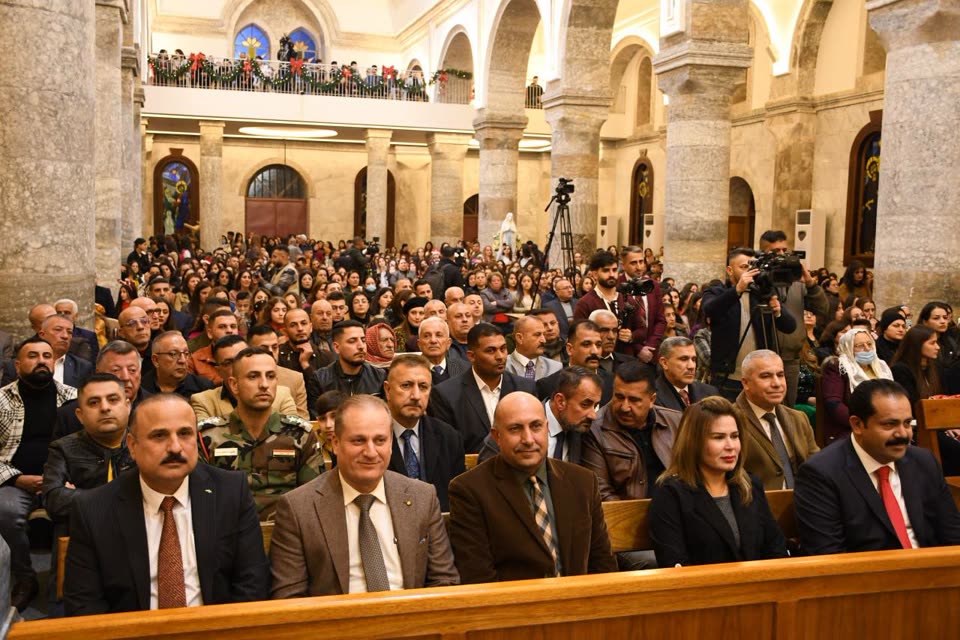
Iraqi heads of government attend a Christmas Mass, and in 2022 Mohammed Shia al-Sudani attended two: Mar Yousif in Baghdad, where he greeted Cardinal Louis Raphael Sako, and then Sayyidat al-Najat — Our Lady of Salvation.
He said why. «حرصتُ اليوم وفي ليلة عيد الميلاد، وتعمّدت أن أكون بينكم هنا في كنيسة سيدة النجاة؛ التي غدت أيقونة من أيقونات حربنا ضد التكفير والتطرّف والارهاب» — I was careful tonight, on Christmas Eve, and I deliberately came to be among you here at the Church of Our Lady of Salvation, which has become one of the icons of our war against takfirism, extremism and terrorism.
That church was stormed in 2010. He put the attack on it in a line with Speicher, Tal Afar, the Yazidis and Mosul, and said the Christmas Mass being held in it at all was «علامة واضحة على أننا قد انتصرنا» — a clear sign that we have won.
The Kurdistan Region closes for Christmas on its own authority, and closes more
Erbil, Duhok and Sulaymaniyah are governed from Erbil, and the Kurdistan Regional Government declares its own holidays. Its Christmas is longer than Baghdad's and it reaches further.
For 2024 the KRG announced «an official 11-day holiday to mark Christmas and the New Year», running from 25 December to 2 January «in all institutions». For 2025 it suspended work on 25 December and said the day «applies to both the public and private sectors», with 1 January also on the region's own holiday calendar.
The federal decision each year covers government departments. The regional one does not stop there.
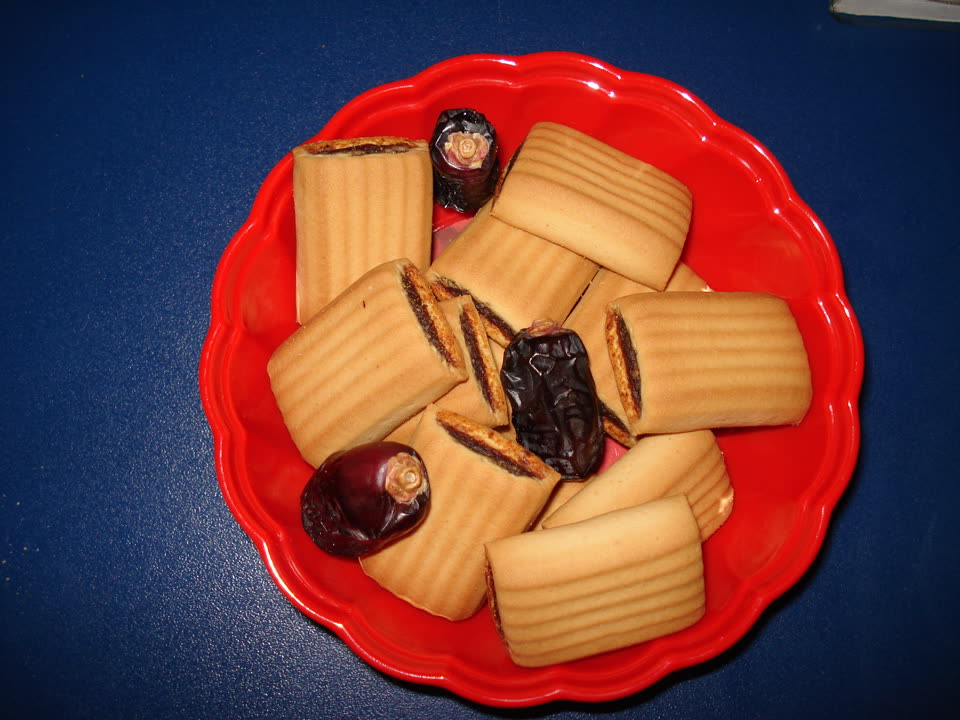
The date-filled cookie that is the season in Iraq, and not only for Christians: the Chaldean News calls it «the queen of the season, a staple in many households» and says it is «loved by all Iraqi groups, including Muslims, Christians, Chaldeans, Assyrians, and Kurds».
It is flour, sugar, butter, cardamom, cinnamon and nutmeg, rolled out, filled with dates — the Khastawi kind — or crushed walnut and sugar or coconut, folded into half-moons, rounds or rectangles, and scattered with sesame.
And it was a procession. Iraqi kitchens had gas burners and no oven, so the women carried the trays to the neighbourhood bakery, «sometimes balance[d] on their heads», waited half an hour or came back for them. Now they are mostly bought ready-made.
If the cookie is the queen, the Chaldean News gives the Christmas table a king: «pacha (stuffed tripe) is the king of the Christmas table. For Chaldeans, Christmas dinner isn't complete without pacha.»
It is the whole animal. Head, feet, tongue and the rest of a sheep or a cow, simmered for hours, with the cleaned stomach stuffed with rice. A worker for an aid organisation in Iraq described it to Christian Today in 2017 in those words — «We cook the head, legs, tongue and other leftovers of a cow or sheep and we put that together with rice in a stomach that we've cleaned. We will eat this at Christmas.»
It is not a Christmas dish by origin. It is an Iraqi dish, eaten by everybody, that Christians put at the centre of Christmas.
Widely repeated claims about Christmas in Iraq that do not survive
checking. Each one says what is actually the case, because a correction
with nothing in its place leaves you worse off than before.
Oversimplified
Iraq made Christmas a national holiday in 2024.
What is actually the case. The year moves about because Iraq has declared Christmas a holiday four separate times, and only one of those made it permanent.
2008: a one-off. It was not renewed, and for years afterwards only Kirkuk province kept it. 2018: the Council of Ministers recommended to parliament that the holidays law be amended to add 25 December — a recommendation, not an amendment, and parliament did not act on it that year. December 2020: parliament voted unanimously to implement that amendment, and from that year Christmas was an annual national holiday — which is the date that matters.
What happens now is the part that keeps producing new headlines. The Council of Ministers still votes each December to suspend work in government departments on 25 December: it did so in 2024 and again in 2025. The Kurdistan Region declares its own, longer, and in 2025 extended it to the private sector as well.
And the statute that governs it now is newer than any of those years. The Official Holidays Law of 2024 replaced the 1972 one, and it does not put Christmas among the general public holidays in Article 1. It puts it in Article 2, among the special holidays, under a heading for Christians. Article 3 lets the Council of Ministers declare temporary holidays of up to seven days a year, and that is the power the December vote uses — which is why there is still a vote.
Iraq declared Christmas a holiday in 2008 and then did not renew it. For years afterwards the only place in the country where it was kept as a day off was the province of Kirkuk.
In 2018 the Council of Ministers recommended to parliament that the holidays law be amended to add 25 December — in the Vatican’s account, raising Christmas «to the rank of a public celebration for all citizens, Christians and Muslims». It was a recommendation and parliament let it sit.
The thing that finished it was a conversation. On 17 October 2020 the Chaldean Patriarch, Cardinal Louis Raphael Sako, asked President Barham Salih at the presidential residence to put a bill before parliament. Parliament voted on it in December 2020 and the vote was unanimous — and three months later Pope Francis landed in Baghdad for the first papal visit Iraq has ever had.
The United States Department of State's religious freedom report for 2023 puts it in one sentence: «According to Christian leaders as well as NGO and media reports, fewer than 150,000 Christians remain in the country, down from a pre-2003 estimate of approximately 1.5 million.»
There is no census behind either number. Iraq has not asked a religion question in a published national count for decades, and both figures come from church leaders and from NGOs.
What the same report can say about who is left: «Approximately 67 percent of Christians are Chaldean Catholics (an eastern rite of the Roman Catholic Church), and nearly 20 percent are members of the Assyrian Church of the East.» The Armenian community's own leaders report about 12,000 people.
On 3 July 2023 President Abdul Latif Rashid revoked the 2013 presidential decree that recognised Cardinal Louis Raphael Sako as Patriarch of the Chaldean Catholic Church in Iraq.
Sako called the move «unprecedented» and «unfair», and said the President was targeting him and that the decision was part of an effort to gain control of church assets.
On 18 December the Chaldean Patriarchate announced that it would cancel Christmas activities, in part in protest at the withdrawal. The same church had asked for the national holiday three years earlier.
Every claim carries its own citation. They are collected below, so you
can see what the page rests on and how much of it comes from where.
Iraq declares Christmas Day public holiday nationwide — 964media (English), 23 December 2025. Retrieved 2026-10-31.For the 2025 Kurdistan decision: «The KRG said the holiday applies to both the public and private sectors and noted that New Year's Day on Jan. 1 is also listed on the region's official holiday calendar.»It is headed «nationwide», and the Cabinet statement it quotes covers «government departments» — which is the distinction the card above keeps.
Christmas in Iraq: Recalling Holiday Traditions — Adhid Miri, PhD, Chaldean News, 1 December 2023. Retrieved 2026-10-31. archived 12 November 2024On the figure: «There is neither snow in Iraq during Christmas nor chimneys to climb down, so Baba Noel (Santa Claus) was rumored to come in with his 4-wheel modified sleigh pulled by his trusted reindeer.» On what children actually got: «Iraqi parents did not buy traditional Christmas gifts presents for their children, as that custom was not common. Instead, the children received a new outfit.»
ASIA/IRAQ — Parliament recognizes Christmas as a public holiday throughout the country — Agenzia Fides, Vatican news agency, 17 December 2020. Retrieved 2026-10-31. archived 25 January 2025Independently, on the same vote and the same meeting: «A bill to have Christmas Day officially recognized as a public holiday throughout Iraq was the concrete request that the Babylonian Patriarch of the Chaldeans Cardinal Louis Raphael Sako, presented to Iraqi President Barham Salih, who received the Patriarch at the Head of State's residence on Saturday 17 October.»
Iraqi Christians prepare for first Christmas back home in Qaraqosh — Christian Today, December 2017. Retrieved 2026-10-31.The director of a partner organisation in Iraq, speaking under a pseudonym: «We have special food. Most traditional is "pacha". We cook the head, legs, tongue and other leftovers of a cow or sheep and we put that together with rice in a stomach that we've cleaned. We will eat this at Christmas. I think about 80 per cent of the Christians will eat that.»The same interview has the houses «decorated» even during displacement, and Iraqi Christmas songs sung beside translations of Jingle Bells and Silent Night.
Official Holidays Law No. 12 of 2024, Articles 1 to 3 — General Secretariat of the Council of Ministers of Iraq. Retrieved 2026-11-03. archived 5 November 2026It is in Article 2, the special official holidays, under the heading «للمسيحيين» — for Christians — as «ميلاد السيد المسيح», the Nativity of Christ, beside the Sabean and Yazidi feasts under their own headings.Article 3 is what the December vote runs on: «يحق لمجلس الوزراء أن يقرر عطلة رسمية مؤقتة لمناسبات خاصة على أن لا تزيد على سبعة أيام في السنة» — the Council of Ministers may declare a temporary official holiday for particular occasions, up to seven days a year.
Official holidays law amended — Iraqi News Agency (INA), state news agency, 30 December 2018. Retrieved 2026-11-03. archived 17 November 2025What the 2018 step actually was: «the confirmation of the ministers’ council recommendation to the Parliament to amend the official holidays’ law».
The Cabinet: Official working hours off in government departments next Thursday — Iraqi News Agency (INA), state news agency, December 2025. Retrieved 2026-10-31.For the annual Cabinet decision, in the Cabinet's own words through the state wire: «The Cabinet decided to suspend official working hours in government departments on Thursday, December 25, 2025.» The Arabic report of the previous year's decision carries the same shape: «مجلس الوزراء صوت على اعتبار يوم غد الأربعاء 25 كانون الأول 2024، عطلة رسمية، وذلك بمناسبة أعياد الميلاد المجيدة».
السوداني بمناسبة أعياد الميلاد: حكومتنا حريصة على إعلاء قيم التعايش — Kurdistan24 (Arabic), 24 December 2022. Retrieved 2026-10-31. archived 29 October 2025The Prime Minister's own words, quoted from his message: «أهنئ أهلنا، أبناء المكون المسيحي، وسائر شعبنا الكريم، بحلول أعياد الميلاد المجيد» — I congratulate our people, those of the Christian component, and all our noble people, on the arrival of the glorious Nativity feasts. He added «التنوع العراقي مصدر قوة»: Iraqi diversity is a source of strength.
Iraq declares public holiday for Christmas celebration — Shafaq News, 24 December 2024. Retrieved 2026-10-31. archived 24 December 2024For the 2024 pair of decisions: «the Council of Ministers voted to make December 25, 2024, an official holiday in observance of the Christmas festivities», and «Earlier, the Kurdistan Regional Government announced an official 11-day holiday to mark Christmas and the New Year. KRG confirmed that the holiday will begin on December 25 and last until Thursday, January 2, 2025, in all institutions.»
For Iraq's Christians, a bittersweet first Christmas home after Isis takeover — The Guardian, 25 December 2017. Retrieved 2026-10-31.The church, the chairs, the graffiti and the bonfire are all in it, and so is the mood: it calls the season «Joy soaked in tears» and the Nineveh Plains «the epicenter of Iraq's ancient Christian community».
Nineveh Christians celebrate first Christmas home after ISIL — The National (Abu Dhabi), December 2017. Retrieved 2026-10-31. archived 7 November 2025Reporting from Teleskof on the first Christmas after the towns were retaken: «The town will mark Christmas Eve with large bonfires and evening mass at church — to be held earlier than the customary midnight to make allowance for the current security environment.»
Iraq: Christmas to be annually recognised as a public holiday — Vatican News, December 2020. Retrieved 2026-10-31. archived 29 May 2026The 2008 one-off, the Kirkuk years, the 2018 cabinet amendment and the 2020 vote are all in one paragraph of this report, and the Pope's visit is dated in the next: «just months before Pope Francis is due to visit the country on his Apostolic Journey», set for 5 to 8 March 2021.