A Catalan speaker recording for Lingua Libre, contributing as «Marvives», saying Bon Nadal.
Wikimedia Commons, CC0.
The d is soft, the th of this. The vowel of the first syllable changes with the dialect: a neutral uh in Barcelona and the Balearics, a clear ah in Lleida and Valencia.
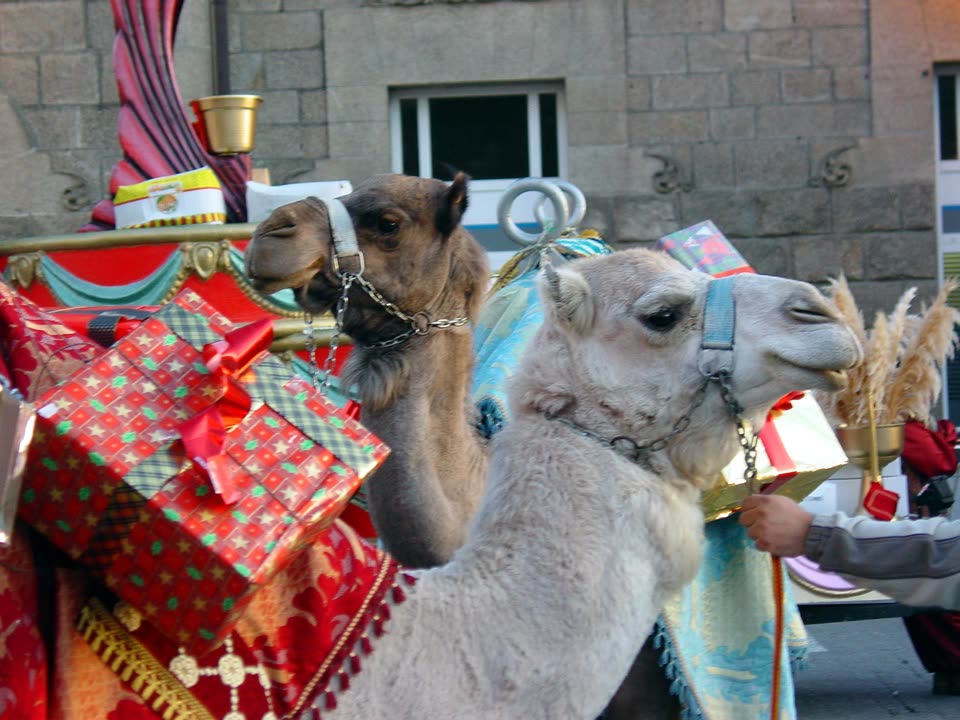
Los Reyes Magos — the Three Kings Melchor, Gaspar y Baltasar
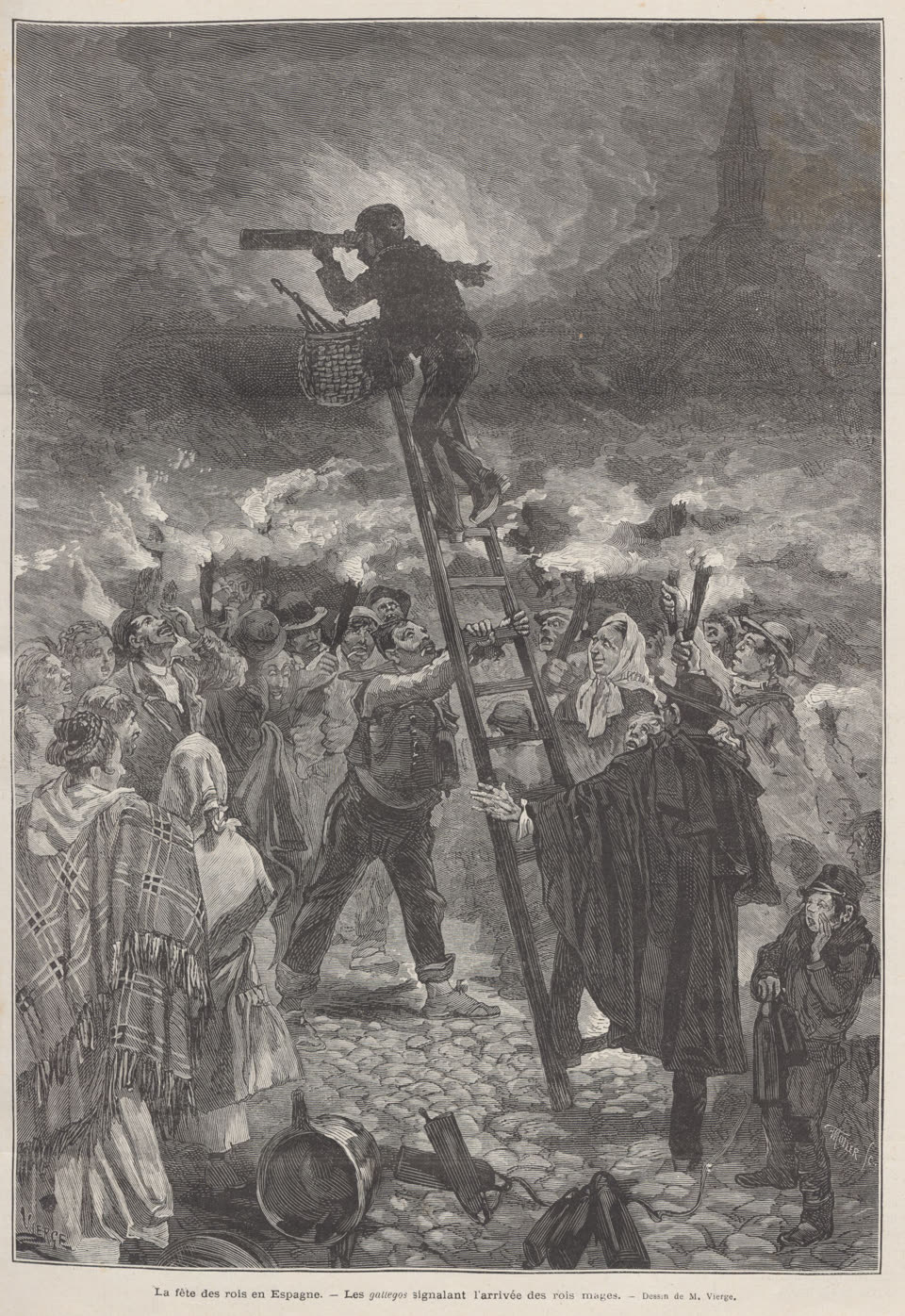
The main event, and the reason Spanish children go back to school later than most of Europe. The Kings come on the night of 5 January, leave the presents by morning, and leave coal for the ones who have not behaved.
They are not as old in this role as they feel. The Galician mythographer Antonio Reigosa puts their popularity at the nineteenth century and credits a push by the Church: «Semella que levamos cos reis desde sempre, pero na realidade comezaron a se popularizar no século XIX, por un esforzo da Igrexa. Anteriormente estaba San Nicolao.» Before the Kings, in other words, Spain had Saint Nicholas — as much of Catholic Europe did, though not all of it: Italy had the Befana and Santa Lucia doing the same job, and still does.
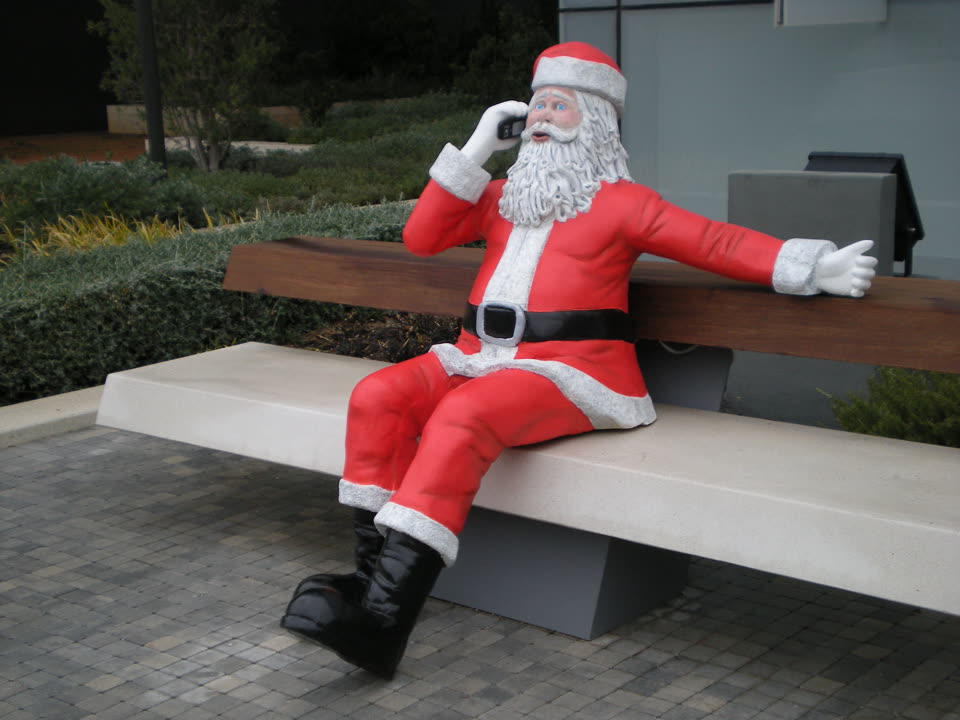
The newcomer, and he did not replace the Kings so much as get added in front of them. In households that keep both, something is opened on the 25th and the rest on the 6th.
The sequence is documented for the Basque Country, where an ethnographer writing in the 2000s lists the gift bringers in the order they arrived: «los 'tres' Reyes Magos, los clásicos hasta mediados de siglo, Santa Claus o Papá Noël (Père Noël), posteriormente, e intentando hacerlos coincidir en el tiempo» — the Kings classic until the middle of the twentieth century, Santa afterwards, and an effort to make the two fit in the same calendar.
El carbonero Olentzero y el obispo (San) Nicolás — Emilio Xabier Dueñas, in «Olentzeroren tradizioa Lesakan eta Euskal Herriko Eguberrietan», Lankidetzan 41, Eusko Ikaskuntza — Sociedad de Estudios Vascos
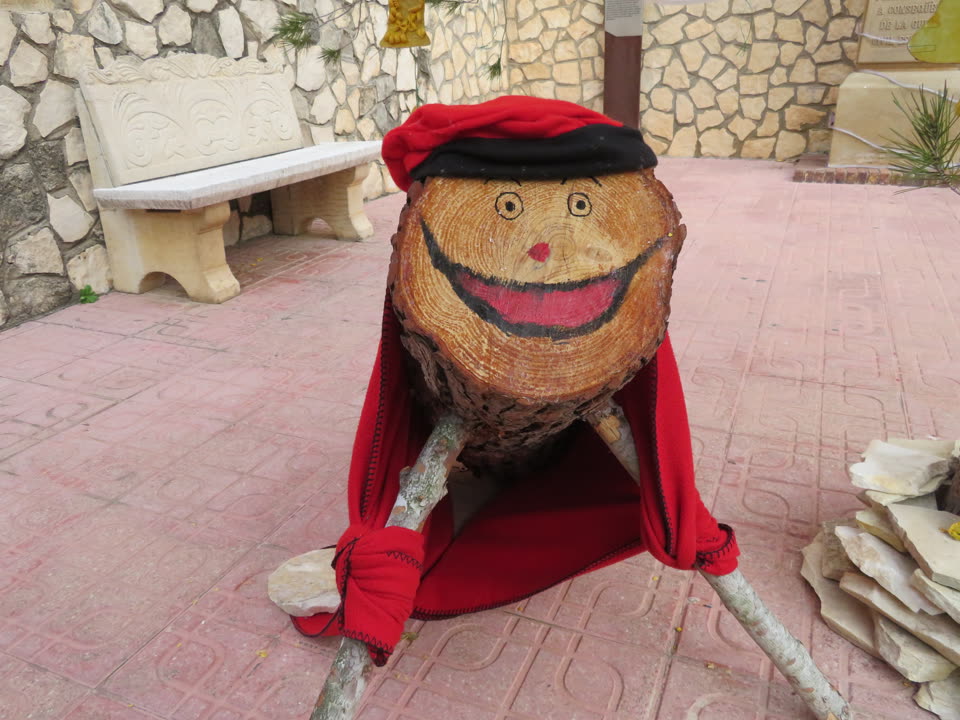
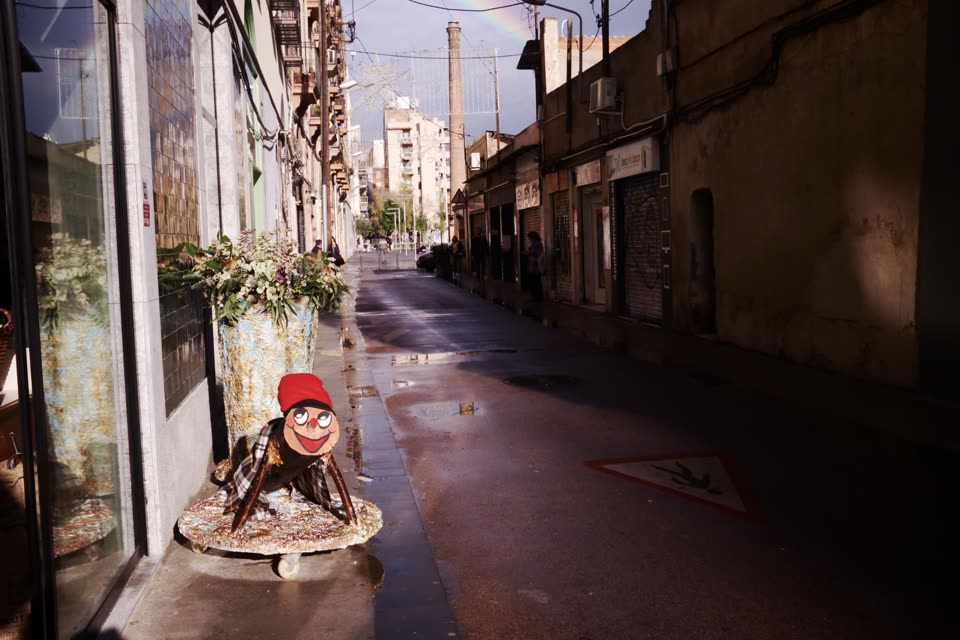
El Tió de Nadal — the Christmas log Tió de Nadal, Cagatió
A log that is fed for days, covered with a blanket, and then beaten with sticks until it produces sweets. Catalan children sing at it while they hit it, and the oldest recorded form of the order is the plainest: «Tió, caga torró!»
The dictionary that records that line also records the mechanism, which is the part adults forget: the torró was «preparat convenientment darrera el tronc, de manera que la mainada no el vegi fins que el tió ha rebut les bastonades» — put behind the log in advance, so that the children see it only after the beating has been administered.
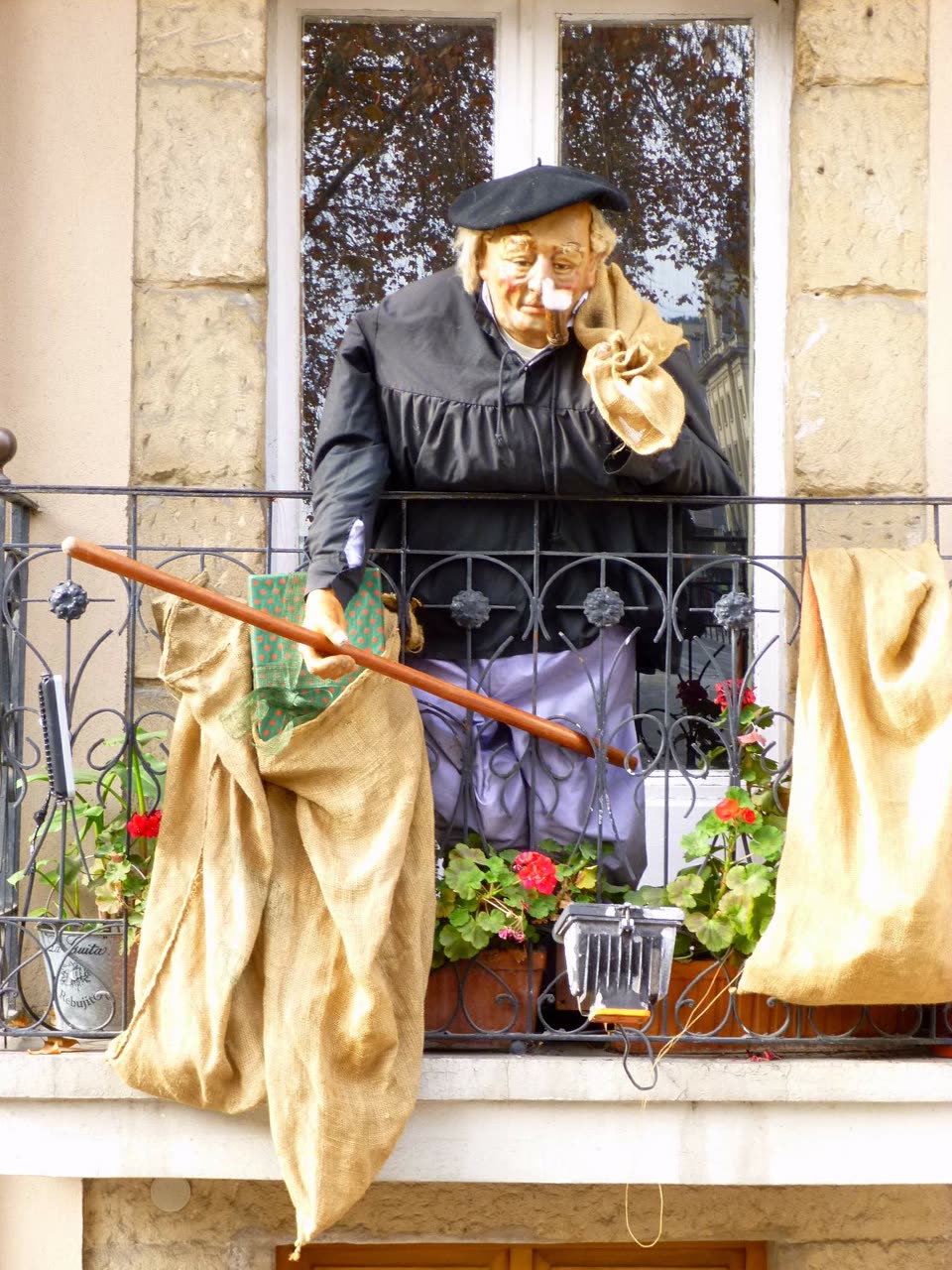
A charcoal burner who comes down from the mountains on Christmas Eve with a pipe, a big head and presents. He is carried through Basque towns on a chair by groups who sing at the doors, and in some places he is burned at the end of the night.
He was a log first. The same word named the trunk put on the hearth fire at Christmas, and a man born in 1914 in Amezketa told an ethnographer in 1988 what his own father had called it: «Antes en Nochebuena... se ponía un tronco en la chimenea. Al tronco se le llamaba Olentzago.» The figure and the firewood have one name because they were one thing.
El carbonero Olentzero y el obispo (San) Nicolás — Emilio Xabier Dueñas, in «Olentzeroren tradizioa Lesakan eta Euskal Herriko Eguberrietan», Lankidetzan 41, Eusko Ikaskuntza — Sociedad de Estudios Vascos
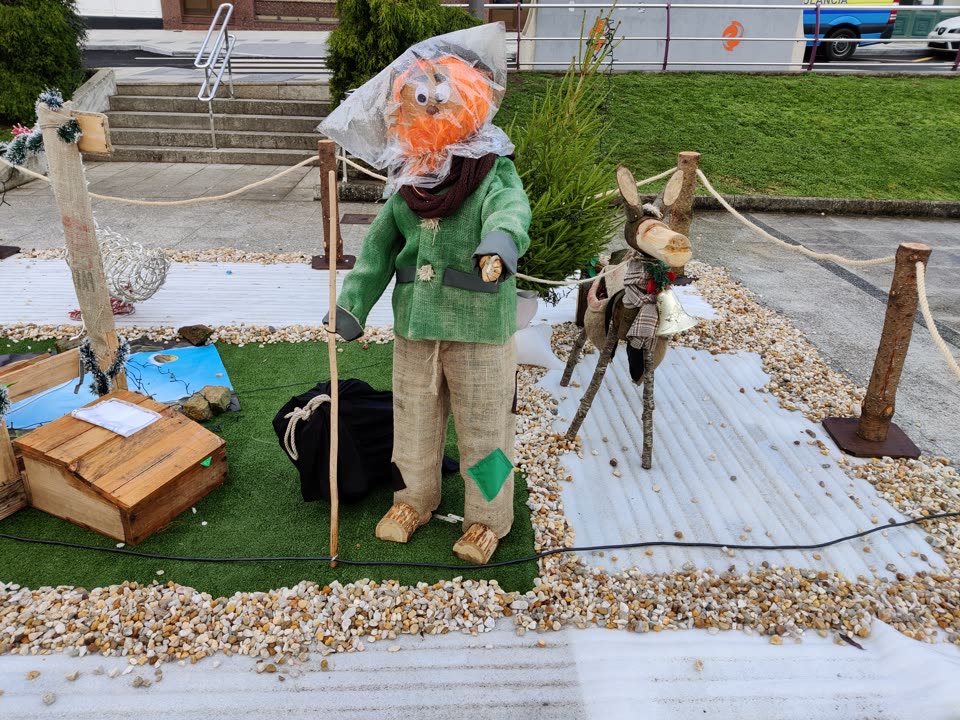
A giant charcoal burner from the mountains of eastern Galicia who comes down on Christmas Eve, feels the children's bellies to find out whether they have eaten enough, and leaves chestnuts and a wish for a year without hunger.
The documentation is thin and the source says so itself. Antonio Reigosa: «Non hai moita documentación, pero si abonda para certificar que existía ese personaxe que baixa do bosque e lle dá comida a nenos» — not much documentation, but enough to certify that the figure existed. What has changed is the job. He fed hungry children; the modern Apalpador brings presents, which Reigosa calls «complicado», because the figures he is being asked to compete with have multinationals and advertising behind them.
Nochebuena is the meal, and the Misa del Gallo is at midnight
Christmas Eve carries the weight in Spain, as it does in most of Catholic Europe. The family eats late and long, and the devout go on to the Misa del Gallo, the rooster's mass, at midnight.
A Catalan dictionary compiled before the war records the timing more exactly than any modern description does: matins first, then the mass at midnight, «i a certes comarques a les cinc del matí del dia 25» — in some districts at five in the morning instead.
The fish on many Spanish Christmas Eve tables is a leftover of a rule rather than a taste. Antonio Reigosa: the Church imposed a vigil through Advent and allowed no meat until after the Misa do Galo, «isto durou ata 1918», and that is why the night belongs to salt cod and sea bream.
El Gordo: the whole country listens to children sing numbers for four hours
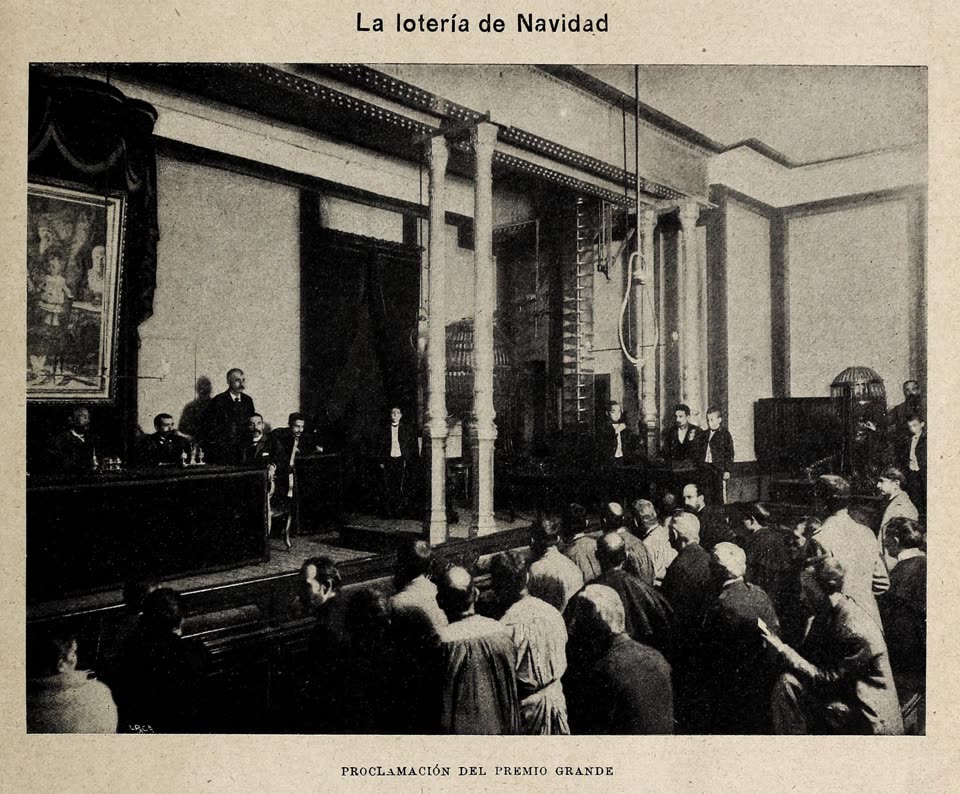
On 22 December the Sorteo Extraordinario de Navidad is drawn in Madrid, and Spain stops. Pupils of the Colegio de San Ildefonso sing the numbers and the prizes in pairs, in a chant with no tune to speak of, for about four hours, and the broadcast runs all morning in bars, offices and kitchens.
The scale is the part that does not translate. In 2025 the draw issued 198 series of 100,000 tickets at 20 euros a tenth — an emission of 3,960 million euros, of which 70 per cent, 2,772 million, went back out in 30,301,920 prizes. It is not a lottery with a big winner so much as a lottery with a very large number of small ones, which is why a whole village can share one number.
At midnight on 31 December Spain eats one grape at each of the twelve strokes of the clock, racing to finish, usually in front of a television showing the clock on the Puerta del Sol in Madrid.
The custom is older than its famous origin story. A Madrid newspaper reported it as already general on 2 January 1894, reprinting a piece from El Imparcial of the day before: «Hasta hace pocos años eran muy contadas las personas que comían uvas el 31 de Diciembre al sonar la primera campanada de las doce de la noche. Hoy se ha generalizado esta práctica salvadora.» The 1894 writer had no idea where it came from either, and guessed France.
The Cabalgata de Reyes, and the ladders at the balconies
On the evening of 5 January every Spanish town of any size parades its Three Kings through the streets, throwing sweets to the crowd. The oldest is at Alcoy in Alicante, run continuously since 1885 with documentary traces back to 1866, and it does something no other does: a legion of pages carries long ladders, climbs to the balconies of the houses, and hands the presents in through the windows.
The parade ends in the Plaça d'Espanya, where the Kings dismount and walk to the nativity scene for the Adoration, with fireworks and Handel's Messiah over the loudspeakers.
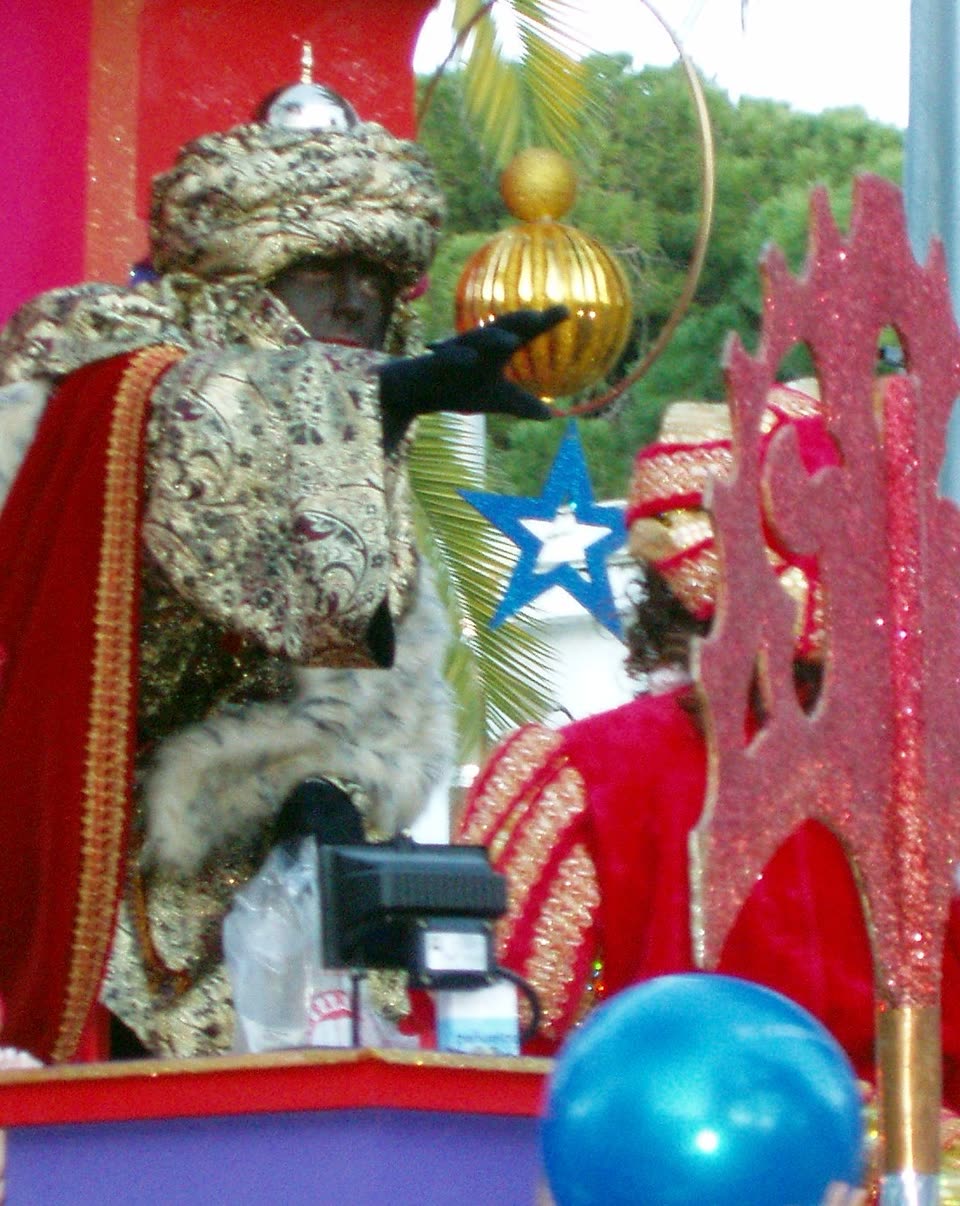
The pages of the Cabalgata are played in blackface, and it is contested
In Alcoy and in hundreds of other Spanish towns, the Kings' pages — and in many places King Balthazar himself — are played by white performers with their faces blacked. The Alcoy council's own description of its parade names them: «una legión de pajes -els negres-».
The objection is made by Black Spaniards. The organisation Afroféminas campaigns for Alcoy to redesign the figure, calling the pages «una burda parodia de los esclavos negros de la época colonial: un blackface con labios rojos», and stating plainly that it is the representation of the pages they are against and not the parade. They cite the European Parliament, which on 19 June 2020 adopted a resolution whose paragraph 16 «calls on the Member States to denounce and refrain from racist and Afrophobic traditions, such as the black face practice».
Málaga ended it by a vote. On 27 November 2024 the city’s Junta de Portavoces — the leaders of every group on the council — agreed, on the mayor’s proposal, that Balthazar «será encarnado siempre por una persona negra», chosen for merit or for something they had done. The first was Mansour Konte, eighteen, from Guinea-Conakry, who had reached the Canary Islands by boat and who had pulled a woman out of the floodwater at a petrol station during the storms of the month before.
Seville went the other way, and more publicly. Its cabalgata was founded in 1918 by the Ateneo de Sevilla, a private society that still chooses the three Kings from among prominent Sevillians, and on 5 January 2026 the man who rode as Balthazar with his face painted black was Juan Manuel Moreno, the president of the regional government of Andalusia. Afroféminas called it «una muestra de insensibilidad y una irresponsabilidad tremenda por parte de alguien con su poder» and published a map of more than fifty Andalusian towns where the painting continues. A motion in the Andalusian Parliament to end it in that parade was voted down.
The Catalan log is brought into the house in early December, covered with a blanket, given something to eat each night, and on Christmas Eve or Christmas Day beaten with sticks by the children until it delivers sweets, nougat and small presents.
It used to be a different scene. The oldest person in the house presided and sometimes blessed the log with wine; the children were sent to another room to say a Paternoster first; the tió itself was a bare trunk with no face, and after Christmas it was burned and its ashes scattered on the field.
What spread it was school. The custom was rural and domestic, and the anthropologist Josefina Roma points out that in the cities the presents came from the Kings while in the villages «només es feia cagar la soca». After 1975 the schools became the main channel for Catalan popular tradition, the tió went with them, and it acquired the painted eyes, nose and legs it now has.
D'on ve la tradició de fer cagar el tió? — 3Cat — Corporació Catalana de Mitjans Audiovisuals, 23 December 2023, quoting Josefina Roma i Riu, emeritus professor of anthropology at the Universitat de Barcelona
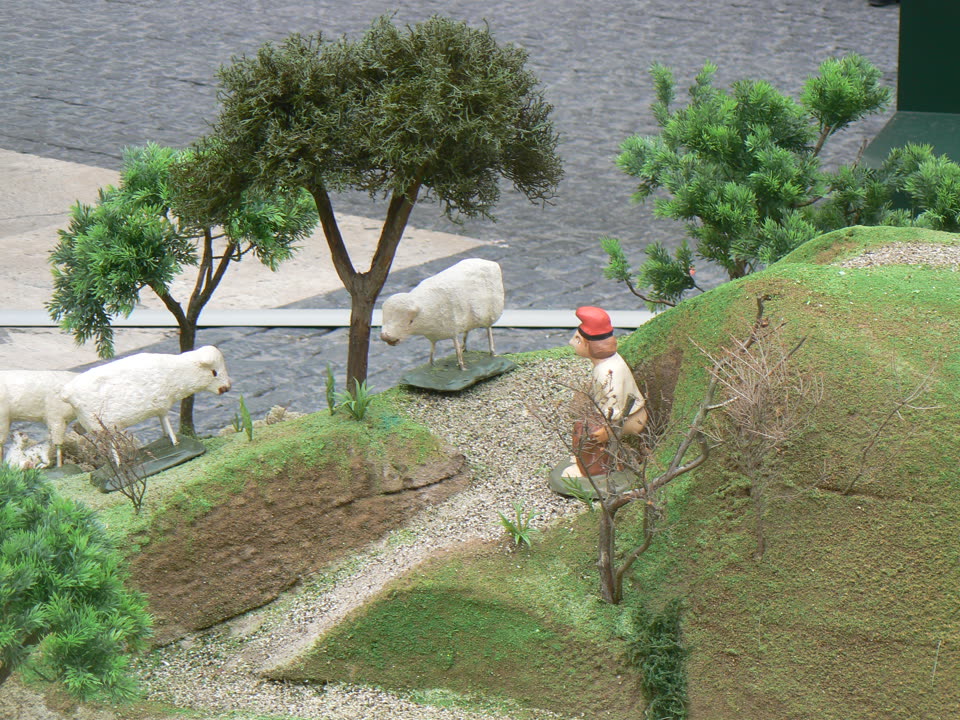
The Catalan nativity scene is built out of moss, cork and butcher's broom, and it is populated well beyond the Gospel: the woman washing, the old woman spinning, a fisherman, and some frank anachronisms — a priest with an umbrella, a Civil Guard, a hunter.
Among them, hidden somewhere at the back, squats the caganer: a man in a barretina with his trousers down, smoking a pipe or reading the newspaper, sometimes with a piglet sniffing at him. He appears in Catalan cribs from the end of the seventeenth or the start of the eighteenth century, and he is not unique to Catalonia — Murcia, Portugal and Naples have their own.
Barcelona's crib trade is old enough to have an association: the Associació de Pessebristes de Barcelona was founded in 1863, and the Fira de Santa Llúcia has sold the pieces since the eighteenth century.
El Cant de la Sibil·la, sung by a child with a sword
At matins on the night of 24 December, in churches across Mallorca, a boy or girl sings the Sibyl's prophecy of the end of the world, unaccompanied except for the organ between the verses.
The singer walks up through the church to the chancel holding a sword upright in front of their face, with altar servers carrying candles on either side, and at the end of the song draws a cross in the air with the sword. The chant was sung across medieval Europe, and the Council of Trent ended it almost everywhere by banning theatrical performance inside churches. UNESCO inscribed the Mallorcan chant on 16 November 2010.
Chant of the Sybil on Majorca — UNESCO, Representative List of the Intangible Cultural Heritage of Humanity, inscribed 2010 (5.COM)
La Zambomba: a friction drum, a bonfire, and singing until dawn
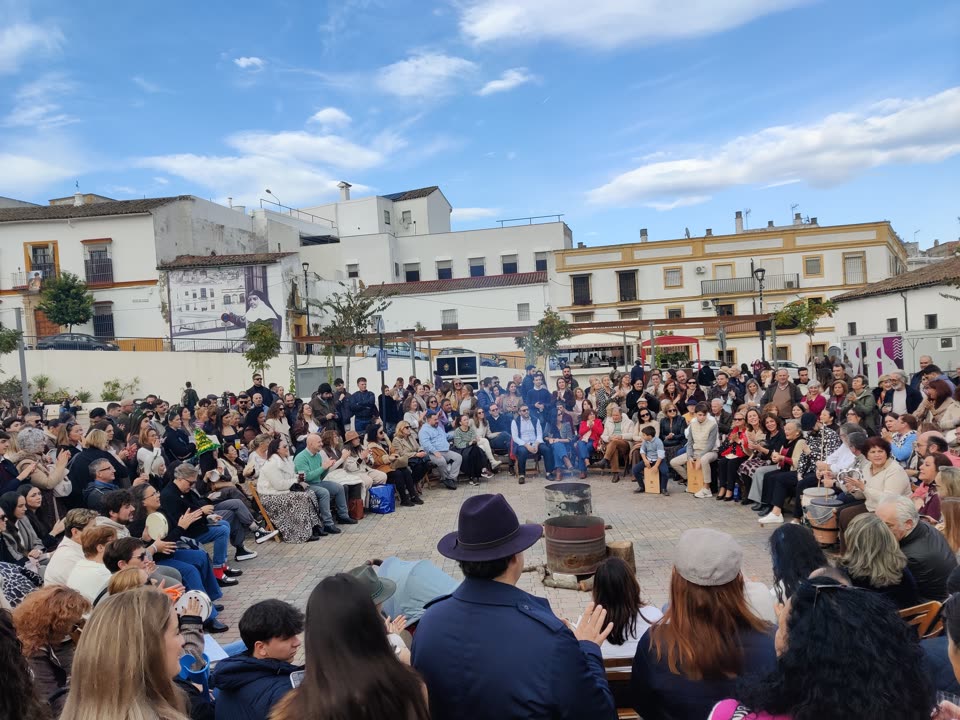
In Jerez de la Frontera and Arcos de la Frontera, Christmas is a gathering around a zambomba — a friction drum made of a skin stretched over a jar with a cane through it, played by rubbing rather than striking.
The zambombas run from the Immaculate Conception on 8 December to Christmas Eve, getting denser as the month goes on. The day's work is part of it: lighting the fire and making the pestiños, buñuelos and roscos together is how the thing opens. Then the singing, from late afternoon until the small hours, in a repertoire that mixes old ballads and lyric song with flamenco.
It began in the shared courtyards and farm workers' houses of the Jerez countryside, and has moved out of them into the streets and the bars, which the regional government's own decree describes as a move «de lo privado a lo público».
Olentzero comes down from the hills, and is sometimes burned
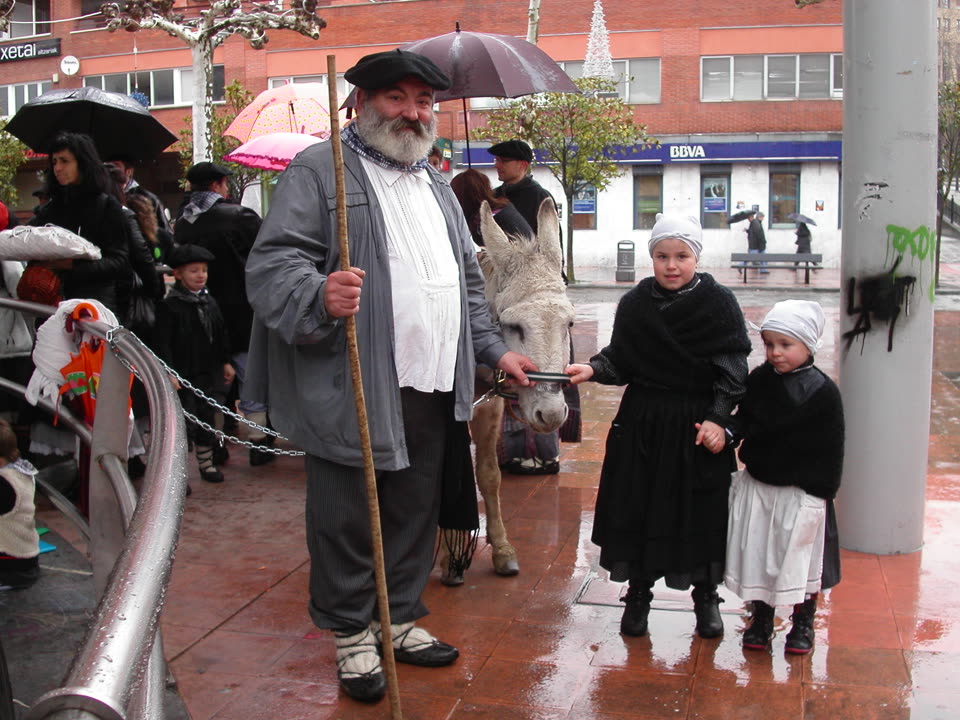
On 24 December Basque towns carry Olentzero through the streets — a straw-and-rag figure on a chair, or a man dressed as a charcoal burner — stopping at houses to sing for money or food. Children do the rounds by day and adults by night.
The songs disagree about his trade along an exact line: inland they make him a charcoal burner, on the coast a sailor.
In Lesaka the figure is burned at the end. The ethnographer who traced that detail found something more interesting than the bonfire: Barandiaran's first article on Olentzero, in 1922, does not mention Lesaka or any burning; Caro Baroja reports it in 1946 from an informant speaking around 1928; Barandiaran repeats it in 1956 crediting Caro Baroja, and then in 1972, 1973 and 1980 repeats it without crediting anyone. A single testimony had become a fact by being cited.
El carbonero Olentzero y el obispo (San) Nicolás — Emilio Xabier Dueñas, in «Olentzeroren tradizioa Lesakan eta Euskal Herriko Eguberrietan», Lankidetzan 41, Eusko Ikaskuntza — Sociedad de Estudios Vascos
Castilla y León
The Autos de Reyes, played by the neighbours
In villages across Castilla y León, on the afternoon of 5 January or the morning of the 6th, people gathered to watch Los reyes — the Epiphany story acted by their own neighbours.
The casting was pointed. Herod was played by the fiercest man available. The wise men of Jerusalem wore glasses, to show that they had studied, and black, for seriousness. The Innocents were played by actual one- and two-year-olds, borrowed from their parents, at whom Herod's men advanced to mime the beheading — producing, as the account dryly records, a tantrum from the children and general disapproval from the audience.
Spain's April Fools' Day falls on 28 December, the feast of the Holy Innocents, and the word for the prank has its own entry in the academy's dictionary: an inocentada is «broma o chasco que se da a alguien en el día de los Santos Inocentes».
Newspapers run invented stories, television reports things that did not happen, and in Catalonia the specific form is the llufa — a paper figure stuck to the back of somebody who has not noticed.
The Galician Christmas table runs to salt cod with greens on the Eve and capon on the day, and both are consequences of the same rule. No meat was allowed until after the midnight mass, so the Eve went to fish that keeps.
The capon is the exception that was granted. According to Antonio Reigosa, in the ninth century the Church accepted the castrated cockerel as an exemption from the vigil, and that is the origin of eating capon at Christmas; the Feira do Capón at Vilalba, held in the days before Christmas, is what the exemption grew into. Similar fairs existed in Catalonia and in southern France.
On 28 December the flour-covered take over Ibi, pass absurd laws and fine anyone who breaks them
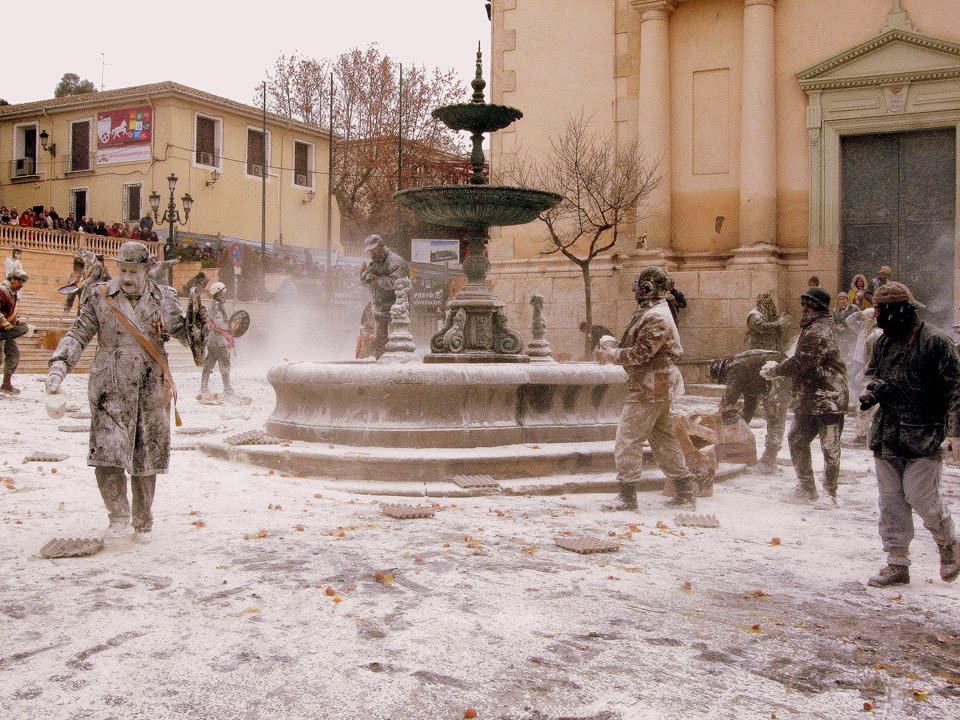
Ibi, in Alicante province, spends Holy Innocents' Day under a government of enfarinats — men coated in a paste of flour, egg and gunpowder, who seize the town at first light, declare themselves the municipal authority and start issuing ordinances. An opposition refuses the new rules, and the argument is settled with flour for about an hour and a half.
The fines are the part that gives it away as a parody of government rather than a food fight. Premises that will not pay are sealed with an orange notice signed by «el Excm. i Ilustríssim Alcalde dels Enfarinats», over the authority of a Fiscalia de Tases Municipals that does not exist. The money goes to charity.
It is not unique, and knowing that is what makes it legible: the day belongs to the «festes de folls» or «ajuntaments de farsa», mock councils kept around the feast of the Holy Innocents. By early afternoon the enfarinats meet the opposition and the dancers, with the virrei at their head and the dancers in black capes, immaculate beside them.
The festival lapsed at the end of the 1950s and was revived in 1981 by a group of friends, according to El País. Two researchers who spent three years on its history put the origin at 1862 while saying plainly that «no hay nada que pueda establecer una fecha concreta de su nacimiento» — the year rests on a reference in the town's book of proclamations to a group called Els Emmanantats, «una alusión a lo que posiblemente después fueron Els Enfarinats». It sits inside Ibi's Festes d'Hivern, which run from Santa Llúcia on 13 December to 5 January.
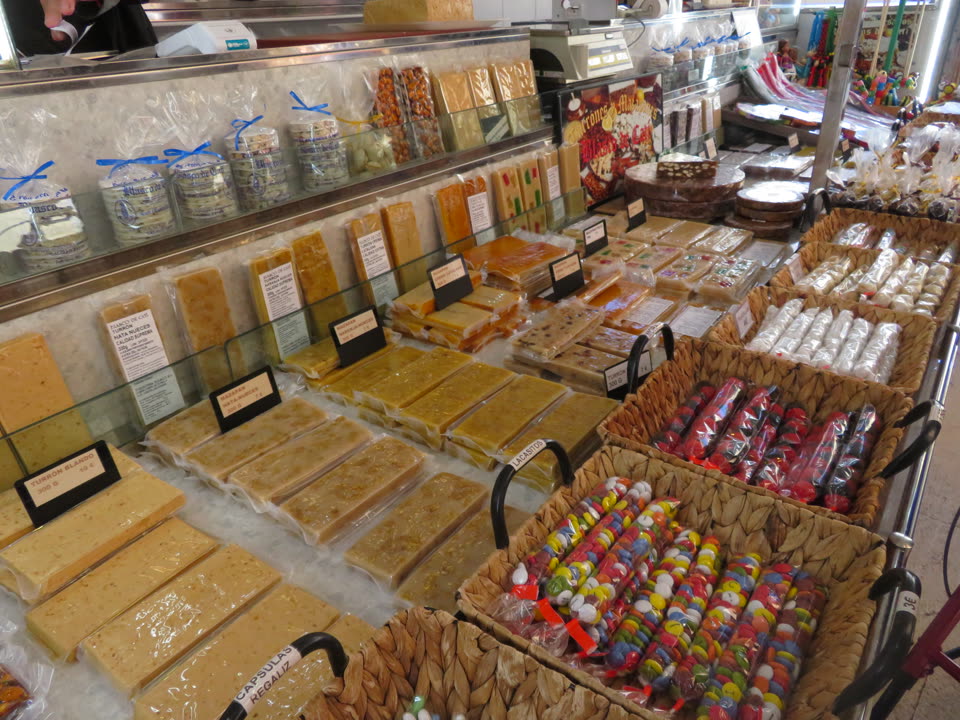
Soft nougat of ground toasted almonds and honey, the colour of wet sand, sold in a tablet and eaten in slivers after the meal. Its harder cousin, Turrón de Alicante, keeps the almonds whole.
It is a protected name with a legal recipe. To be labelled Calidad Suprema a tablet must be at least 64 per cent toasted almond and at least 10 per cent pure bee honey; Calidad Extra drops the almond to 50. Everything, including the cooling, moulding and cutting, has to happen inside one municipality: Jijona/Xixona, in the province of Alicante.
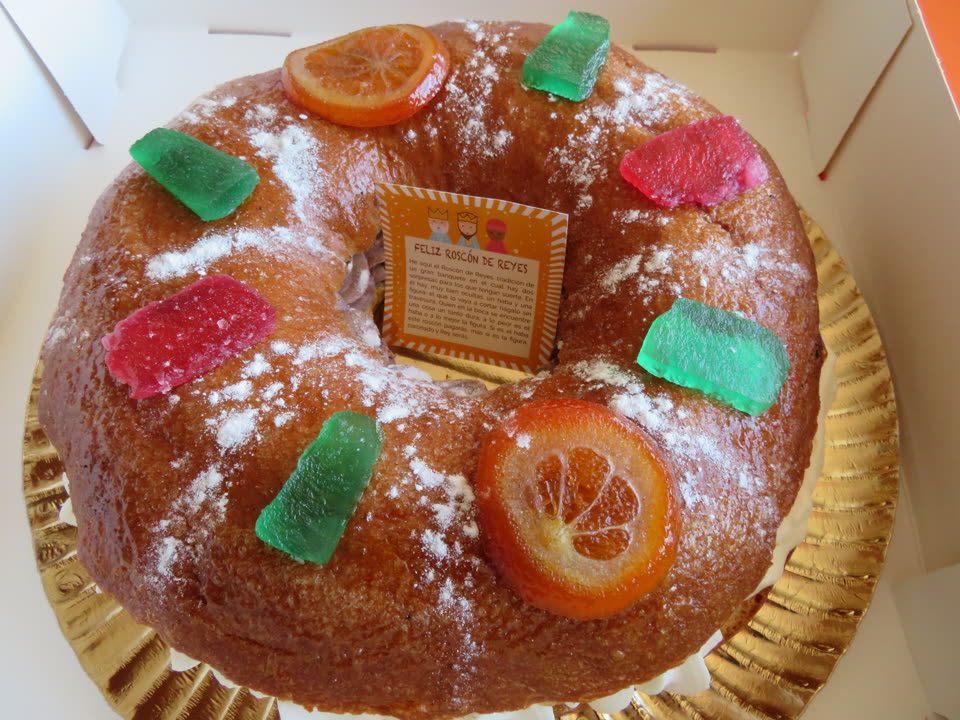
A ring of soft sweet bread, scented with orange-flower water and crowned with candied fruit, eaten on the morning of 6 January and cut at the table. Two things are hidden inside: a small figure, and a dried broad bean. Finding the figure makes you king of the day; finding the bean means you pay for the cake.
The bean is the older half. From the Middle Ages the Castilian court chose a rey de la haba by lot, the lot being a bean baked into a cake, and the real monarch granted the finder favours for the start of the year. The custom attached itself to Epiphany later, and in some places the surprise is still called the haba whatever it is actually made of.
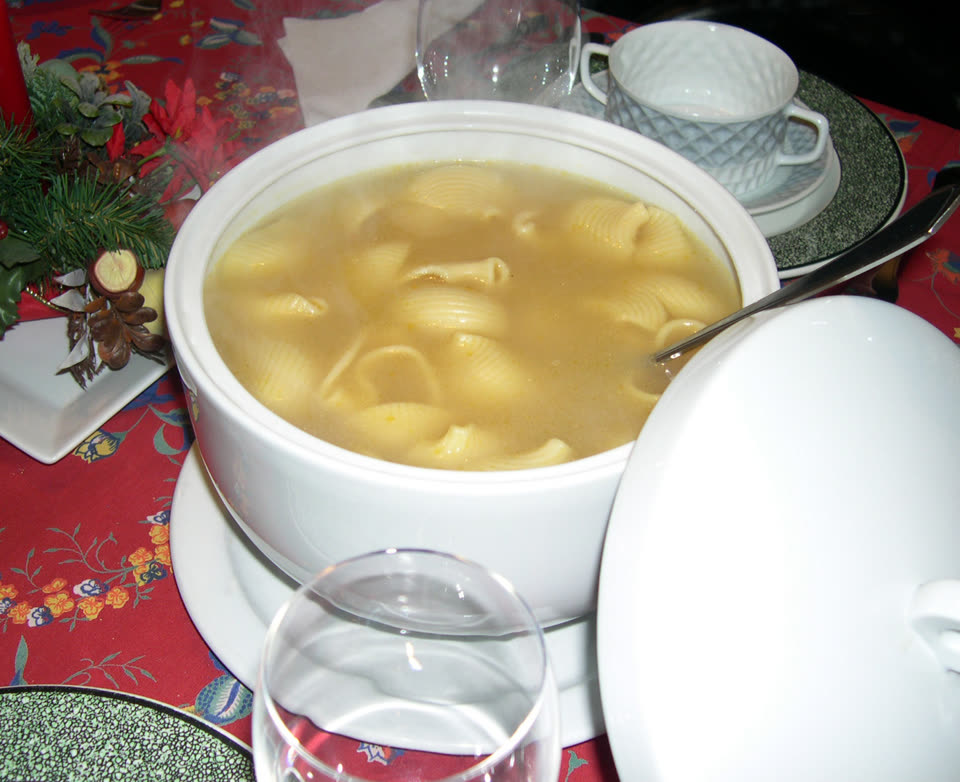
The Catalan Christmas Day meal, and effectively two courses out of one pot: a broth with big pasta shells, the galets, followed by the meat and vegetables that made it.
The day after has its own dish. What is left of the carn d'olla is chopped and rolled into canelons for Sant Esteve on 26 December, which in Catalonia and the Balearics is a holiday rather than a working day — one of the few places in Spain where the second day of Christmas still is.
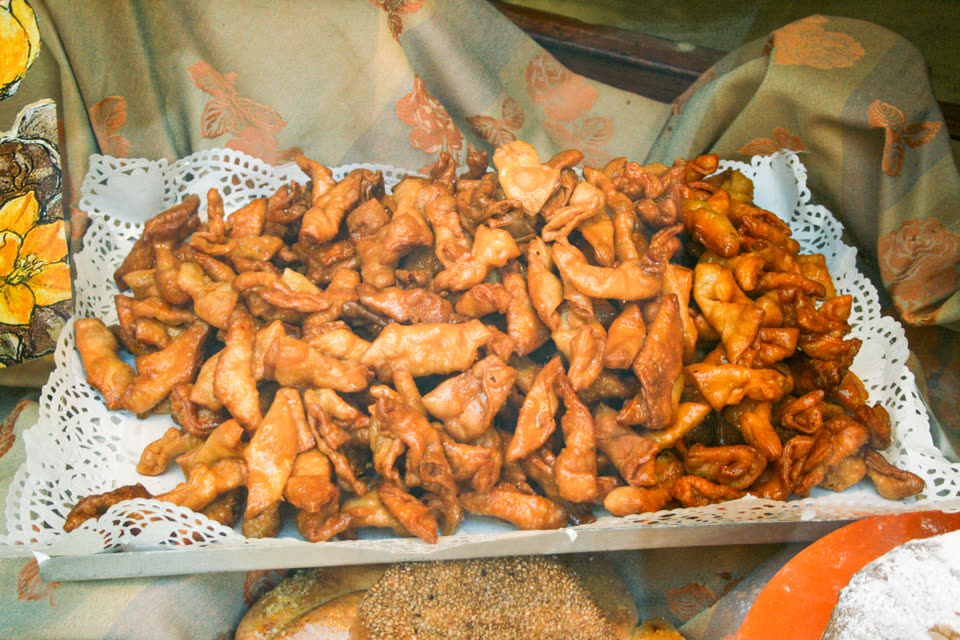
The fried sweets of an Andalusian Christmas: pestiños, dough fried and glazed with honey or sugar, alongside buñuelos and roscos.
Making them is not preparation for the party, it is the start of it. The decree that protects the zambomba describes the fire being laid and the sweets made collectively as the opening of the night's ritual, before any singing begins.
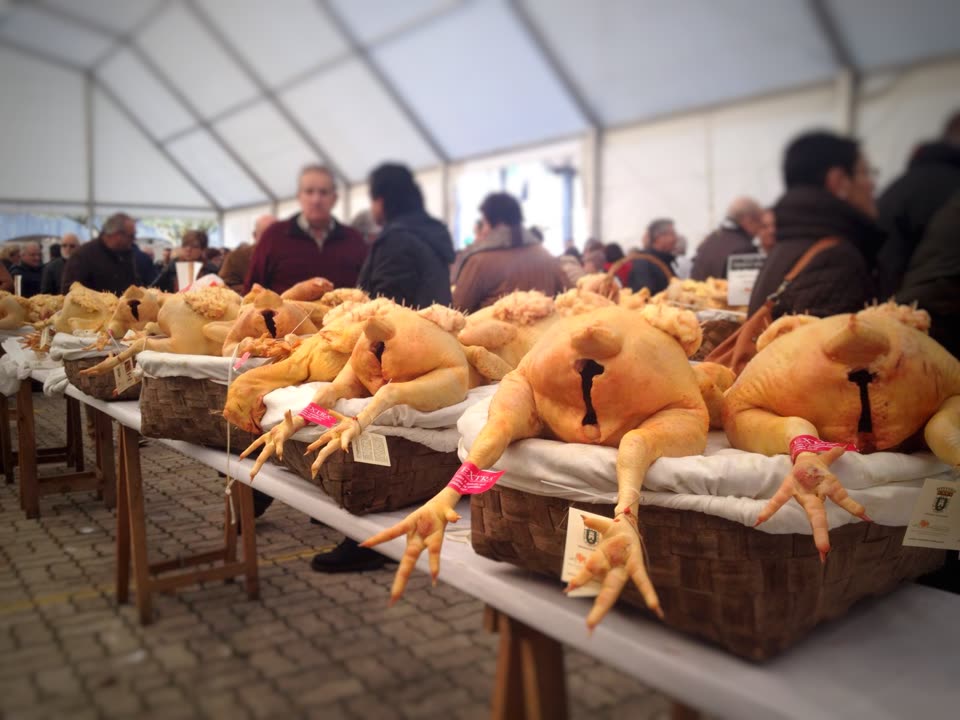
A cockerel castrated before it matures, penned on St Martin's day and fattened until Christmas, and the centre of a Galician Christmas dinner.
The Feira do Capón at Vilalba, in Lugo, is held in the days before Christmas, and the birds do not arrive alive. The breeders' association describes the day before: each bird is killed at its own breeder's house, plucked by hand because the skin over the breast tears, and eviscerated. The fat taken out of it is kept and put back on the bird's back as the finishing ornament, the ensunlla. A carcass must weigh at least 3.5 kg to be let into the fair, and most pass 4.5. They come in laid on straw in wicker or wooden baskets under a white cloth, heads to the middle and feet outward.
Widely repeated claims about Christmas in Spain that do not survive
checking. Each one says what is actually the case, because a correction
with nothing in its place leaves you worse off than before.
Contradicted
The twelve grapes of New Year's Eve were invented in 1909, when growers in Alicante had a surplus harvest and needed to shift it.
What is actually the case. The custom was already general in Madrid fifteen years earlier. On 2 January 1894 a Madrid daily reprinted a piece from El Imparcial reporting that until a few years before very few people ate grapes at midnight on 31 December, and that «hoy se ha generalizado esta práctica salvadora».
What 1909 can have done is make it bigger, and the Alicante growers are a real part of the story of how a Madrid habit became a national one. They are not where it started, and the 1894 writers did not know where it started either — their guess was that it came from France and had «adquirido entre nosotros carta de naturaleza».
In Spain the Three Kings are the ancient native tradition, and Papá Noel is the modern American import pushing them out.
What is actually the case. Papá Noel is indeed the newer of the two in Spain, and he does now take a share of the presents. But the Kings are not immemorial either.
Antonio Reigosa dates their popularity to the nineteenth century and attributes it to an effort by the Church, noting that the gift bringer before them was Saint Nicholas — the same figure Papá Noel descends from. In the Basque Country an ethnographer lists the Kings as «los clásicos hasta mediados de siglo» and Santa as arriving afterwards.
So the sequence is Saint Nicholas, then the Kings, then Santa Claus coming back round in a red suit. What Spain is defending is roughly two centuries old, not two thousand.
El carbonero Olentzero y el obispo (San) Nicolás — Emilio Xabier Dueñas, in «Olentzeroren tradizioa Lesakan eta Euskal Herriko Eguberrietan», Lankidetzan 41, Eusko Ikaskuntza — Sociedad de Estudios Vascos
Oversimplified
The tió de Nadal is an unbroken Catalan tradition, handed down intact from pre-Christian times.
What is actually the case. The log on the hearth is genuinely old and genuinely widespread — the same custom, under other names, runs across Europe, and the Catalan government's own account lists the Yule Log, the Scottish Yeel Carline and the French bûche de Noël beside it.
But the thing in Catalan houses today is a revival with a visible seam. These customs declined across Europe at the end of the nineteenth century; in Catalonia the tió survived domestically and was then spread deliberately after 1975, largely through schools, from the villages to the cities where the presents had come from the Kings. The face is part of that: «inicialment el tió era un simple tronc buit, sense cara», and the eyes, nose and legs were added to humanise it.
The pre-Christian origin is a reasonable hypothesis rather than a documented descent. The sources that offer it say so — «pot tenir l'origen en les tradicions precristianes», with a pot.
D'on ve la tradició de fer cagar el tió? — 3Cat — Corporació Catalana de Mitjans Audiovisuals, 23 December 2023, quoting Josefina Roma i Riu, Universitat de Barcelona
Contested
El Gordo has been drawn every Christmas since 1812
What is actually the case. The operator contradicts itself, and it is the only authority there is on its own draw.
Its Christmas press page says the first Sorteo de Navidad was held on 18 December 1812 in Cádiz and counts «212 años de historia» from there. Its corporate history gives a different account of the same thing: 4 March 1812 is «la fecha marcada en la historia del nacimiento de la Lotería Nacional», the December draw of that year being simply one of its draws; the Christmas draw proper begins in «1818 se organiza un sorteo especial coincidiendo con la Navidad. Puede considerarse como el origen»; and it did not become an annual fixture until «no sería hasta 1839 cuando el popular sorteo navideño comienza a celebrarse regularmente». It was not officially called the Christmas draw until 1897.
So the two pages are describing different objects. One is the lottery that happened to draw near Christmas in 1812; the other is the Christmas draw as an institution. What NEITHER page supports is the unbroken run: an annual Christmas draw from 1812 onwards is contradicted by the operator’s own 1839, and the stretch from 1812 to 1839 is exactly where the Carlist wars sit.
Carlos III brought the belén to Spain from Naples in the eighteenth century
What is actually the case. He did not bring it; he made a Neapolitan kind of it fashionable at court. Spain's own heritage institute says the popular version is wrong in as many words: «a pesar de que tradicionalmente se ha venido repitiendo que Carlos III fue su introductor en el país en el siglo XVIII, lo que está fuertemente asentado en el imaginario popular, esto es erróneo».
The belén was in Spain two and a half centuries earlier, and the documents are specific. In 1513 the sculptor Jorge Fernández carved two nacimientos, now lost, for the Dominican convents of Écija and Seville. In 1576 the seventh Duke of Medina Sidonia commissioned one for his palace chapel at Sanlúcar de Barrameda, where his wife had already been setting up a demountable crib on a wooden frame in her private oratory. In 1585 a canon of Vic cathedral is recorded holding «unes ymages de terra, del naixement». The expression «poner el Belén» is in use by 1502.
The oldest one still in use is the Belén de Jesús in the church of the Anunciación in Palma, from the end of the fifteenth century. It is probably not the oldest that exists: the Museu-Monestir de Pedralbes in Barcelona holds an alabaster Misterio from the second half of the fourteenth century, though the report is careful to say it is unclear whether those figures were meant to make up a crib at all.
What Carlos III actually did is still worth saying. From his accession in 1759 the royal family set up a belén every Christmas, and the Belén del Príncipe — his gift to the heir, the future Carlos IV — grew to 5,950 figures by various artists, of which only a handful survive in the Palacio Real. A king making something fashionable is how a tradition spreads; it is not how it starts.
A bishop banned the Sibyl's chant in Mallorca in 1570, and five years later another bishop put it back because his own cathedral chapter asked him to. Diego Arnedo prohibited it; Joan Vich restored it in 1575, and added some devout cantilenas that were sung in other churches, particularly in Valencia.
So «it survived in Mallorca» is the short version of something less tidy. The chant also kept going in the Crown of Aragon — València in 1533, Vic in 1568, Urgell in 1580, Barcelona in 1569 — and it is still sung at the cathedral of Gandia and the cathedral of València. And in the Catalan-speaking city of l'Alguer, in Sardinia, the cathedral sings on Christmas Eve the longest Catalan version anybody performs: longer than Mallorca's.
Boxing Day is a holiday in two of Spain's nineteen territories. The 2026 labour calendar marks 26 December, Sant Esteve, only in Illes Balears and Catalunya; everywhere else it is a working day. And in the Val d'Aran, which is inside Catalonia, it is traded away — Sant Esteve is replaced there by the Festa d'Aran on 17 June.
Epiphany is the national holiday that every Spanish region was allowed to abolish and none did. Spanish law divides national holidays into those the autonomous communities may not touch and those they may swap for a local feast. 6 January is in the second group — and all nineteen territories kept it.
The Christmas lottery was born in a city under siege. The Lotería Nacional was created at Cádiz in 1811, while the Cortes sat there with the French outside, as a way of raising money for a state at war without raising taxes — «Fue en 1811, en Cádiz, cuando se aprueba su creación» — and the first draw of its history followed on 4 March 1812. The operator counts the Christmas draw from December of that same year: «El primer Sorteo de Navidad se celebró el 18 de diciembre de 1812 en Cádiz.» Its own corporate history dates the origin elsewhere, and that disagreement has its own entry below.
In Galician, and in the Catalan of Alghero, the word for Christmas is also the word for December. The Royal Galician Academy gives nadal three senses: the feast, the days around it, and the month — with the example «Espero verte en Nadal», which in Galician means I hope to see you in December.
Spanish Christmas nougat has a legal minimum almond content, and it is 64 per cent. A tablet of Turrón de Jijona may only be labelled Calidad Suprema if at least 64 per cent of the finished product is toasted almond and at least 10 per cent is pure bee honey.
Whether Olentzero is a charcoal burner or a sailor depends on how far you are from the sea. The begging songs sung with the figure name his trade, and the ethnographic record notes the split cleanly: charcoal burner inland, sailor on the coast.
El carbonero Olentzero y el obispo (San) Nicolás — Emilio Xabier Dueñas, in «Olentzeroren tradizioa Lesakan eta Euskal Herriko Eguberrietan», Lankidetzan 41, Eusko Ikaskuntza — Sociedad de Estudios Vascos
Comunitat Valenciana
The oldest date anyone attaches to Els Enfarinats is 1636, and it is not a date for Els Enfarinats. El País puts it as carefully as it can be put: «Hay una referencia histórica sobre las fiestas de invierno de Ibi de 1636, aunque se desconoce si ya entonces se celebraba Els Enfarinats, sobre la que apenas hay documentación, quizás porque su carácter subversivo no gustaba a las autoridades.»
A reference to a town's winter festivities is not a reference to this one, and the reason offered for the silence is the interesting part: a festival whose whole content is mocking the authorities is not a festival the authorities write down.
What is firmly dated is the gap. «Tras desaparecer a finales de la década de 1950, un grupo de amigos recuperó la fiesta en 1981» — and 27 December belongs to Els Amantats, who go through Ibi under blankets on an open lorry reciting satirical verses about their neighbours, and who put on the flour the following morning.
When the blankets began is a second open question, and the two accounts of it disagree. El País puts them after the revival in as many words — «Desde entonces, el 27 de diciembre se celebran también los bandos de Els Amantats» — and a local account dates «els enmantats» in Ibi's book of proclamations to 27 December 1862, which would make them older than the festival's own gap. One is a national paper quoting a man who was in the original group; the other survives at second hand, through a book published in 2007. The blankets are therefore as undated as the flour.
The table grape of the Vinalopó valley in Alicante spends its last weeks on the vine inside a paper bag, one bag to a bunch. The protected designation's own specification says where and when that began: «Esta práctica se inició en el municipio de Novelda hacia 1920, con objeto de proteger sus racimos del ataque de la polilla del racimo, por medio de “bolsos” de papel.» — at Novelda, around 1920, to keep the grape moth off the bunches, by means of paper bags. The same paragraph says the technique is used «“exclusivamente” en el Medio-Vinalopó», and the quotation marks around the word are the specification's own.
The bagging is timed to the plant and not to the calendar. It happens «poco antes del envero», shortly before the berries begin to colour, and a bunch must have been in its bag «un tiempo mínimo de cuarenta y cinco días» before picking starts. The paper is specified as closely as the fruit: long-fibre cellulose, «satinado y de color caña», waterproofed, which deepens the colour and keeps the rain off — and which «puede llegar a quemar algunos granos de los hombros de los racimos si cuando se coloca la bolsa hay una temperatura elevada», can scorch the grapes on the shoulders of a bunch if it goes on in heat.
Aledo is the first variety the specification lists, and what it says about it is the ripening: «La maduración tardía, de noviembre a diciembre». A white grape that comes ripe in November and December is a grape still worth eating on the last night of the year.
Every claim carries its own citation. They are collected below, so you
can see what the page rests on and how much of it comes from where.
D'on ve la tradició de fer cagar el tió? — 3Cat — Corporació Catalana de Mitjans Audiovisuals, 23 December 2023, quoting Josefina Roma i Riu, emeritus professor of anthropology at the Universitat de Barcelona. Retrieved 2026-10-13. archived 23 April 2024Roma's explanation of the food offerings is the part worth keeping: the ancestors took «la part espiritual dels aliments» and what remained was eaten by the descendants, «sobretot els nens».
Reactivamos campaña en Change.org para eliminar el blackface de la Cabalgata de Reyes de Alcoy — Afroféminas, 13 December 2025. Retrieved 2026-10-13. archived 12 May 2026Afroféminas draws the parallel with Zwarte Piet in the Netherlands themselves, and the comparison they make is about the defence rather than the costume: that people who consider themselves anti-racist decline to see it, «por conflicto identitario». They are explicit that they are not asking for the Cabalgata to stop — «No estamos en contra de la Cabalgata de Reyes de Alcoi, sino en contra de la representación de los pajes» — and propose a design competition for a new figure.
Cabalgata — Navidad y Reyes Magos — Ajuntament d'Alcoi / Ayuntamiento de Alcoy. Retrieved 2026-10-13. archived 14 March 2026The council's own account: «Su celebración se viene realizando de forma continuada desde 1885, si bien sus antecedentes documentales se remontan al año 1866.» It claims to be one of the oldest in Spain «y, posiblemente, en el mundo», which is the organiser's claim rather than an independent finding.
Caganer — Personatges i elements festius — Ajuntament de Barcelona, Cultura Popular. Retrieved 2026-10-13. archived 25 June 2024The city calls him «el contrapunt pragmàtic de tota la representació i la mística del misteri de Nadal». The figure was not invented for the crib: «les antigues rajoles dels oficis ja l'havien representada».
El 28 de desembre a la vila d’Ibi: dels enfarinats al ball del virrei — Alicante Plaza, in Valencian. Retrieved 2026-10-29. archived 24 April 2025A reporter's account of the day in Ibi, which places it in a family of festivals rather than treating it as a local oddity: «La festa dels enfarinats d’Ibi forma part del conjunt de les anomenades “festes de folls” (festes bojos) o “ajuntaments de farsa”, celebrades al voltant de la festivitat cristiana dels sants màrtir innocents (28 de desembre).»Premises that will not pay are sealed with an orange notice: «Local presintat. Fiscalia de Tases Municipals. No podrà obrir de nit ni de dia según ordenanza de la Corporació. Manat i signat per el Excm. i Ilustríssim Alcalde dels Enfarinats». By one in the afternoon the enfarinats, the opposition and the dancers meet, «amb el virrei al capdavant» — the enfarinats covered in a paste of flour, egg and gunpowder, the dancers in black capes and immaculate.
Resolución de 17 de octubre de 2025, de la Dirección General de Trabajo, por la que se publica la relación de fiestas laborales para el año 2026 — Boletín Oficial del Estado — BOE-A-2025-21667, published 28 October 2025. Retrieved 2026-10-13. archived 23 July 2026«25 Natividad del Señor» carries a single asterisk in all nineteen, which the key defines as Fiesta Nacional no sustituible — a national holiday the regions are not permitted to swap. «6 Epifanía del Señor» carries a double asterisk in all nineteen, and that means something different: a national holiday the regions may substitute, in every one of which the power was not used.«26 San Esteban» is the surprise.
O Capón — Asociación de Criadores do Capón de Vilalba — capondevilalba.com (Asociación de Criadores do Capón de Vilalba). Retrieved 2026-11-19.«O sacrificio e preparación do animal lévase a cabo na casa de cada criador»; «Despois desplúmanse, tendo coidado de non danar a pel ó facelo, xa que esta é moi delicada, sobre todo á altura do peito»; «Unha vez finalizado o desplume, procederase á evisceración»; «Esta graxa, separada das vísceras, emprégase como adorno final no capón, a chamada ENSUNLLA»; «Pésanse as canais (desplumadas e sen órganos internos), que para entrar na Feira, deben ter un peso mínimo de 3,5 kg, aínda que case todas superan os 4,5 kg»; «A tradición marca que os capóns se encerren nas CAPOEIRAS o día de San Martiño (11 de novembro)». The association's page on the fair itself adds the cloth and the arrangement: «O último paso na presentación é a colocación das aves en cestas de vimbio ou madeira, cun recheo de palla e cubertas cun pano branco. É sobre estes panos onde se colocan os exemplares, coas cabezas cara o centro da cesta e as patas cara fóra, quedando así listo para a venda»Until 19 November 2026 it read «is held in the days before Christmas and sells the birds live», which no source here ever said and which the organiser contradicts in five separate sentences. The only «vivo» anywhere on the page is about paying rent in capons being a practice still alive.The same site says «que ten lugar o domingo antes de noiteboa», which moves every year, and «Todos os capóns se venden na feira anual do 21 de decembro», which does not.
Christmas in Ritual and Tradition, Christian and Pagan, chapter XVI — Clement A. Miles, 1912, T. Fisher Unwin, London; full text at Project Gutenberg. Retrieved 2026-10-13. archived 5 September 2026Cited for the European spread of the same cake and the same bean at Epiphany, which Miles documents at length from English and French sources of the seventeenth to nineteenth centuries, including Herrick's «Now, now the mirth comes / With the cake full of plums, / Where bean's the king of the sport here».
Informe sobre el Cant de la Sibil·la — Consell Valencià de Cultura, Comissió del Llegat Històric; approved in plenary 27 June 2016. Retrieved 2026-10-15.The report’s background to that case runs: «Després del concili tridentí desapareix la celebració i només en determinats llocs de la corona aragonesa es manté interpretada sovint en llengua vulgar (sabem que a la Seu de València s'interpretava així ja en 1533, a la de Vic en 1568, a la d'Urgell en 1580 i a la de Barcelona en 1569). També apareix a la població sarda de l'Alguer. A Mallorca el bisbe Diego Arnedo la prohibeix en 1570, però en 1575 un nou bisbe, Joan Vich, la restitueix a petició del Capítol catedralici amb l'afegit d'algunas cantilenas devotas que se hacían en otras iglesias, particularmente en Valencia.»l'Alguer is in its footnote 2: «A la Catedral de l'Alguer encara s'interpreta la vespra de Nadal la versió en català més extensa de les que actualment s'executen, més que la de Mallorca, per exemple.»It is also the source for a distinction the UNESCO page does not draw: the 16 November 2010 inscription is «en la seua manifestació mallorquina» — the Mallorcan form of the chant and not the chant.
Recursos Nadal — «Bo Nadal» — Coordinadora Galega de Equipos de Normalización e Dinamización Lingüística, hosted by the Consello da Cultura Galega. Retrieved 2026-10-13. archived 6 February 2023A teaching-resource index for Galician schools that heads its Christmas section «Bo Nadal» and gives the Apalpador a section of his own.
O noso estraño Nadal — Antonio Reigosa indaga na orixe e nas tradicións destas celebracións no noso país — culturagalega.gal, Consello da Cultura Galega, 22 December 2011; interviewing Antonio Reigosa on «Trece noites, trece lúas». Retrieved 2026-10-13. archived 23 June 2025Reigosa adds that the modern look of Saint Nicholas «débeselle á Coca-Cola, que é quen o lanza á fama» — so both of Spain's gift bringers reached their present shape within the last two centuries, and the one that feels ancient is the one that changed most recently.
Celebrem el tió i la cultura popular. Bones Festes! — Direcció General de Cultura Popular i Associacionisme Cultural, Departament de Cultura, Generalitat de Catalunya, 1 December 2025. Retrieved 2026-10-13. archived 1 December 2025It is also the source for the face being modern: «inicialment el tió era un simple tronc buit, sense cara».
Pliego de condiciones de la D.O.P. Uva de mesa embolsada Vinalopó — Dirección General de Producción Agrícola y Ganadera, Generalitat Valenciana, published by the Ministerio de Agricultura, Pesca y Alimentación. Retrieved 2026-10-31.Its protected area is named municipality by municipality — «Agost, Aspe, Hondón de los Frailes, Hondón de las Nieves, Monforte del Cid, Novelda y La Romana» — and the fruit must reach «12,5ºBrix» at least. What the bag is for beyond the moth is also stated: the bagged grape keeps «la práctica totalidad de su pruina», almost all of its bloom.
Els Enfarinats: la revolución de la harina — El País, 28 December 2014, reporting from Ibi. Retrieved 2026-10-29. archived 11 February 2026The takeover itself is quoted: «¡Hoy todas las leyes de Ibi quedan abolidas!», declared by Vicente Candela, «jefe del nuevo gobierno local y líder de Els Enfarinats», at the head of «cerca de una veintena de hombres con atuendo militar». The real mayor of Ibi is quoted in reply, smiling: «Su Gobierno no sería legítimo, no los elige la gente, es como un golpe de Estado.»On the history it is careful, and the hedge is the paper's own: «Hay una referencia histórica sobre las fiestas de invierno de Ibi de 1636, aunque se desconoce si ya entonces se celebraba Els Enfarinats, sobre la que apenas hay documentación, quizás porque su carácter subversivo no gustaba a las autoridades.» It also dates the gap and the return: «Tras desaparecer a finales de la década de 1950, un grupo de amigos recuperó la fiesta en 1981», and records that since then 27 December carries Els Amantats, who tour Ibi «cubiertos con mantas en un camión abierto recitando versos satíricos sobre la gente del pueblo» and become Els Enfarinats the next day.
El carbonero Olentzero y el obispo (San) Nicolás — Emilio Xabier Dueñas, in «Olentzeroren tradizioa Lesakan eta Euskal Herriko Eguberrietan», Lankidetzan 41, Eusko Ikaskuntza — Sociedad de Estudios Vascos. Retrieved 2026-10-13.
Costums i tradicions (Conèixer Catalunya series) — Eulàlia Barrasetas and Rafael Català; Departament de Cultura, Generalitat de Catalunya, 1992. Retrieved 2026-10-13.Lists the end-of-year games as one bundle — planting llufes on Innocents' day, the man with as many noses as there are days left in the year, and «aconseguir d'empassar-se dotze grans de raïm, al so de les últimes campanades del darrer dia de l'any».
El Belenismo en España, informe del Plan Nacional de Salvaguardia del Patrimonio Cultural Inmaterial — Instituto del Patrimonio Cultural de España, Ministerio de Cultura y Deporte, March 2022. Retrieved 2026-10-29.It states the correction without hedging: «En cuanto a su origen en España, a pesar de que tradicionalmente se ha venido repitiendo que Carlos III fue su introductor en el país en el siglo XVIII, lo que está fuertemente asentado en el imaginario popular, esto es erróneo.»The oldest still in use: «Se considera al Belén de Jesús de la Iglesia de la Anunciación de Palma (Mallorca) […] fechado a finales del siglo XV, como el belén más antiguo de España aún en uso.» Older than that, with a caveat: a round-carved alabaster Misterio at the Museu-Monestir de Pedralbes in Barcelona, «datado en la segunda mitad del S. XIV», though «no está claro si su función respondía a la de componer con ellas un belén». Documented commissions: «Consta documentalmente que en 1513 el escultor Jorge Fernández talló dos nacimientos, hoy perdidos, para los conventos de Santo Domingo de Écija (Sevilla) y Sevilla.» A canon of Vic cathedral who in 1585 owned «unes ymages de terra, del naixement». And a nobleman's commission: «En 1576 el VII duque de Medina Sidonia, don Alonso Pérez de Guzmán el Bueno, encargó un belén para la capilla de su palacio en Sanlúcar de Barrameda (Cádiz).»The same report gives Carlos III his actual role: from his accession in 1759 the royal family set one up every Christmas, and the Belén del Príncipe — the king's gift to his heir, the future Carlos IV — «llegó a constar de 5.950 figuras ejecutadas por diversos artistas», of which very few survive in the Palacio Real.
Algunas curiosidades históricas del Sorteo Extraordinario de Navidad — Loterías y Apuestas del Estado (SELAE), 20 December 2024. Retrieved 2026-10-13. archived 25 December 2024Wooden balls replaced paper slips in 1813 and are still used; the first metal drums came in February 1853; the name «Sorteo de Navidad» first appeared in the prize programme in 1892, and on the tickets in 1897.
Pliego de condiciones de la IGP «Jijona» — Ministerio de Agricultura, Pesca y Alimentación, Spain; specification dated 5 September 2023. Retrieved 2026-10-13.The specification argues the product's history as well as its chemistry, and the history it gives is not a Spanish one: it credits «los árabes o los judíos» with bringing a paste called Halva or Al.lajú to the town then called Sexona, and with the use of sugar, honey and nuts that the local recipe grew out of.
«navidad», Diccionario de la lengua española — Real Academia Española and Asociación de Academias de la Lengua Española, 23rd edition. Retrieved 2026-10-13. archived 25 May 2026Three senses: the feast, the day, and «Tiempo comprendido entre Nochebuena y la festividad de los Reyes Magos».
Chant of the Sybil on Majorca — UNESCO, Representative List of the Intangible Cultural Heritage of Humanity, inscribed 2010 (5.COM). Retrieved 2026-10-13. archived 17 May 2026«The chant of the Sybil is performed at matins on the night of 24 December in churches throughout Majorca», sung by a boy or girl with two or more altar servers, a cappella, in a white or coloured tunic often worn with a cape.