Christmas Day in Portugal is 25 December. It is a public holiday.
How to say it
Portuguese
Feliz Natal
Feliz Natal
A synthesised voice — not a recording of a person — saying Feliz Natal
in pt-PT.
The ordinary Portuguese for «Merry Christmas». Beside it runs «Boas Festas», which is the season rather than the day: a Portuguese dictionary defines boas-festas as «Cumprimento feito pelo Natal e pelo Ano Novo» — a greeting made at Christmas and at the New Year — and makes it a noun, so in Portuguese you can GIVE somebody the boas-festas.
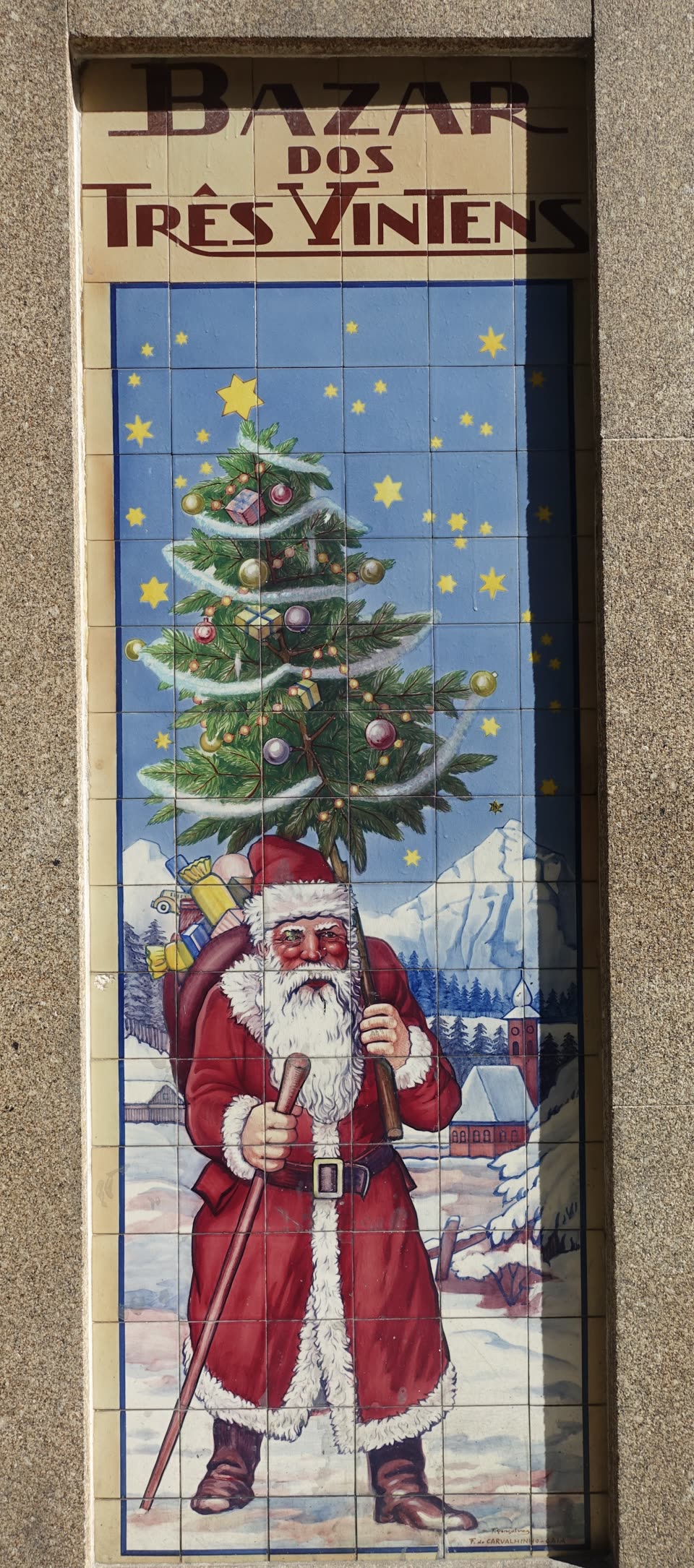
Until the mid-1980s Portugal was one of the European countries where children addressed their Christmas requests to the Child Jesus. A stocking or a little shoe went at the chimney — or under the tree — and you waited until the next morning for the generosity of the child born in the manger at Bethlehem.
In a Lisbon memory of the 1970s the grandmother cleans the chimney so the Child will not dirty his feet, and Pai Natal is explained to the children as someone who merely helps him, the Child being too small to jump from roof to roof.
He has not disappeared. What changed is which name the letters are addressed to, and in Beira Baixa there are still families who sing happy birthday to him at midnight.
Father Christmas, who took the leading role in Portugal from the middle of the 1980s. The newspaper that describes the change likens it to shifts in Germany, Hungary and Italy, and says that only then did he acquire, «among us», the prominence he has now.
The date it can be pinned to is administrative. In 1985 the Portuguese post office set up a service to answer children's Christmas letters — and by then the addressee was no longer the Menino Jesus but Pai Natal.
The Consoada is a fish supper, and the reason is the fast
Christmas Eve is the Consoada, and the dish is salt cod. An Archdiocese of Braga feature says the Braga Christmas table is not very different from that of the Portuguese generally, and that families made sacrifices — sometimes great ones — so that the bacalhau was never missing.
The reason given is penitential. Advent was kept as a fast, so the main dish of the Christmas Eve supper is by tradition fish, and only after the Missa do Galo could the faithful eat sweets and meat. That is why, the archdiocese writes, bacalhau remains an imperative on the Consoada table.
The name carries the same idea: the supper after midnight Mass was a moment of singular consolation, and consoada is what it was called.
Missa do Galo, and a village waiting for the bells in 1899
The midnight Mass is the Missa do Galo, the Mass of the Cock, celebrated after midnight into 25 December.
The nineteenth century left a description of the wait rather than of the Mass. Writing from Serpa in the Alentejo in January 1899, M. Dias Nunes described families — chiefly among the country people — gathering on Christmas night in the largest number they could manage, around great fires fed with logs of holm oak. While they waited for the festive peal of bells announcing the classic missa do gallo, which the most devout attended, they alternated cups of coffee with a heavy meal of acorns roasted in thick batches, and singing to the Child God.
In Beira Baixa the supper is boiled cod, and in one village they sing happy birthday to the Child
A broadcast report from Beira Baixa describes the regional Consoada as boiled bacalhau and vegetables, and does not forget the filhós. In Ladoeiro, a parish of Idanha-a-Nova, there are even people who sing «parabéns» to the Menino Jesus at the end of the meal — at midnight, to the figure in the crib, the song you would sing at a birthday.
The same report shows women making filhoses the Beira way, a family praying at the table, and the presépio they sing to.
The madeiro is a bonfire for the Child, and the young men cut it
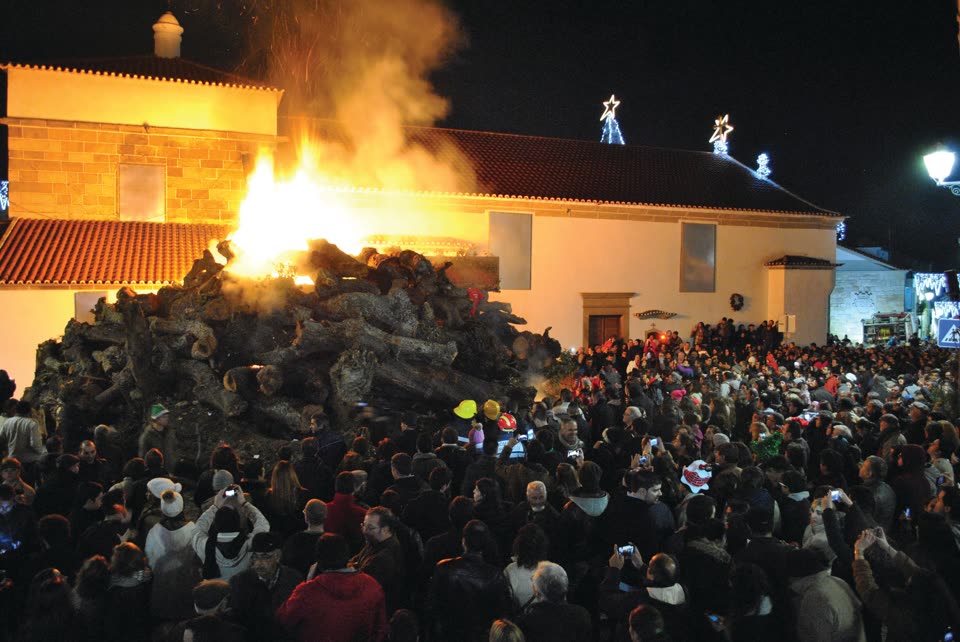
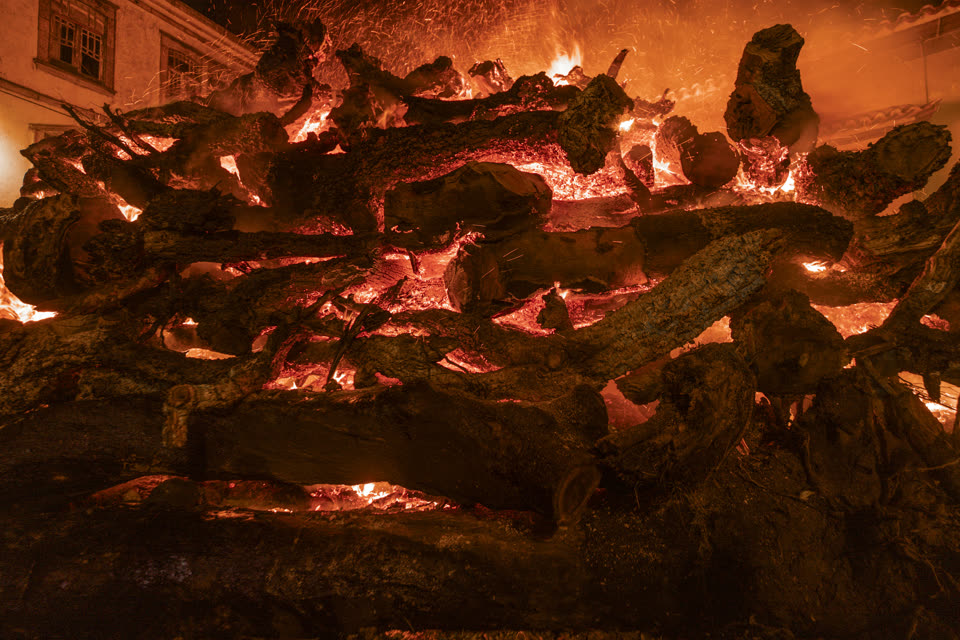
In the parishes of Penamacor the Christmas fire is the Madeiro, which the municipality describes as the name the bonfire of the Menino Jesus takes there. Every year as Christmas approaches, the young people of military-service age come together to cut and carry the trunks that will feed the fire to warm the Child.
The pile is stacked in the churchyard and lit at nightfall on the 24th — except in Penamacor town itself, which burns from the 23rd to the 24th — and it stays alight for days. After the Christmas Eve supper the population gathers round it.
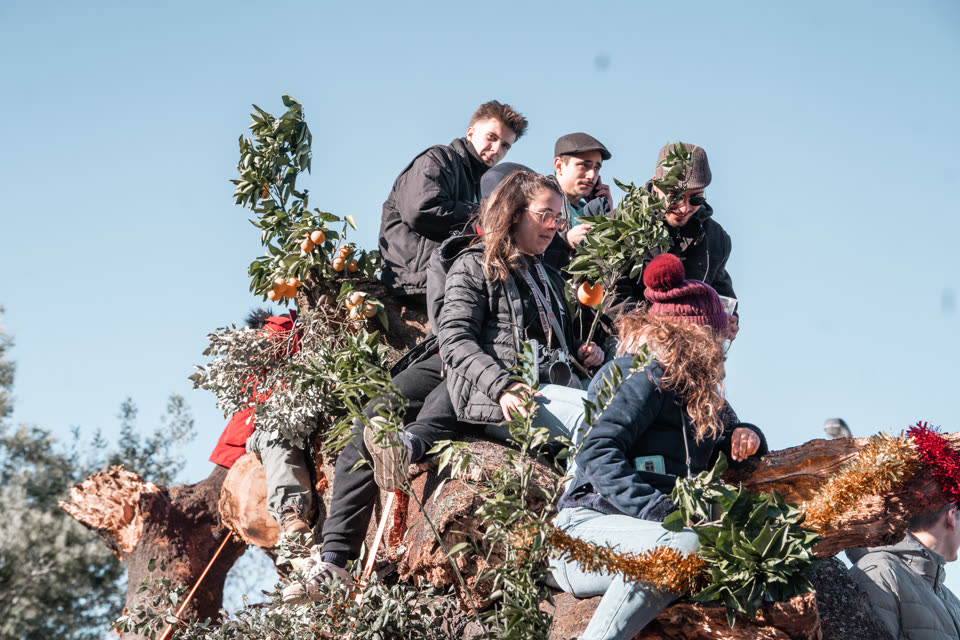
On 8 December the trunks come into town on tractors, and the young people on top throw oranges
Penamacor town does not simply find its madeiro waiting in the churchyard. The arrival has a date of its own, 8 December, and the municipality treats it as a festivity: the town comes out into the street to greet a convoy of tractors and trailers whose number, it says, always tries to beat last year’s.
On top of the trunks ride the jovens do ano — the young people whose year it is, once only the boys and now the girls as well. They carry a branch of orange that custom requires them to bring, and they throw the fruit off it into the crowd as they pass, singing to a concertina.
Getting the wood was not always so genial. The municipality records that when the young men depended on what the richer houses chose to give, and it fell short, they took firewood, oxen and carts by night — to prove the spirit of the «Malta das sortes», the band of lads drawn for military service that year. Penamacor’s madeiro has the name of being the biggest in the country.
Serpa staged the nativity as a play, with a part for the lout
From Christmas Eve until Dia de Reis, Serpa in the Alentejo used to perform the Auto Sacramental do Presépio live and in high spirits, with the whole cast tradition calls for: St Joseph, Our Lady, the angel in the cloud and the lost Child; three shepherds, one of them called the pastor alarve — the oaf; King Herod, and the Magi.
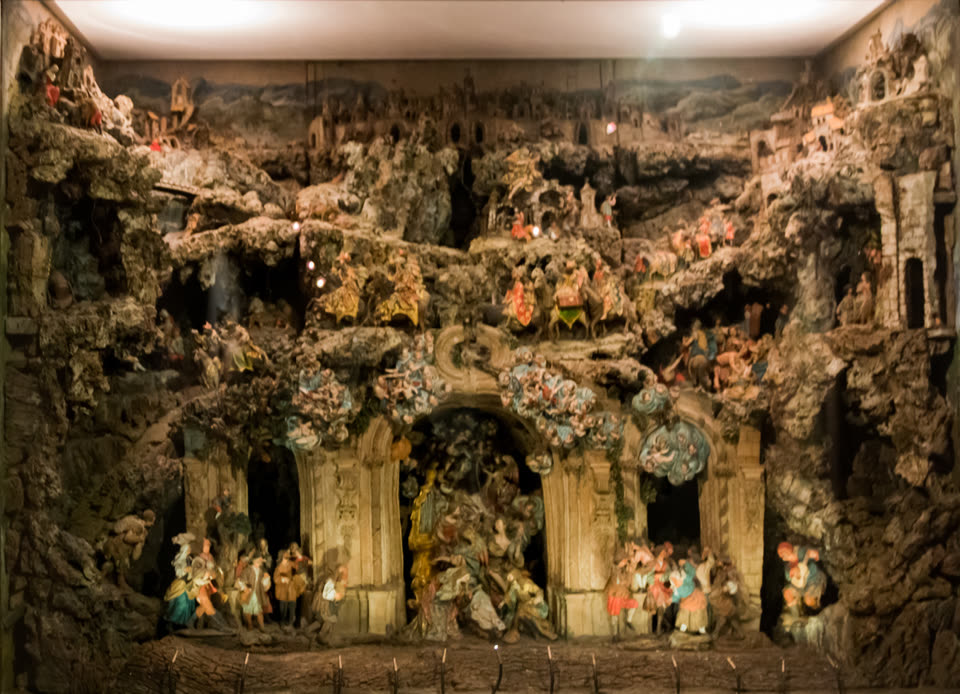
The same account treats the singing to the Child God, the Janeiras and the Reis as parts of one world rather than separate customs, which is how the season held together: a crib, a cast, and songs that went on into January.
Between December and January, groups go from house to house singing — bombos and ferrinhos, a concertina, violas and tambourines — with modinhas about Christmas and about the Kings. The tunes change from region to region and from group to group. In local speech you do not sing the Janeiras; you «go and take» them, vão tirar as janeiras.
The municipality of Vale de Cambra, in the north, calls it one of the most popular traditions in the country and among the most picturesque of the north, still holding out against modern times. It continues across that municipality, which has run a Janeiras gathering of its own; the council took over organising it in 2015.
Salt cod, soaked and boiled, with potatoes, cabbage or other vegetables and plenty of olive oil. It is the Christmas Eve dish, and what it comes with is a reason rather than a recipe: the Advent fast is why the main dish of the supper is fish, and the Braga archdiocese says families made sacrifices so that it was never missing from the table.
In Beira Baixa the broadcast record of the regional Consoada is exactly this — boiled bacalhau and vegetables — with filhós after it.
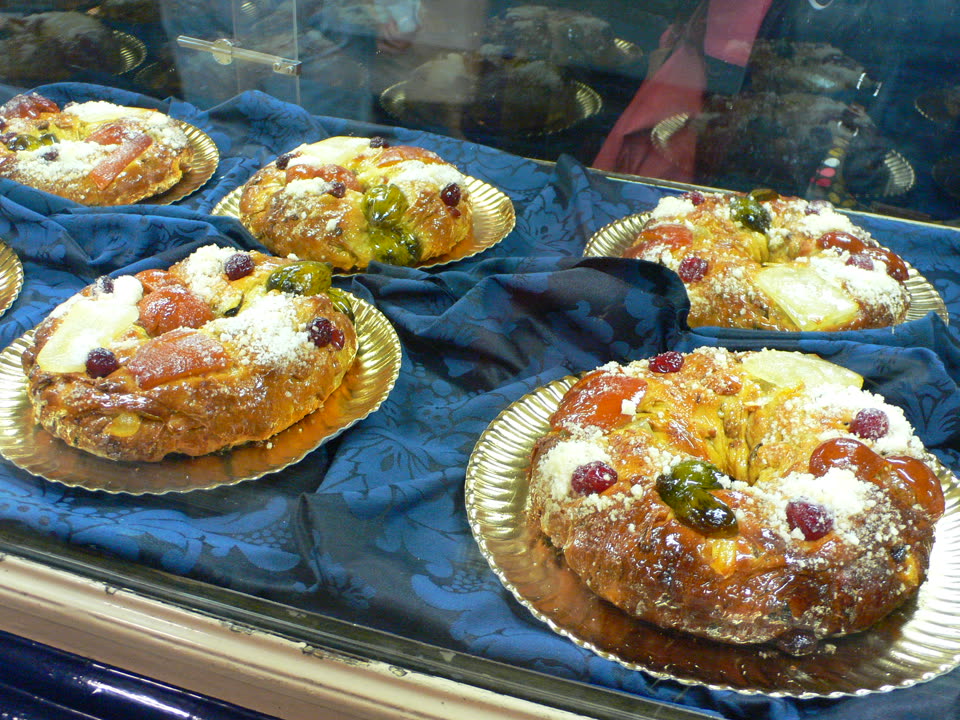
A ring of soft sweet dough under candied fruit and nuts, and the festive cake of the season. Two things are baked into it. Whoever finds the dried broad bean — the fava — pays for next year's bolo-rei. Whoever found the brinde, a small charm that was the children's delight, was said to have got luck.
The brinde has become hard to find in a shop cake, and not because anybody banned it. A 2011 rule on mixing trinkets directly into foodstuffs made the traditional metal charm rare in commercial cakes; the inspector-general of ASAE, the food-safety authority, told the national broadcaster that the rules do not prohibit selling a cake with a brinde, that a set of requirements was imposed for it, and that there may have been confusion with a general ban. Including a charm indirectly is allowed if the labelling and other rules are met.
Fried sweets pressed from a flower-shaped metal mould, dipped and lifted out of the oil so the batter takes the mould's shape. The official register of traditional Portuguese products records them for the Alentejo, and records the thing people get wrong about them: fried sweets and cakes there are typical of Christmas and of Carnival.
Popular tradition has filhós made on the Quinta-feira das Comadres — the Thursday before Carnival — to be given to the comadres, to family and to friends. The Filhós de Forma are among those made in the greatest abundance. After frying they were drained on metal sieves, now often replaced by paper.
Filhós de Forma — Produtos Tradicionais Portugueses, DGADR (Direção-Geral de Agricultura e Desenvolvimento Rural)
What people get wrong
Widely repeated claims about Christmas in Portugal that do not survive
checking. Each one says what is actually the case, because a correction
with nothing in its place leaves you worse off than before.
Contradicted
The charm in a Portuguese bolo-rei is banned.
What is actually the case. It is rare in shop cakes and it is not prohibited. A 2011 rule on mixing trinkets directly into foodstuffs is what made the traditional metal brinde uncommon in commercial bolo-rei, and the inspector-general of ASAE, the food-safety authority, said so in as many words to the national broadcaster: the legislation does not forbid selling a cake with a brinde; a set of requirements was imposed for doing so; and there may have been confusion with a general prohibition. A charm included indirectly is allowed where labelling and the other rules are met.
The fava — the dried broad bean that makes you pay for next year's cake — was never in question.
Pai Natal has always been the Portuguese gift-bringer.
What is actually the case. Until the middle of the 1980s the presents came from the Menino Jesus, and the letters were addressed to him. A stocking or a little shoe went at the chimney and the child born at Bethlehem filled it. Pai Natal was already appearing before then, but as a helper: the Child was too small to jump from roof to roof, so Father Christmas gave him a hand.
The newspaper that records the change dates the shift to the mid-1980s and likens it to what happened in Germany, Hungary and Italy. The administrative marker is 1985, when CTT began answering the letters and the addressee had already changed.
What is actually the case. 24 December is not among the mandatory national holidays. The Labour Code's list of them runs 1 January, Good Friday, Easter Sunday, 25 April, 1 May, Corpus Christi, 10 June, 15 August, 5 October, 1 November, and 1, 8 and 25 December. Christmas Eve is not on it — and nor is 6 January — while 8 December is.
That is a statement about the mandatory list rather than about what shops and offices actually do on the afternoon of the 24th, which is a different question and not one the Labour Code answers.
What is actually the case. They are a Christmas sweet and a Carnival one, and the official register of traditional products says both in its first sentence: fried sweets and cakes are typical of Christmas AND of Carnival in the Alentejo. Popular tradition puts the making on the Thursday before Carnival, the Quinta-feira das Comadres, when they were given to the comadres, to family and to friends.
There is also more than one thing called filhós. The Alentejo Filhós de Forma are pressed from a flower-shaped metal mould; the filhós that follow the boiled cod in Beira Baixa are the regional sweet of that supper, and the two are not the same object.
The two December dates a visitor assumes are holidays in Portugal are not the ones that are. Article 234 of the Labour Code makes 1, 8 and 25 December mandatory national holidays — so the Immaculate Conception on the 8th is a day off, and Christmas Eve, when the Consoada is actually eaten, is not. Neither is 6 January, Dia de Reis, which the Janeiras songs are half about.
The Penamacor madeiro arrives seventeen days before it is lit. The wood is brought into the town on 8 December, carried by the young people of the year, who ride in on the trunks throwing the fruit of an orange branch that custom requires and singing to a concertina. It is not set alight until the night of the 23rd, and then it burns on — the municipality says it is kept until 6 January, Dia de Reis, as tradition dictates.
Portugal's post office has been answering children's Christmas letters since 1985, and the service arrived just after the addressee changed. The newspaper that records it puts the two facts side by side: CTT created the reply service in 1985, fourteen years after an earlier initiative, and by then the letters were going to Pai Natal rather than to the Menino Jesus.
Every claim carries its own citation. They are collected below, so you
can see what the page rests on and how much of it comes from where.
A consoada braguesa — Arquidiocese de Braga, 23 December 2024. Retrieved 2026-11-10. archived 14 August 2025The fast and the fish in one passage: «As famílias esforçavam-se para que nunca faltasse o bacalhau, fazendo, por vezes, grandes sacrifícios para o comprar. O carácter penitencial que costumava ser observado no Advento justifica o facto do prato principal do jantar natalício ser, por tradição, peixe. Apenas depois da Missa do Galo os fiéis poderiam consumir doces e carne. Por isso mesmo, o bacalhau continua a ser um imperativo na mesa da consoada.» And the name: «Seria apenas após a Missa do Galo, celebrada após a meia-noite de 25 de dezembro, que se realizava a ceia natalícia, momento de singular consolação, por isso mesmo, designado de consoada.»
Antes do Pai Natal, havia as cartas ao Menino Jesus — Maria João Martins, Diário de Notícias, 23 December 2020. Retrieved 2026-11-10. archived 8 August 2026«Até meados dos anos 1980, Portugal era um dos países europeus em que os pedidos natalícios das crianças eram dirigidos ao Menino Jesus. Punha-se a meia ou o sapatinho na chaminé (ou sob a árvore de Natal) e esperava-se até à manhã seguinte pela generosidade da criança nascida na manjedoura de Belém.» And on the helper: «O Pai Natal começava a aparecer mas dele, explicavam os adultos, esperava-se apenas que ajudasse o Menino.»
O Madeiro — Município de Penamacor. Retrieved 2026-11-10. archived 9 September 2024The rite and the two lighting dates: «O Madeiro, designação que aqui assume a fogueira do Menino Jesus, é tradição forte em terras de Penamacor. Todos os anos, com o aproximar do Natal, por todas as freguesias do concelho, os jovens em idade de cumprir o serviço militar unem-se para cortar e transportar os troncos que alimentarão a fogueira para aquecer o Menino Jesus.» And: «O grande monte de madeira, depositado no adro da igreja, é ateado ao cair da noite do dia 24, à exceção de Penamacor, que arde de 23 para 24, e mantém-se aceso durante vários dias. Depois da ceia de Natal, a população reúne-se em redor da fogueira.» The 8 December arrival and who rides it are in the same page, «dantes só os rapazes e agora também as raparigas».
Tradição do Madeiro cumpriu-se em Penamacor — Município de Penamacor, 25 December 2023. Retrieved 2026-11-10.For how long it burns, from the year the municipality reported it: «Na passada noite de 23 para 24 foi aceso o maior madeiro do país, em Penamacor», and it would warm the town through the first days of winter «até dia 6 de janeiro, dia de Reis, conforme dita a tradição».
Encontro Concelhio Cantares Janeiras — Município de Vale de Cambra. Retrieved 2026-11-10. archived 16 July 2026The custom and the idiom: «O Cantar das Janeiras é uma das tradições mais populares do país e um testemunho do saber popular das gentes que cantam modinhas alusivas ao Natal e aos Reis.» / «as Janeiras são das tradições mais pitorescas do Norte do País, que ainda vão resistindo aos tempos modernos.» / «percorrem os lugares, de casa em casa, cantando às famílias e animando as noites frias entre Dezembro e Janeiro.» / «como se diz na gíria popular “vão tirar as janeiras”.»
O Presépio na tradição popular portuguesa — Museu Nacional de Arqueologia, quoting M. Dias Nunes, «Anno-Bom e Rêis», A Tradição, Serpa, January 1899. Retrieved 2026-11-10. archived 20 July 2018The museum preserves the 1899 passage with its own spelling: «Em noite de Natal, ao redor dos grandes lumes alimentados a tóros de azinho, reune cada familia - principalmente entre a classe camponeza - no maior numero possivel dos seus membros. E, emquanto aguardam o repicar festivo dos sinos annunciando a proximidade da classica missa do gallo, a que assistem os mais devotos, vão alternando a chavena do café e o pesado repasto das bolotas, preparadas em grossas assaduras, com apreciaveis córos ao Deus-Menino.»
Código do Trabalho, Artigo 234.º — Feriados obrigatórios — Portuguese Labour Code, quoted in a published extract of articles 234.º–236.º by SNQTB (Sindicato Nacional dos Quadros e Técnicos Bancários). Retrieved 2026-11-10. archived 29 June 2024The article lists the mandatory holidays in one sentence, and three of them are in December: «1 - São feriados obrigatórios os dias 1 de janeiro, de Sexta-Feira Santa, de Domingo de Páscoa, 25 de abril, 1 de maio, de Corpo de Deus, 10 de junho, 15 de agosto, 5 de outubro, 1 de novembro, 1, 8 e 25 de dezembro.»
boas-festas, in Dicionário Priberam da Língua Portuguesa — Priberam Informática, Lisbon. Retrieved 2026-11-10.The entry is a feminine plural noun rather than an interjection, which is the part worth knowing: «boas-festas ( bo·as·-fes·tas ) nome feminino plural Cumprimento feito pelo Natal e pelo Ano Novo (ex.: cartão de boas-festas; escreveu a dar as boas-festas ). Origem: boa, feminino de bom + festa.»
Filhós de Forma — Produtos Tradicionais Portugueses, DGADR (Direção-Geral de Agricultura e Desenvolvimento Rural). Retrieved 2026-11-10. archived 16 July 2024The register puts both feasts in its first sentence: «Os doces e bolos fritos são típicos do Natal e do Carnaval no Alentejo. É da tradição popular que as filhós se faziam no Alentejo na quinta-feira das comadres (quinta-feira anterior ao Carnaval) para se presentearem as comadres, familiares e amigos. As Filhós de Forma são das que se fazem em maior abundância.»
Ceia de Natal da Beira Baixa — RTP Arquivos — Notícias do dia, 24 December 2017, journalist Paulo Braz. Retrieved 2026-11-10.The broadcaster's own summary of the report: «Beira Baixa, consoada beirã serve-se com o tradicional bacalhau cozido e legumes, não esquecendo as filhós e no Ladoeiro, freguesia do concelho de Idanha a Nova, no final da ceia há mesmo quem cante os parabéns ao menino jesus.» And from the shot list: «família cantam os parabéns ao "Menino Jesus" à meia noite.»
Brinde no bolo-rei é tradição, não proibição — RTP Notícias. Retrieved 2026-11-10. archived 8 December 2022The two surprises: «Quem encontrasse no interior do bolo a fava seca tinha de pagar o bolo-rei no ano seguinte. A quem calhasse o brinde, que fazia a delícia das crianças, dizia-se que ganhava sorte.» The rule: «após uma lei de 2011 relativa à mistura direta de brindes em géneros alimentícios é raro encontrar à venda o bolo com o tradicional brinde.» And the authority's own correction, from inspector-general Pedro Portugal Gaspar: «a legislação que regula esta matéria não proíbe a venda do bolo com brinde, mas “houve um conjunto de requisitos que foram impostos para essa comercialização e, eventualmente, terá havido uma confusão com uma proibição generalizada”.»