Christmas Day in Namibia is 25 December. It is a public holiday.
How to say it
English
Good morning, have you made it safely to Christmas?
Good morning, have you made it safely to Christmas?
What is said at the gate on Christmas morning in an Aawambo homestead, as children and adults go round the neighbours with sweets. English is Namibia's only official language and the one this was written down in; Oshiwambo calls the day Okrismesa.
A goat is killed, and the list of what else is needed is a national joke
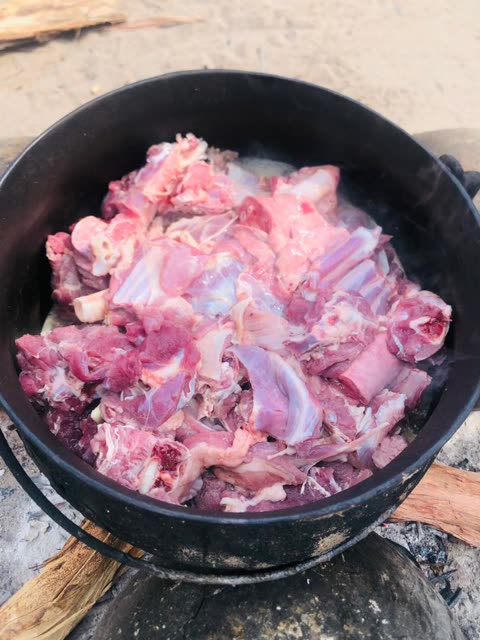
In the north the Christmas that people describe begins with slaughtering a goat. Around it has grown a half-serious canon of everything else required — the beer chilling in cool boxes, tomato sauce laid in by the bottle, rice by the plateful — posted every December as the Wambo Christmas Starter Pack, with the understanding that anyone who needs it explained is not from there.
The Christmas tree is a branch, and in a homestead there is one on every hut
There is no pine. A branch is cut in the bush — jackalberry in the north, a dried thorn bush in the farming south — and in an Aawambo homestead the small branches are fixed to the individual huts and structures while a large one is set in the oshoto, the open yard at the centre. The ornaments go on in the late afternoon, the whole family hanging them while sweets are passed round, and then a fire is lit, scripture is read and the carols start.
The church gives each family its own verses, and they recite them before the play
In a village parish the preparation is divided up. Church leaders pick passages — Isaiah, Luke, Matthew, John — and assign verses to each family to learn. Shops shut at noon on the 24th; at five the whole community is in the church hall for the Christmas play, and when it is over each family stands and recites what it was given. The service itself starts at eleven and runs to midnight, and then the bells go and the fireworks start.
Christmas morning is spent checking the neighbours got here
Before anything else on the 25th, children and adults walk between the homesteads with sweets, calling at each one. The question asked at the gate is not how are you but whether you made it — a greeting that takes for granted that a year is something a household comes through rather than simply passes. Presents, if there are any, are opened before setting out.
For most children it is the one day of the year they get new clothes
Dressing up is not decoration here, it is the point. Families go to church on Christmas Eve and again on the 25th, and the children are turned out in something new — which for most of them happens once a year, on this day.
The country drives north, and some of it drives two thousand kilometres
Christmas is when Namibians go back to the family place, and in a country this size and this empty that means real distance. Most stay put and host; the ones who travel often cross most of the country to do it. The village, not the town, is where the day is understood to happen.
In Afrikaans Namibia the evening before carries a concert, and the day itself may be a beach
The Afrikaans-speaking Christmas has its own shape: a concert got up at home on Oukersaand, songs around the tree, and a table that runs to grandmother's trifle, fruit cake, sheep's head and a mustard ring. The 25th is spent under the sun — on the sand at Henties Bay, over a potjie on the farm, or cooking at home.
Windhoek's German congregation puts the children on first and the sermon second
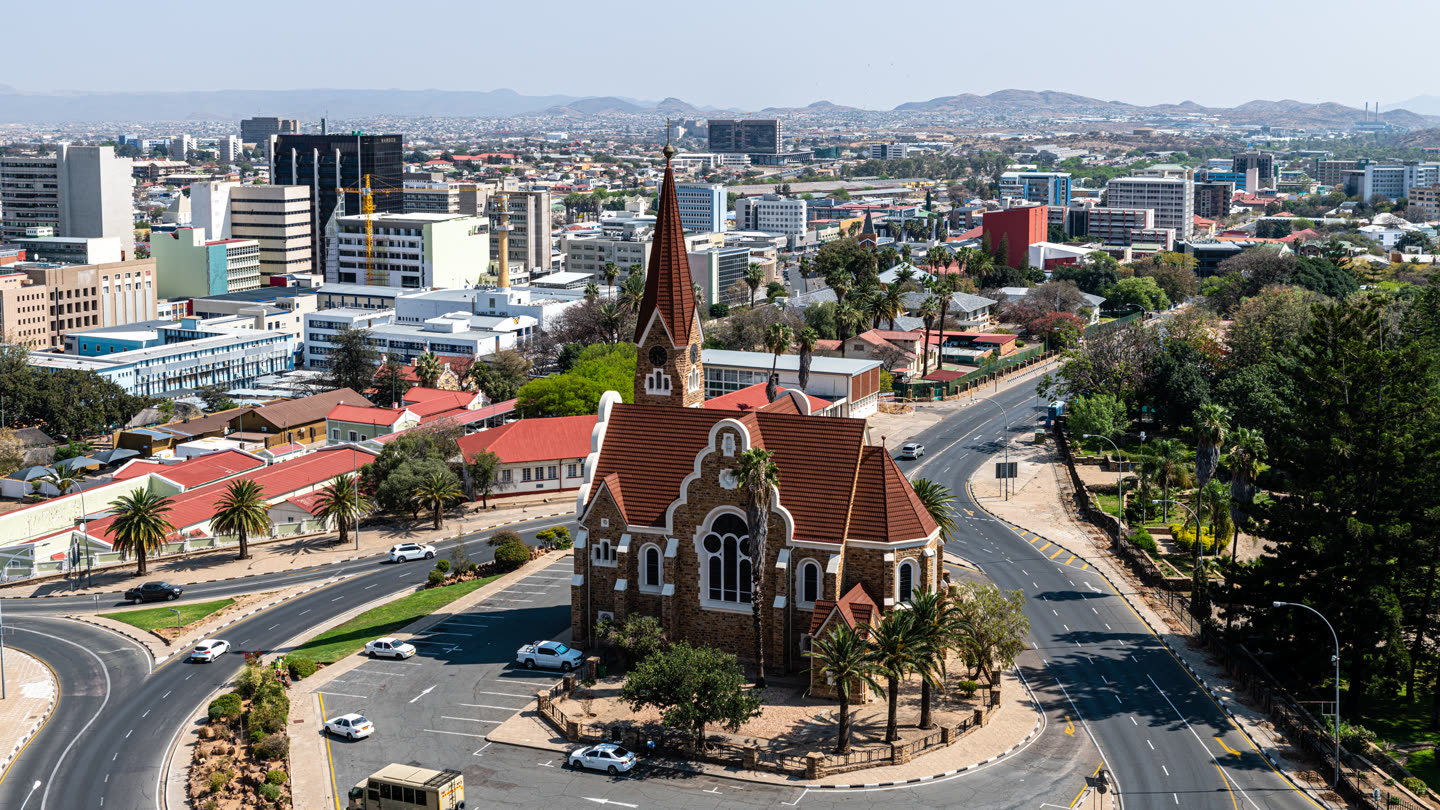
The German-speaking Lutheran parish keeps a two-part Christmas Eve at the Christuskirche: an afternoon family service carried almost entirely by the children, who stage a musical of the Nativity with narration and singing, and then a plainer evening service for the adults. The afternoon one gets applause and an encore, which is not usual in that building.
The animal, killed at the homestead for the day. It is the fixed point of a northern Namibian Christmas — the thing that has to happen before any of the rest of it — and what goes alongside is whatever the household runs to: rice, macaroni, salad.
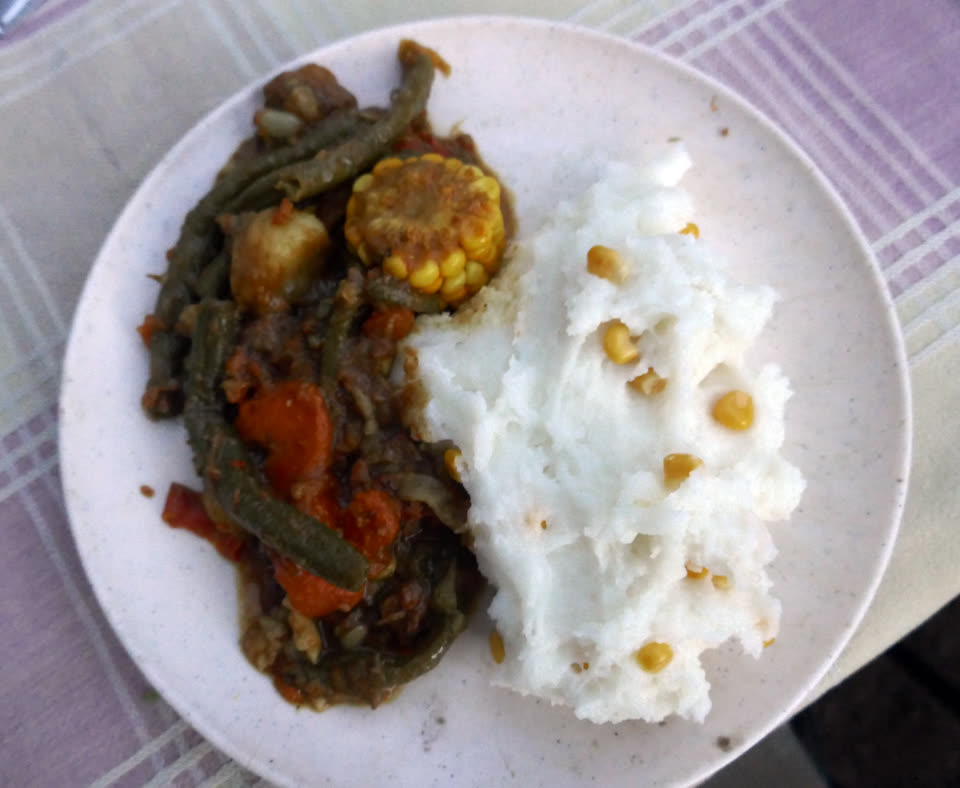
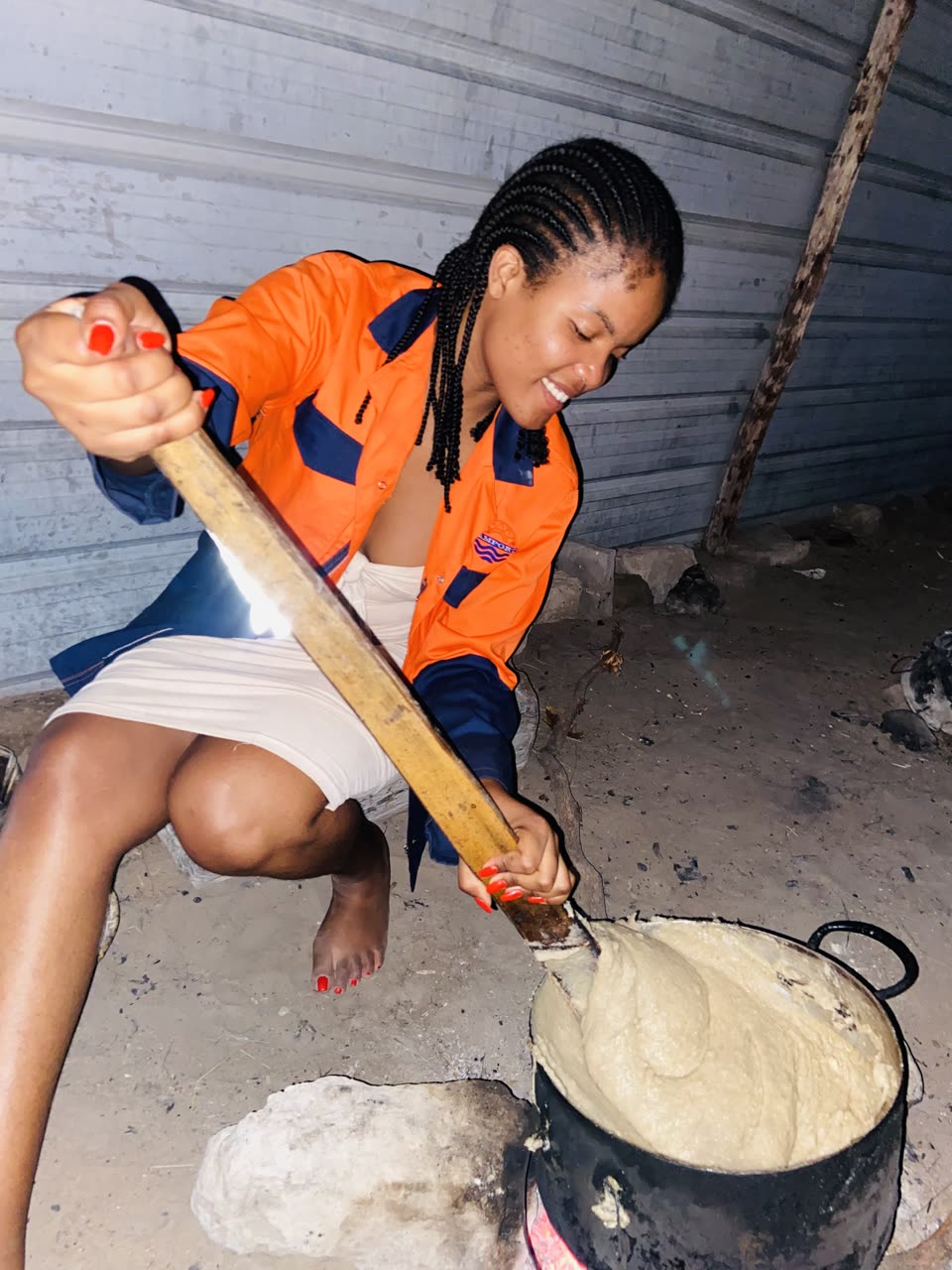
Stiff porridge pounded from omahangu, the pearl millet that is the staple crop of the north, and the thing goat meat is eaten with. It is on the Christmas Eve table beside the boiled fish and the vegetables, and it is one of the three dishes a national survey found two-thirds of Namibians still manage to put on the table at Christmas however tight the money is.
Not a side dish so much as an obligation. It appears in the national survey's short list of the traditional Christmas foods, alongside the goat and the porridge, and in family accounts it is the one item nobody is allowed to forget.
The Public Holidays Act gives the following Monday when a holiday lands on a Sunday — but only if that Monday is not already a holiday. The day after Christmas is Family Day. So in the years when the 25th is a Sunday the rule switches itself off, and Namibians get two holidays instead of the three the same calendar hands most of their neighbours. It last happened in 2022; the next is 2033.
The same survey that found family at the centre of the season found the other half of it: 53% of respondents said loneliness is a significant problem at Christmas, and the fund publishing the figures said so out loud rather than burying it. Two in five take more than a fortnight off, which is its own kind of financial pressure.
The harbour town's mayor switches on the lights and then gives away 650 parcels of food to older residents — a bag of fish, a bag of chicken, and two kilos each of rice, sugar, macaroni and maize meal with two litres of oil. The distribution is not done by the council. Representatives of twenty different churches collect the parcels from the mayor's office and deliver them.
Every claim carries its own citation. They are collected below, so you
can see what the page rests on and how much of it comes from where.
Heiligabend in der Christuskirche: Frohes Spiel und ernste Worte — Allgemeine Zeitung (Windhoek). Retrieved 2026-11-18.«Mit dem Musical „Das erste Weihnachtswunder“ unter Leitung eines Mitarbeiterteams um Angelika Höcht verzauberten 21 Kinder im Alter von sechs bis 13 Jahren die Besucher des Familiengottesdienstes am Nachmittag. Dabei wurde die Geburt Jesu mit Erzählungen, Musik und Gesang dargestellt. Am Ende durfte sogar geklatscht werden, und es gab eine Zugabe.» In the evening Pastor Achim Gerber preached on John 3:16–21: «Wir treten am Weihnachtsabend auch aus den Schatten ins Licht der Botschaft vom Neuanfang.»
Städte erstrahlen in weihnachtlichem Lichterglanz — Allgemeine Zeitung (Windhoek). Retrieved 2026-11-18.«Die Bürgermeisterin von Lüderitz, Brigitte Fredericks, verteilte 650 Lebensmittelpakete an ältere Menschen in der Hafenstadt. Die Pakete enthielten eine Tüte Fisch, eine Tüte Hähnchenfleisch und eine Tüte mit 2 kg Reis, 2 kg Zucker, 2 kg Makkaroni, 2 kg Maismehl und 2 l Speiseöl. Ausgewählte Vertreter von 20 Kirchen holten die Pakete im Büro der Bürgermeisterin ab und verteilten sie an die Begünstigten.»
Public Holidays Act 26 of 1990 (GG 125), section 1 and Schedule — Legal Assistance Centre, Windhoek — Namibia: Annotated Statutes. Retrieved 2026-11-18.Section 1(1): «The days specified in the Schedule shall be public holidays.» The Schedule runs: New Years Day, Good Friday, Easter Monday, Independence Day (the twenty-first day of March), Workers Day (the first day of May), Cassinga Day (the fourth day of May), Ascension Day, Africa Day (the twenty-fifth day of May), Heroes Day (the twenty-sixth day of August), Day of the Namibian Women and International Human Rights Day (the tenth day of December), «Christmas Day (the twenty-fifth day of December)» and «Family Day (the twenty-sixth day of December)».
Opinion — How do you spend Christmas in Namibia? — New Era (Namibia). Retrieved 2026-11-18.«The morning of Christmas Day, children and adults visit the neighbours' homesteads to share sweets and treats and check in with them if they all made it to Christmas, there is a phrase we usually share as we enter each homestead, “Good morning, have you made it safely to Christmas?”» The Oshiwambo word for the feast is attested separately — The Namibian's Oshiwambo edition uses «Okrismesa», as in the headline «…otashi dulika ku yulululwe manga Okrismesa inai fika», 6 November 2026.
Lanterns, rolskaats en trolle vir Kersfees — Republikein (Namibia). Retrieved 2026-11-18.The Namibian sentence is: «Namibiese families geniet tradisies soos konsert hou op Oukersaand, liedjies om die Kersboom, ouma se triffle, vrugtekoek, skaapkop of 'n mostertring. Kersdag word gevier onder die warm son op Hentiesbaai se strand, 'n potjiekos op die plaas of kookkos by die huis.»
A Namibian Christmas — The Namibian. Retrieved 2026-11-18.It opens: «'Twas the night before Christmas and all through the north, goats had just been slaughtered. Tafel was chilling in cooler boxes, tomato sauce had been stored in abundance and rice enough would soon be eaten by the plateful.» Those elements are Shaende Kondjeni Justus's, posted as an image titled «The Wambo Christmas Starter Pack» with the words «if you know, you know»; Mutinta Nchindo's correction was that «Tafel is missing». Selma Bachler puts the same thing as a question: «What's Christmas without slaughtering a goat in the north?» Not every voice is warm about it — Desmond Usuta Kandorozu's answer was that «it is just another drinking day».
61% of Namibians opt to spend festive season with family — survey — The Namibian. Retrieved 2026-11-18.«For those who travelled, the dedication to reconnecting with family was evident, with many journeying over 2 000 kilometres.» The Namibian's 2018 reader piece puts the same thing in one line from Aaron Tuyooleni Shapaka: «The village is the place to be, Iipanda to be exact.»