Christmas Day in Croatia is 25 December. It is a public holiday.
How to say it
Croatian
Sretan Božić
say it: SREH-tan BOH-zheech
A synthesised voice — not a recording of a person — saying Sretan Božić
in hr-HR.
Happy Christmas. Croatian capitalises Božić, because it is the name of the feast rather than a season.
The form in the source is the full sentence the Archbishop of Zagreb closes his Christmas message with — «Neka vam svima Božić bude sretan i blagoslovljen», may Christmas be happy and blessed for all of you. The two-word greeting is the everyday short form of that construction, and the adjective is the same one: sretan.
Badnjak is the day, and the log is a different word
In Croatian, badnjak is Christmas Eve itself — the last day of Advent, also called Badnja večer. The log that burns on the hearth is the panj badnjak, a separate entry in the national encyclopedia, which matters because in neighbouring Serbian the one word badnjak is the log.
The name comes from the Proto-Slavic root bъd, to keep watch: the vigil kept on the eve of a great feast until the midnight service has ended. The encyclopedia puts the ritual part of the day in one sentence — «Obredni dio Badnjaka završavao je odlaskom ukućana na ponoćnu misu.»
Badnjak — Hrvatska enciklopedija, mrežno izdanje. Leksikografski zavod Miroslav Krleža, Zagreb
Straw on the floor, and the children sleep on it
Straw is carried into the house on Christmas Eve and spread on the floor, and the children of the house sleep on it. The encyclopedia records it as part of the rural folk tradition rather than as a general practice, and the head of the house is the one who brings it in.
The straw does not simply get swept out. On Ivanje, the feast of Saint John on 27 December, it was carried out to the fruit trees.
Badnjak — Hrvatska enciklopedija, mrežno izdanje. Leksikografski zavod Miroslav Krleža, Zagreb
Sprouted wheat is the old decoration, and the tree is the newcomer
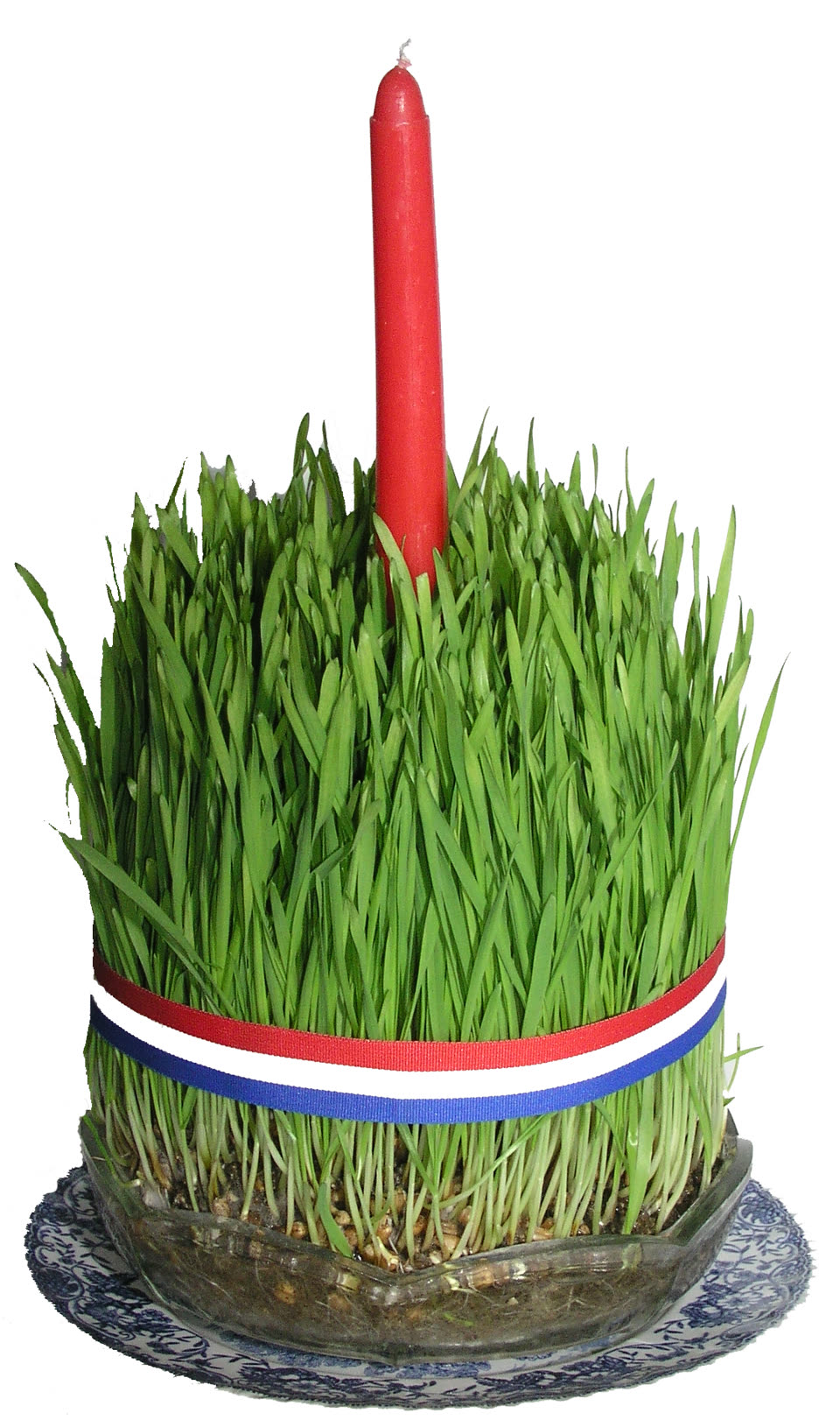
A dish of wheat is sown indoors in December and stands on the Christmas table with its blades grown. The encyclopedia lists it among the things that are obligatory in the room on Christmas Day — «plitica s izniklom pšenicom» — beside a vessel holding different kinds of grain and the Christmas candle.
The sowing day is not one day. The entry on Badnjak gives two feasts rather than a date, «posijane na blagdane sv. Lucije ili sv. Barbare» — sown on the feast of Saint Lucy or of Saint Barbara — so the custom is not fixed to a single morning across the country.
And it is the decorated tree that is the newcomer here, not the wheat. The same entry describes the house dressed in fresh greenery, the sprouted blades or a branch of an evergreen, and says the ornamented Christmas tree is taken up «tek u novije doba», only in recent times, under the influence of town customs.
Badnjak — Hrvatska enciklopedija, mrežno izdanje. Leksikografski zavod Miroslav Krleža, Zagreb
The polaznik, and why he has to sit down heavily
The first person to come through the door after Christmas Eve decides the year's luck, and in Croatian he is the polaznik. He is chosen rather than left to chance, and what he does on arrival is prescribed: he must sit down firmly, so that the poultry will lay well.
It is one of the clearest cases in the record of a Christmas custom whose point is the farmyard rather than the nativity.
Božić — Hrvatska enciklopedija, mrežno izdanje. Leksikografski zavod Miroslav Krleža, Zagreb
Koledari on the coast, betlehemari in the north
The house-visiting singers have different names and different equipment depending on which half of the country you are in. On the Adriatic they are koledari. In the northern regions they are betlehemari, and they carry a lit nativity scene from door to door.
In Slavonia the visit is a play: a performance of Adam and Eve, staged on the day itself.
Božić — Hrvatska enciklopedija, mrežno izdanje. Leksikografski zavod Miroslav Krleža, Zagreb
Neviđane lights its koleda three times a winter, on a plague vow
At Neviđane on the island of Pašman in northern Dalmatia — 353 people at the 2021 census — a great bonfire called the koleda is lit at a place in the village kept for it, the Koledište. A group of men, the koledari, walk round it in order, singing the tune that belongs to it and calling down God's blessing; the rest of the village then joins the dance around the fire.
It happens three times: on Badnjak, on New Year's Eve and at Epiphany. The village's own account of why is a vow made in the seventeenth century, that they would mark it three times a year and give thanks if God kept the plague from them.
The custom lapsed from the second half of the 1940s until the mid-1990s — the fire was still lit, but the rest was not done — and was put back together in 1995 from what Krsto Štorić, who had taken part as a boy and a young man, could remember. He died in 2000, aged ninety.
Riding on Saint Stephen's day, and a village king two days after Christmas
The cycle does not end on the 25th, and what happens next depends on where you are. In northern Croatia, Stjepanje — 26 December — was a day for riding horses. On the Adriatic islands a seoski kralj, a village king, was chosen two days after Christmas.
On Nevina dječica, Holy Innocents, children were whipped with fresh twigs. The whole cycle closes on Tri kralja, Epiphany: the last day of carolling, of lighting candles and of eating the Christmas breads.
Božić — Hrvatska enciklopedija, mrežno izdanje. Leksikografski zavod Miroslav Krleža, Zagreb
In the village, only the children were given anything
The encyclopedia draws a line between town and country that is worth keeping, because it is the opposite of what a modern reader expects. In town, everyone in the household gave each other presents. In the village, only the children were given anything, and what they were given was hazelnuts and walnuts.
The adults had their own exchange and it was not a present. Young men and women gave each other red apples, as a sign of affection.
Božić — Hrvatska enciklopedija, mrežno izdanje. Leksikografski zavod Miroslav Krleža, Zagreb
What is eaten
The meatless Christmas Eve table
Badnjak is a fast, and the encyclopedia lists what stands on the table instead of meat: beans, honey, garlic, walnuts and fish. It is a short list and a deliberate one — the day's food is defined by what is left out.
Badnjak — Hrvatska enciklopedija, mrežno izdanje. Leksikografski zavod Miroslav Krleža, Zagreb
The ritual bread, under five names
A ritual bread stands on the Christmas Eve table, and the encyclopedia gives five of its names at once: česnica, ljetnica, litnjak, božitnjak, krsnica. The spread of names across one small country is the point — this is a bread recorded locally and called locally, not a single national loaf.
Badnjak — Hrvatska enciklopedija, mrežno izdanje. Leksikografski zavod Miroslav Krleža, Zagreb
What people get wrong
Widely repeated claims about Christmas in Croatia that do not survive
checking. Each one says what is actually the case, because a correction
with nothing in its place leaves you worse off than before.
Contradicted
Christmas Eve is a public holiday in Croatia.
What is actually the case. It is not in the Act, and the Act is short enough to read end to end. The Zakon o blagdanima, spomendanima i neradnim danima u Republici Hrvatskoj lists the holidays one by one in članak 1., and 24 December is not among them; it is not among the spomendani in članak 2. either, nor in the religious non-working days of članak 3.
What the Act does name is 25 December, Božić, and 26 December, «prvi dan po Božiću, Sveti Stjepan». Badnjak is the day Croatian Christmas is actually built around — the fast, the straw, the bread, the midnight mass — and the law has nothing to say about it.
Djed Božićnjak is Croatia's traditional Christmas gift-bringer.
What is actually the case. He is the gift-bringer now, and he is not old. Croatian ethnology watched him arrive.
Dunja Rihtman-Auguštin of the Institute of Ethnology and Folklore Research in Zagreb wrote the figure up in 1994, in a paper about the public arguments that broke out over Christmas symbols in Croatia in December 1993. She calls the most heated of those arguments — the one with a political subtext — the debate over «novoizumljenoj tradiciji “Djedu Božićnjaku”», the newly invented tradition of Djed Božićnjak.
The same paper sets out why there was room for a new figure at all: after half a century in which the keeping of Christmas was pushed down, the feast and the whole cycle of customs around it came back in post-communist Croatia, and were partly restored as a deliberate act. Rihtman-Auguštin also points to Lydia Sklevicky's 1988 study of the «Nova Nova godina», which showed how the communist authorities had moved the symbols of Christmas onto New Year.
So the honest version is that Croatia's current gift-bringer dates from within living memory, and that people were still arguing about him in the newspapers in 1993.
Dunja Rihtman-Auguštin, «Božićni prijepori» — Etnološka tribina: Godišnjak Hrvatskog etnološkog društva, vol. 24, no. 17 (1994), pp. 75–89. Izvorni znanstveni članak. Institut za etnologiju i folkloristiku, Zagreb
Worth knowing
Croatian law gives a day off on 7 January — to the people who keep Christmas then. Članak 3. of the Act on holidays makes that day non-working for «kršćani koji slave blagdan Božića na dan 7. siječnja». The statute's own Christmas is the 25th, and it writes the other date in beside it.
The Croatian statute does not call 26 December the second day of Christmas. It calls it «prvi dan po Božiću, Sveti Stjepan» — the first day after Christmas, Saint Stephen. The counting starts again on the 26th rather than treating the two as a pair.
If a Croatian public holiday falls on a Sunday, it is not moved. Članak 4. says so in one line, which means that in a year when Christmas Day is a Sunday the country loses a day off rather than gaining a Monday.
The word for Christmas Eve is a word for staying awake. Badnjak comes from the Proto-Slavic root bъd, the vigil kept before a great feast until the midnight service has finished — the night is named after not sleeping through it.
Badnjak — Hrvatska enciklopedija, mrežno izdanje. Leksikografski zavod Miroslav Krleža, Zagreb
Sources
Every claim carries its own citation. They are collected below, so you
can see what the page rests on and how much of it comes from where.
Rahela Jurković, «Tradicijski godišnji običaj neviska koleda: Neviđane, otok Pašman» — Asesor, Zagreb, November 2023; electronic edition, ISBN 978-953-48711-4-0, published with the support of the Ministarstvo kulture i medija Republike Hrvatske. Retrieved 2026-11-24.The monograph records that the custom was protected as a Croatian intangible cultural good in 2013, by a decision of the Ministry of Culture of 30 July 2013, klasa UP/I-612-08/13-06/0186, and that the protection decision itself dates the custom to the seventeenth century «kao dio zavjeta koji su stanovnici mjesta dali Bogu da će ga tri puta godišnje slaviti i zahvaljivati mu ako ih zaštiti od kuge». The three days are given as «Badnjak, Stara godina i Sveta tri kralja». On the lapse and the revival: «Nakon što se u razdoblju od druge polovice 1940-ih do sredine 1990-ih godina nije u cijelosti održavao (samo se palila koleda), običaj je obnovljen 1995. godine».
Dunja Rihtman-Auguštin, «Božićni prijepori» — Etnološka tribina: Godišnjak Hrvatskog etnološkog društva, vol. 24, no. 17 (1994), pp. 75–89. Izvorni znanstveni članak. Institut za etnologiju i folkloristiku, Zagreb. Retrieved 2026-11-24.The paper's own abstract on p. 75: «Istražujući javnu polemiku o božićnim simbolima (Djed Božićnjak) i zbivanjima (božićna i novogodišnja pucnjava) u prosincu 1993. autorica usporedno propituje postmodernu antropološku kritiku pojma običaj, a prijepore oko običaja i simbola nastoji intrepretirati kao znakove kolebanja i (ili) sukoba mentaliteta.» On p. 76: «Najizrazitija, s političkim podtekstom, bila je rasprava o novoizumljenoj tradiciji “Djedu Božićnjaku”.»
Badnjak — Hrvatska enciklopedija, mrežno izdanje. Leksikografski zavod Miroslav Krleža, Zagreb. Retrieved 2026-11-24.The entry opens «Badnjak ili Badnji dan, posljednji dan Adventa (Došašća), dan uoči Božića» and derives the name from the Proto-Slavic bъd, a vigil «uoči velikih kršćanskih blagdana, dok ne završi ponoćna služba Božja». The site's own citation line reads «Badnjak. Hrvatska enciklopedija, mrežno izdanje. Leksikografski zavod Miroslav Krleža, 2013. – 2026.»
Božić — Hrvatska enciklopedija, mrežno izdanje. Leksikografski zavod Miroslav Krleža, Zagreb. Retrieved 2026-11-24.Citation line: «Božić. Hrvatska enciklopedija, mrežno izdanje. Leksikografski zavod Miroslav Krleža, 2013. – 2026.»
Zakon o blagdanima, spomendanima i neradnim danima u Republici Hrvatskoj, članak 1. — Narodne novine, the official gazette of the Republic of Croatia. Retrieved 2026-11-24.The list in članak 1. is headed «Blagdani i neradni dani u Republici Hrvatskoj su:» and carries «– 25. prosinca – Božić» and «– 26. prosinca, prvi dan po Božiću, Sveti Stjepan.» Članak 5. gives the pay: «Zaposleni u Republici Hrvatskoj u dane iz članaka 1. i 3. ovoga Zakona imaju pravo na naknadu plaće.»
Božićna poruka zagrebačkoga nadbiskupa Dražena Kutleše — Zagrebačka nadbiskupija (the Archdiocese of Zagreb). Retrieved 2026-11-24.The archbishop's Christmas message for 2025, signed «✠ Dražen Kutleša, zagrebački nadbiskup». Its closing wish reads: «Neka vam svima Božić bude sretan i blagoslovljen, ispunjen tihim mirom Betlehema i radošću koja izvire iz Spasiteljeva rođenja.»