Christmas Day in Slovenia is 25 December. It is a public holiday.
How to say it
Slovenian
Vesel božič
say it: veh-SEL BOH-zheech
A synthesised voice — not a recording of a person — saying Vesel božič
in sl-SI.
Happy Christmas. Slovene writes božič in lower case — it is a common noun, not a name — which the Academy's own dictionary confirms: the headword in SSKJ² is printed bôžič -íča, with the circumflex marking the long open o.
The longer form is at least as common in public use. In the same broadcast round-up, one politician wishes the country «vesele božične praznike», happy Christmas holidays, and the Prime Minister of the day «blagoslovljene božične praznike», blessed ones.
Saint Nicholas, the oldest of Slovenia's three December gift-bringers. He brings dried fruit to the children who have been good and a switch to the others, and his round is made on the eve of his feast day rather than on the day itself.
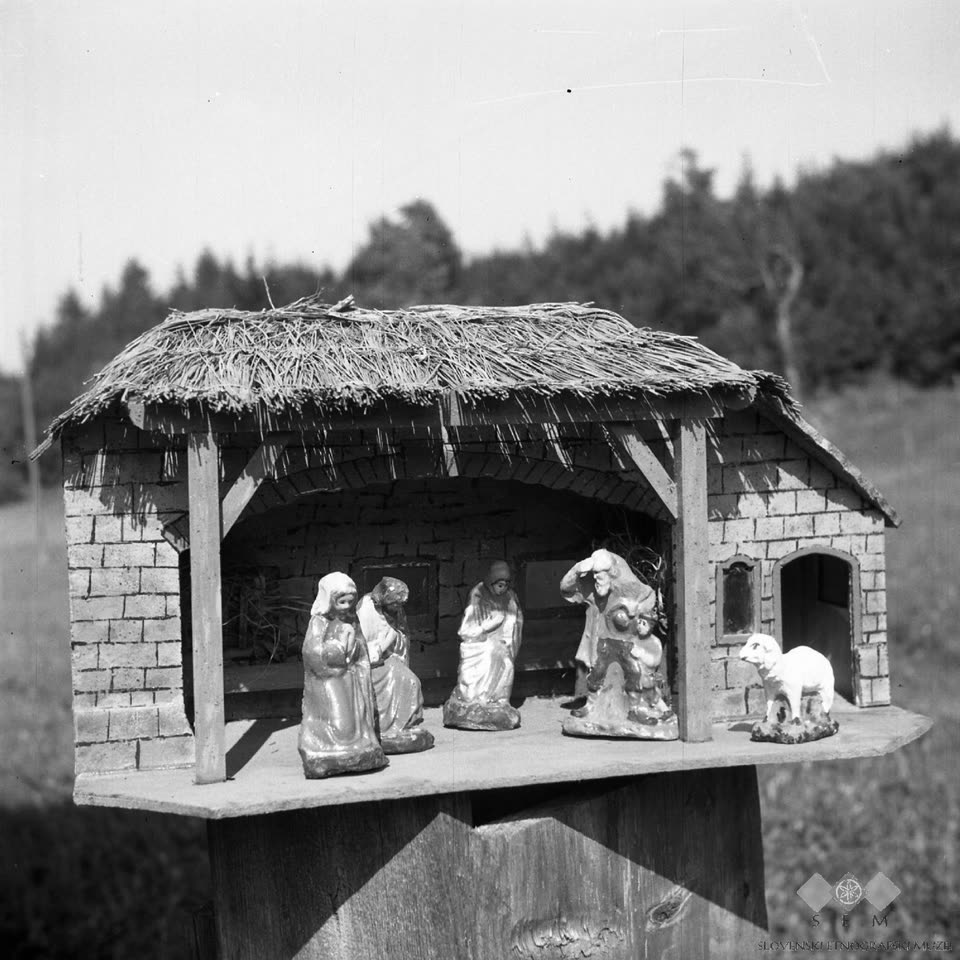
Making and setting up nativity scenes is a registered item of Slovenian intangible cultural heritage in its own right — jasličarstvo, unit 2-00100, entered on 14 December 2021 — and its history in Slovenia is datable to the year.
The first documented nativity scenes were put up in 1641 in the church at Gornji Grad and in 1644 in the Jesuit church of St James in Ljubljana. Then they were stopped: from 1782 to 1804 Joseph II banned nativity scenes in churches, and they survived only in monasteries. They stand until Epiphany on 6 January, or until Candlemas on 2 February.
The nativity scene took two centuries to reach an ordinary house
The same register sheet traces the route, and it goes downwards through society one class at a time. Out of the churches the nativity scene spread to noble houses, in the eighteenth century to burgher houses, and at the beginning of the nineteenth century into peasant homes — first in Gorenjska, the alpine north-west. Everywhere else it only came into general use between the two world wars.
What was in those houses differed with the money in them. In most burgher homes the first nativity figures were paper, and only later wood, plaster or clay.
Slovenia's best-known nativity scene is not a model. In 1990 a living nativity was staged for the first time in the Postojna Cave — a theatrical performance of the birth of Christ inside the karst cave system. The year after, in 1991, the first life-size nativity figures were put up at Šmarna gora near Ljubljana. Both forms then spread elsewhere in the country.
The register sheet is careful to treat these as additions rather than replacements: the miniature scene in the corner of a room is still what jasličarstvo mostly means.
Slovenia has three December gift-bringers and the public broadcaster treats the sequence as the point. Miklavž — Saint Nicholas — is the old one, and his day is 6 December. Božiček is the one who came back across the Atlantic: the broadcaster derives him from Miklavž by way of North America, where he became Santa Claus. Dedek Mraz is the newcomer, brought in after the Second World War on the Soviet model of Ded Moroz, and Miklavž had to give way to him.
All three are now current at once, which is the part visitors find hardest to believe.
The procession is on the eve of the saint's day, and Miklavž does not walk alone: by the legend he goes from house to house with angels and with parkeljni, the devils. The parkeljni wear sheepskins turned inside out, with horns and a red tongue, and they carry chains, bells and switches.
What he leaves behind is sorted accordingly. Dried fruit for the children who have been good, and a switch for the ones who have not. Street processions and fairs are still organised in some of the larger towns.
Three Kings carolling, from Saint Stephen to Epiphany
Trikraljevsko koledovanje is one of the five register items the Ministry of Culture ties to Christmas. It begins on the feast of Saint Stephen, 26 December, and ends on 6 January — so the carolling season starts on the day after Christmas and closes on the day the nativity scene comes down.
It is not ancient. The ministry dates it to the sixteenth or seventeenth century, when town schoolboys went carolling to wealthier townspeople to wish them a good new year and were given something for it, and says it had spread across all the Slovene regions by the middle of the nineteenth. After the Second World War carolling was banned, and it began to die out.
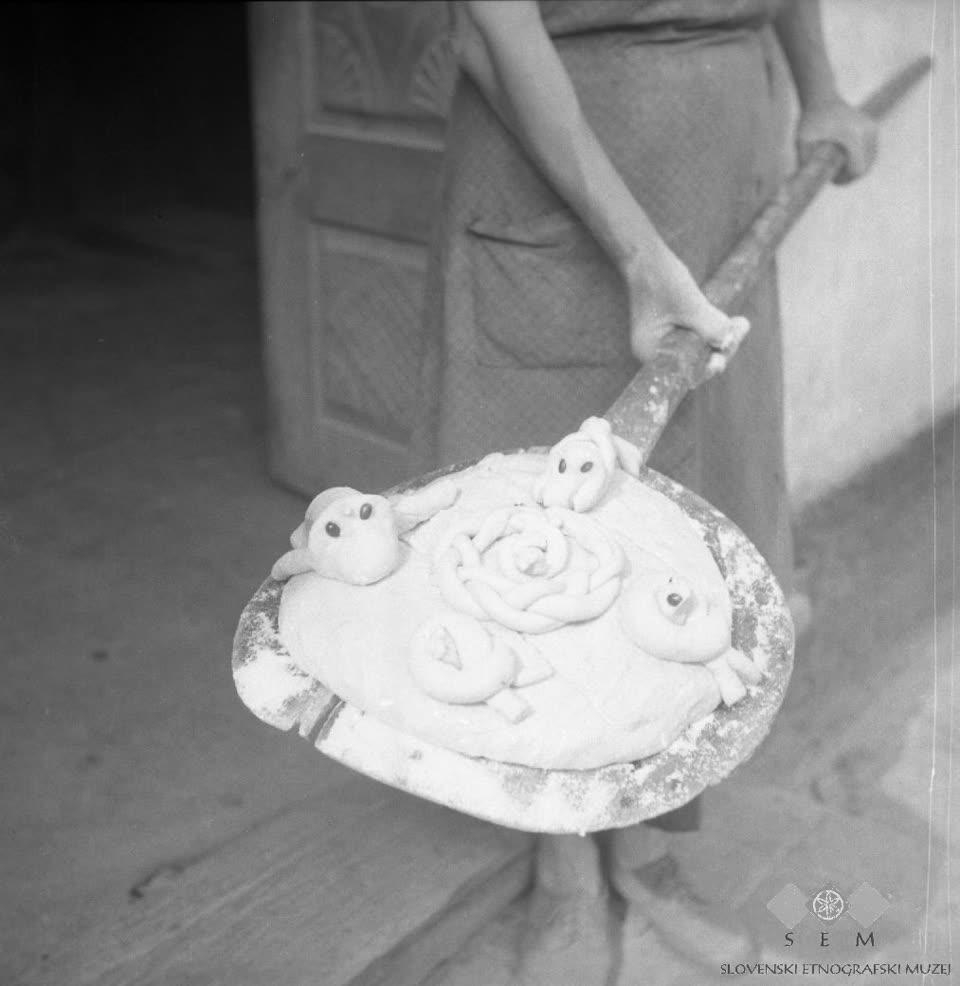
Poprtnik is a ritual bread, and its name is a description of where it sat. Until the middle of the twentieth century it was baked at Christmas across almost the whole of Slovenia, in the belief that it had magical power, and it stood on the table covered with a cloth — a prt — which is where the commonest of its names comes from.
The ministry puts its origin before Christianity, with the caution that word deserves, and dates the first written mention and description to the early seventeenth century. After the Second World War potica began to take its place; some regions started baking it again towards the end of the twentieth century.
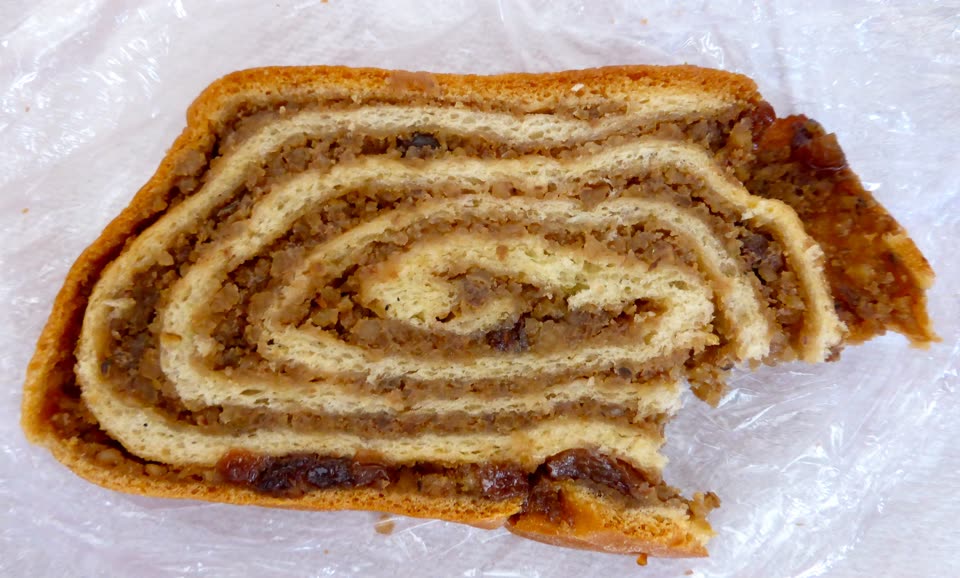
The rolled, filled cake is the one Slovenian Christmas food everybody can name, and the baking of it — peka potic — is itself an entry in the national register of intangible cultural heritage, one of the five the Ministry of Culture ties to Christmas.
It is also, in the ministry's account, a replacement rather than an original: potica is what began to take the place of the poprtnik on Slovene Christmas tables after the Second World War.
Widely repeated claims about Christmas in Slovenia that do not survive
checking. Each one says what is actually the case, because a correction
with nothing in its place leaves you worse off than before.
Contradicted
In Slovenia 25 and 26 December are the two days of Christmas, the way they are in Austria or Germany.
What is actually the case. Neither half holds, and the Act says so in two consecutive articles.
25 December is a work-free day but it is not a state holiday. The Act keeps two separate lists: 1. člen, «Prazniki v Republiki Sloveniji so:», and 2. člen, «Dela prosti dnevi v Republiki Sloveniji so tudi:». Božič is in the second list, with Easter, Whitsun, the Assumption and the Day of Reformation. It is not in the first.
26 December IS in the first list, and it is not Saint Stephen's Day. It is «dan samostojnosti in enotnosti», the Day of Independence and Unity — a national day that happens to fall the day after Christmas, not a second Christmas day.
The distinction has teeth rather than being a filing matter: eight of the fifteen prazniki are named in the same article as NOT being work-free, so the category a day sits in decides whether anyone gets it off.
Dedek Mraz is just the Slovenian name for the Russian Ded Moroz.
What is actually the case. The import is real and the public broadcaster says so plainly: after the Second World War Miklavž had to give way to Dedek Mraz, «ki so ga takrat uvedli po sovjetskem vzoru deda Moroza» — introduced on the Soviet model of Ded Moroz. The name is the Russian name translated.
What the claim misses is that the figure was argued over almost immediately, and by the people running him. He first appeared at the New Year tree celebrations in December 1948 and the first parade was in 1950. In January 1953 the organisers were still debating whether he should follow the Soviet model or be an original Slovene figure. By then the painter Maksim Gaspari had already drawn him: his appearance rests on images the Zveza prijateljev mladine in Ljubljana published on three greeting cards at the end of 1952, and a guide describing the celebration and the costume followed in 1957.
So: a Soviet import with a Slovene face, and a documented argument in between.
Eight of Slovenia's fifteen state holidays are working days. 1. člen of the Act lists the prazniki and then takes the day off away again from eight of them by name — among others the Day of Primož Trubar, the Day of Triglav, the Day of Slovenian Sport, the Day of Sovereignty and the Day of Science. Being a national holiday in Slovenia does not mean the shops are shut.
Nativity scenes were illegal in Slovenian churches for twenty-two years. Joseph II banned them from 1782 to 1804, and the national register records that they survived the ban only inside monasteries.
The painter who fixed how Dedek Mraz looks had already made a set of nativity figures. Maksim Gaspari created the «Jugoslovanske jaslice», the Yugoslav nativity scene, in 1919; thirty-three years later his drawings of Dedek Mraz were printed on greeting cards and settled that figure's appearance for good.
The Slovene proverb for a mild Christmas is a trade. «Zelen božič, bela velika noč» — a green Christmas, a white Easter: if it does not snow now, it will snow then.
Every claim carries its own citation. They are collected below, so you
can see what the page rests on and how much of it comes from where.
bôžič, in Slovar pregovorov in sorodnih paremioloških izrazov — Fran, the dictionary portal of the Fran Ramovš Institute of the Slovenian Language, ZRC SAZU. Retrieved 2026-11-24.The proverb «Zelen božič, bela velika noč» is carried on the božič page in the Slovar pregovorov (prva izdaja). The same page's SSKJ² entry prints the headword as «bôžič -íča m (ó í)» and defines it «v krščanstvu praznik Kristusovega rojstva».
Opis enote nesnovne kulturne dediščine, EID 2-00100: Jasličarstvo — Ministrstvo za kulturo Republike Slovenije, Register nesnovne kulturne dediščine; strokovna institucija Slovenski etnografski muzej. Retrieved 2026-11-24.«Prve dokumentirane jaslice so v Sloveniji postavili leta 1641 v cerkvi v Gornjem Gradu, leta 1644 pa v jezuitski cerkvi sv. Jakoba v Ljubljani.» On the ban: «Od 1782 do 1804 je Jožef II. prepovedal cerkvene jaslice, obdržale so se le v samostanih.» On how long they stand: «Praviloma stojijo do svečnice (2. februarja), najmanj pa do Svetih treh kraljev (6. januarja).» Datacija: «druga četrtina 17. stol., 1641 (omemba), 1644».
Nesnovna kulturna dediščina, povezana z božičnimi prazniki in praznovanji — Ministrstvo za kulturo Republike Slovenije, via gov.si. Retrieved 2026-11-24.The page says the Register was set up in 2008 and that of its hundred units, five are closely tied to Christmas: «Med njimi jih je pet tesno povezanih z božičnimi prazniki in praznovanji:» — peka potic, jasličarstvo, priprava poprtnikov, otepanje v Bohinju and trikraljevsko koledovanje. On the carolling: it «se začne na praznik sv. Štefana, 26. decembra» and ends on 6 January; «Po drugi svetovni vojni je bilo koledovanje prepovedano, zato je začelo zamirati.»
Zakon o praznikih in dela prostih dnevih v Republiki Sloveniji (ZPDPD), 1. in 2. člen — Pravno-informacijski sistem Republike Slovenije (PISRS), Ministrstvo za pravosodje. Retrieved 2026-11-24.Read as neuradno prečiščeno besedilo št. 11, the consolidated text current on 24 November 2026, which incorporates every amendment from ZPDPD-A (1991) through ZPDPD-I (Uradni list RS, št. 1567/26, 2 October 2026). 2. člen is headed «Dela prosti dnevi v Republiki Sloveniji so tudi:» and its last entry is «25. december, božič». 1. člen is headed «Prazniki v Republiki Sloveniji so:» and its last entry is «26. december, dan samostojnosti in enotnosti».
Voščila ob praznikih tudi iz vrst politike — RTV Slovenija, the Slovenian public broadcaster. Retrieved 2026-11-24.The broadcaster's own sentence reporting one of the video messages reads «Vesel božič, krasne praznike in srečno novo leto je v videovoščilu državljanom zaželel tudi predsednik SNS-a Zmago Jelinčič.» The same piece carries «Vsem je zaželel vesele božične praznike» and, of the then prime minister, «zaželel blagoslovljene božične praznike».
Miklavž: simbol dobrodelnosti, ki otrokom prinaša darila in šibe — RTV Slovenija, the Slovenian public broadcaster. Retrieved 2026-11-24.«6. decembra praznuje god sv. Nikolaj» and «je na predvečer svetnikovega godu obhod dobrega moža». On what he brings: «tradicionalno pridnim otrokom prinese darila, kot je suho sadje, porednim pa šibo».
Vse najboljše za rojstni dan, dedek Mraz! — RTV Slovenija, the Slovenian public broadcaster. Retrieved 2026-11-24.Published 26 December 2018 at 10.13, byline «M. Z.», carried by the broadcaster's own news desk with the Slovenian press agency. «Prvič se je pojavil na t. i. praznovanjih novoletne jelke decembra leta 1948.» «Prvi sprevod dedka Mraza je bil leta 1950.» «Njegova zunanja podoba je temeljila na upodobitvah dedka Mraza izpod prstov slikarja Maksima Gasparija, ki jih je zveza prijateljev mladine v Ljubljani objavila na treh voščilnicah konec leta 1952.»