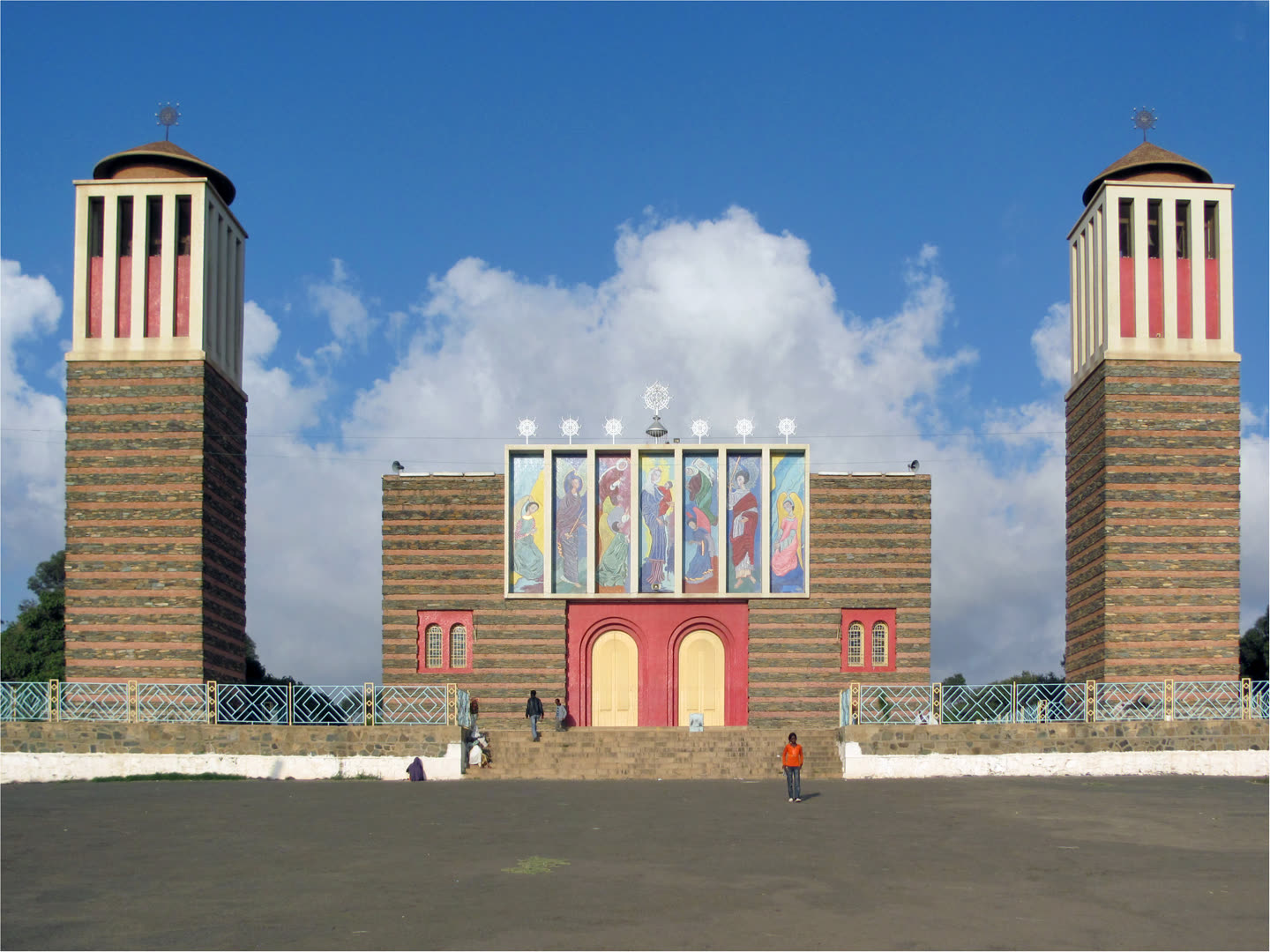
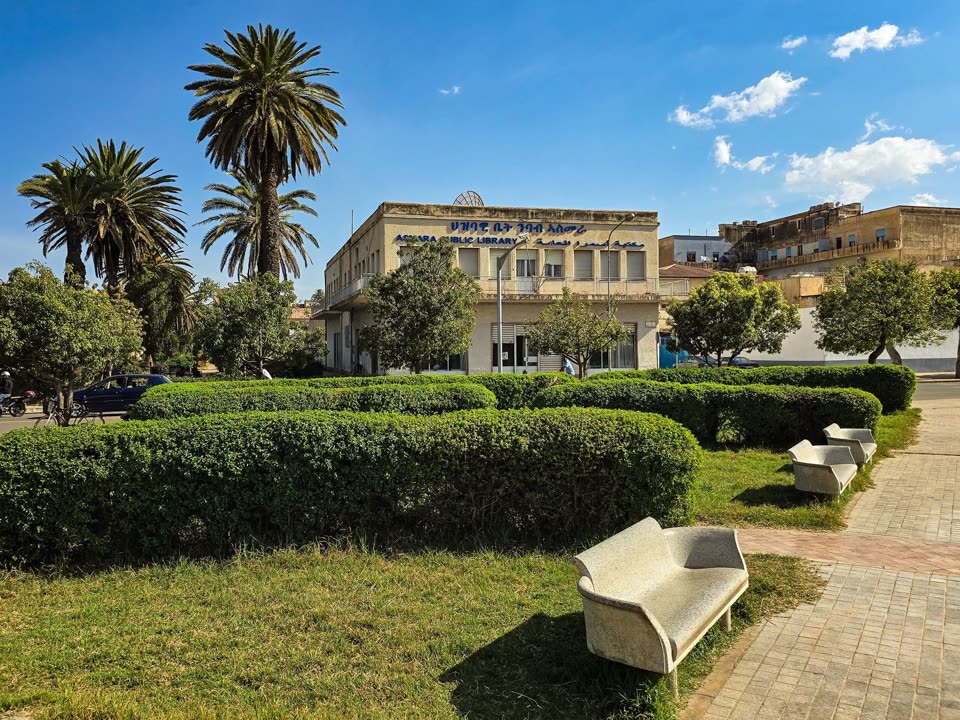
Christmas Day in Eritrea is 7 January. It is a public holiday.
How to say it
Tigrinya
እንቋዕ ናብ ብርሃነ ልደቱ ኣብጽሓና
Enquaʽ nab berhane lidetu abtsehana
«Blessed are we, that He has brought us to the light of His Nativity.» This is how the patriarch of the Eritrean Orthodox Tewahdo Church opens his Christmas blessing, and the same sentence is said back to the congregation a paragraph later in the addressed form — ኣብጸሓናን ኣብጸሓኩምን, brought us and brought you.
The construction is the Tigrinya cousin of the Amharic one on Ethiopia's page: እንቋዕ … ኣብጽሓና is «congratulations on having been brought to», the same «you have reached it» idea rather than «merry».
The country keeps two Christmases, and only one of them is a day off
«We celebrate two Christmases in Eritrea, one on December 25 and the other on January 7.» The state's own newspaper says it in those words, and the gap between the two is not denominational — it is generational, and it runs through families.
The 7 January feast is the one with standing. It is the Eritrean Orthodox Tewahdo Church's Lidet, 29 Tahsas, and it is the public holiday. The 25 December one is newer, urban and young: cafés, lights, a tree, a night out. «Even today, it is young people in the urban areas that celebrate it more. The elderly tend to be more attached to» the Geʽez Christmas.
A second writer in the same paper tells it as a scene rather than a fact. She comes home on 24 December with a cake and chocolate bars, shouts «Merry Christmas», and the elderly relative visiting from the countryside asks what in the delusional world she is talking about. «The older and younger generation celebrate Christmas and New Year on different days although the younger generation tend to celebrate Christmas twice.»
The part that sounds like a contradiction and is not: the two are kept differently on purpose. «People can go out partying on one Christmas eve and attend church services on the other.»
The Geʽez Christmas arrives at the end of a long fast, and the fast is the reason the meal matters. «For devout Christians who follow the Geez calendar it is now the fasting season, which ends a week from the New Year when Christmas is celebrated. After a month and two weeks of fasting, people celebrate Christmas by slaughtering an animal, which is commonly done on religious festivals.»
A month and two weeks is six weeks, and what is given up is meat and dairy. The other account names the rest of the day: the house cleaned before it, coffee, and the rounds of relatives. «The youth in Eritrea spend December 25 having fun on their own but they spend the Geez Christmas with their families doing all the things they are supposed to do during holidays, cleaning their houses prior to the big day and slaughtering a sheep, having coffee and wishing relatives a happy holiday.»
The Holiday Season — Sabrina Solomon, Ministry of Information of Eritrea (shabait.com)
The patriarch's blessing, published every 6 January
On the eve of the feast the Eritrean Orthodox Tewahdo Church issues a ቃለ ቡራኬ — a word of blessing — and the Ministry of Information publishes it. The archive holds one for every year from 2021 to 2026.
They are long, scriptural, and addressed by category rather than generally: to Christians at home and abroad, to the sick sheltering in hospital, to health workers, to the army «in the defence of the country and in development», and to prisoners under rehabilitation. The 2022 one closes by asking that God bring the country to the light of the Nativity in peace and then to the light of the Epiphany in peace, which is the same twelve-day span the holiday calendar marks.
The blessing is also how the date is published. It is headed with both calendars on one line, and that heading is the single clearest Eritrean source for when Christmas is.
The blessing matters enough that its absence is a political event. In January 2005 the patriarch’s Christmas message was not broadcast for the first time in the church’s history, and that silence was the first public sign that Abune Antonios was being removed — see «Worth knowing» below.
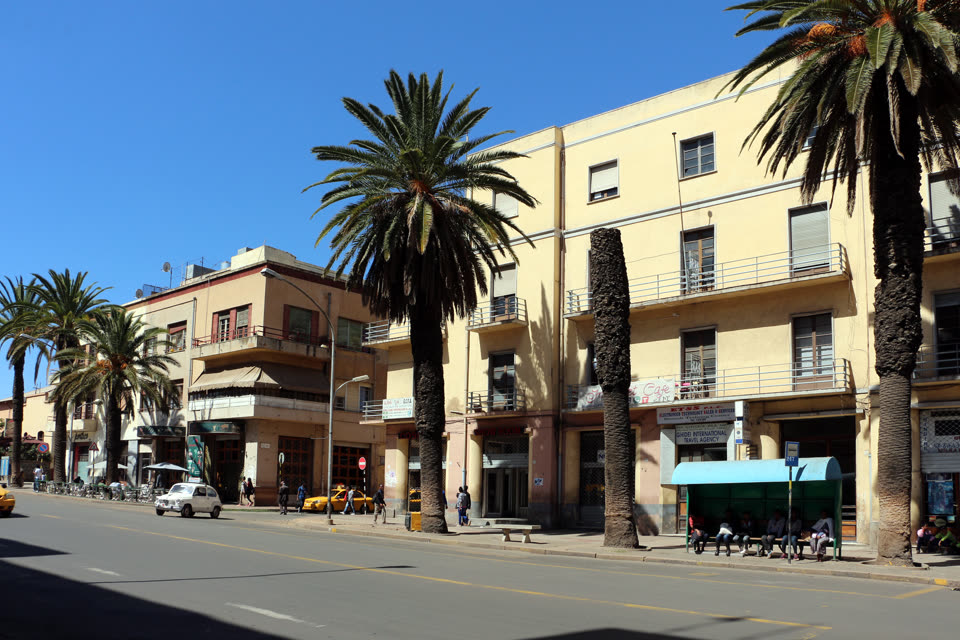
The December Christmas belongs to the street. «On December 25th, cafes, restaurants, bars and lounges are all decorated in breathtaking lights and Christmas posters. Christmas trees are placed on the sidewalks close to the cafes, like the famous Asmara Sweet Café on Harinet [sic] Avenue.»
The trees go up outside rather than only inside, along the avenue that runs through the middle of Asmara. Indoors there are lights and banners and a tree «placed in a prominent place», and on the eve itself «people exchange post cards and gifts to express their joy, friendship and happy wishes». The evening is spent out: «Christmas Eve is celebrated in the evening at recreational places with special events and special performances.»
New Year's Eve then falls seven days later, between the two Christmases, and ends with fireworks.
The Holiday Season — Sabrina Solomon, Ministry of Information of Eritrea (shabait.com)
Twelve days later, Timqet
The Nativity is the first of a pair. Twelve days after it comes ጥምቀት, Timqet, the Theophany — the baptism of Christ in the Jordan — and it is the second public holiday of the Eritrean Christmas season.
The church's own printed calendar gives the two together, in Geʽez and in both reckonings: ልደት, Lidet, the Nativity of our Lord Christ, 29 Tahsas, 7 January; ጥምቀት, Timqet, Theophany, 11 Tiri, 19 January. In the leap year of the Geʽez cycle both lines move by a day, and they do not move the same way: the church holds the Nativity on 7 January by calling it 28 Tahsas, and leaves Timqet on 11 Tiri, which that year is 20 January. So the twelve days become thirteen once every four years. The embassy closure calendar lists «January 19 — Epiphany — Eritrean», which is the same day arrived at from an entirely different kind of document.
The patriarch's Christmas blessing ends by looking ahead to it: having been brought to the light of the Nativity in peace, may we be brought to the light of the Baptism in peace.
Both accounts describe the holiday weeks less as a day than as a social settling-up. «The holiday season in Eritrea is characterized by the visiting of relatives, rejoicing with neighbors, settling conflicts, forgiving friends and foes and looking forward to a new beginning.»
It is listed flatly, between visiting relatives and making resolutions, as one of the ordinary things the season is for.
The Holiday Season — Sabrina Solomon, Ministry of Information of Eritrea (shabait.com)
What is eaten
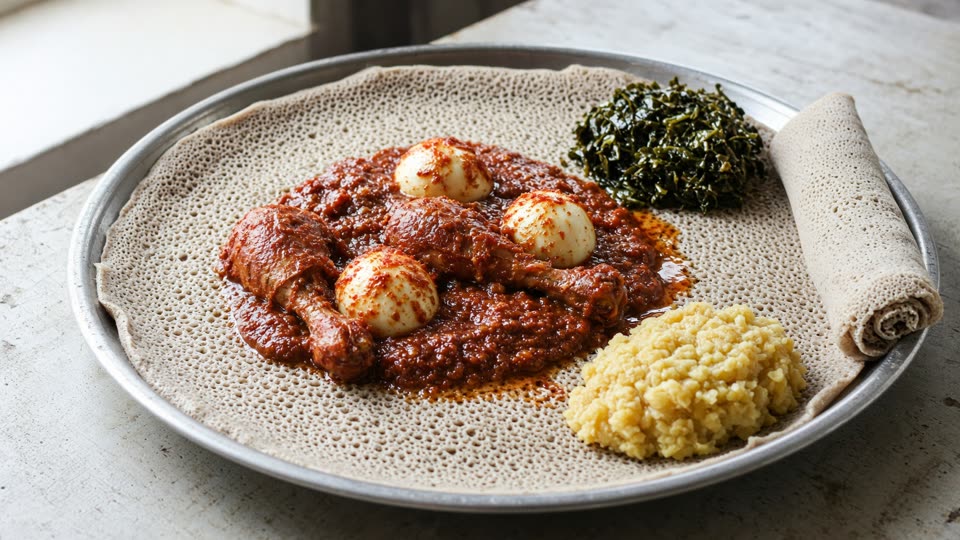
Illustration, generated with Grok Imagine
Dorho tsebhi
The chicken stew that ends the fast. ጸብሒ, tsebhi, is the Tigrinya word for a stew, and it is the centre of an Eritrean meal — poured onto the bread rather than served beside it. Dorho tsebhi is the chicken one, built on berbere, the spice mixture that «accompanies almost all dishes»; zigni is the same thing with beef, and alicha is the version made without berbere at all.
For the Geʽez Christmas, after six weeks without meat or dairy, a sheep is killed. What reaches the bread after that is the point of the fast rather than an accompaniment to it.
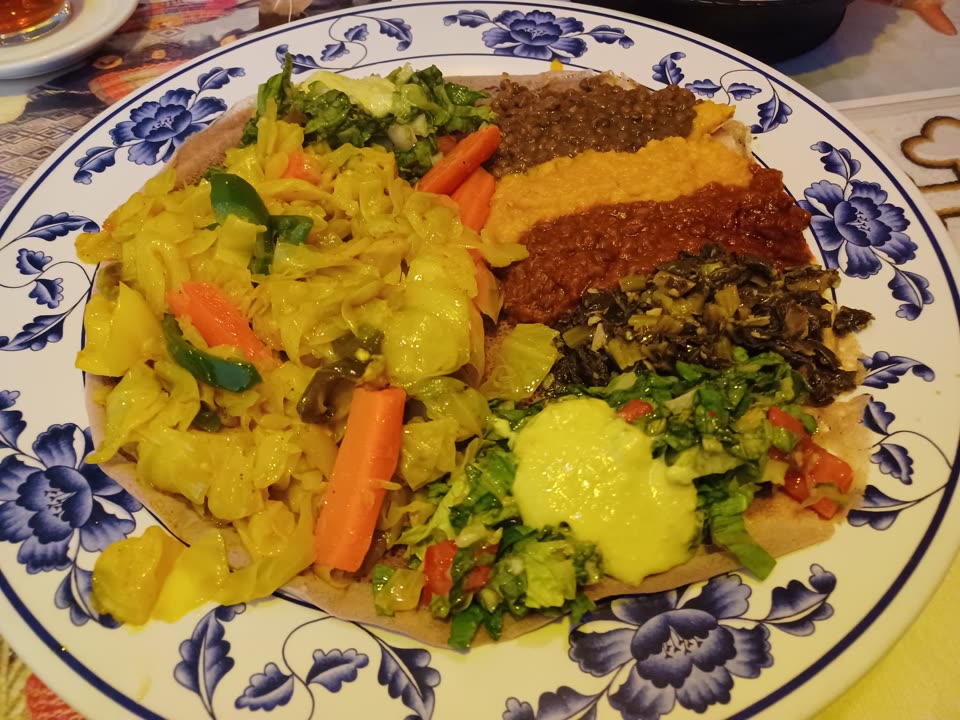
The bread is the plate. A wide sour pancake of fermented teff, spread over a tray, with the stews spooned straight onto it — there are no dishes under them and no cutlery over them. You tear the edge and lift the stew with it, and at the end the bread that has been under the food all along is itself the last course.
In Tigrinya it is ጣይታ, taita. English and Italian sources both call it injera when writing about Eritrea, and both words are in use.
Widely repeated claims about Christmas in Eritrea that do not survive
checking. Each one says what is actually the case, because a correction
with nothing in its place leaves you worse off than before.
Contradicted
Eritrea keeps Christmas on 7 January because it uses the Julian calendar, like Russia and Serbia.
What is actually the case. Eritrea uses the Geʽez calendar, which is not the Julian calendar. It has thirteen months — twelve of thirty days and a short one of five or six — it begins its year on 11 September, and it numbers its years seven or eight behind the Gregorian ones because it dates the Annunciation differently. The patriarch's Christmas blessing for 7 January 2022 is dated 29 Tahsas 2014.
The two systems do land on the same morning, and not by accident: both keep a leap day every fourth year with no century exception, so the thirteen-day gap between them is permanent, and both move to 8 January in 2101. What the Geʽez calendar does not keep is the Julian's placing of that day — it adds its own in September — so for five months of every fourth year the two run a day apart, and the church answers that by keeping Christmas on 28 Tahsas instead of 29. The morning is fixed; the day-number is what gives. But arriving at the same place is not travelling by the same road, and Eritrea's road starts in Alexandria rather than in Rome.
Eritrean Christmas is Ethiopian Christmas — same church, same calendar, same country for most of its history.
What is actually the case. The calendar is shared and the liturgical tradition is shared. The church is not: the Eritrean Orthodox Tewahdo Church has been autocephalous since 1993, granted by Alexandria rather than by Addis Ababa, and the Ethiopian church objected to how it was done.
And the practice diverges. Eritrea keeps two Christmases, thirteen days apart, and the December one is widespread enough that the state's own paper writes features about the generational split it causes. Ethiopia's record describes no such second date. Eritrea's festive stew is dorho tsebhi and not doro wat, because the language is Tigrinya. Its colonial language is Italian and the colony lasted from 1890 to 1941, where Ethiopia's Italian period was five years and left almost nothing.
The country is also about half Muslim, on contested figures: estimates of the Christian share run from 47 to 63 per cent depending on the source, against a 2010 government survey's 61.4.
The 25 December Christmas in Eritrea is the Catholic one, left behind by the Italians.
What is actually the case. No source supports it, and one thing cuts against it. Eritrea's Catholics are not Latin-rite: the Eritrean Catholic Church celebrates in the Alexandrian Rite in Geʽez, and there is no Latin-rite diocese in the country at all. Its Ethiopian counterpart keeps the Nativity on 29 Tahsas, the same day as the Orthodox.
What the Eritrean sources actually describe is a secular and recent observance: trees outside cafés, parties, postcards, and a divide that runs by age rather than by denomination. «The Christmas celebrated on December 25 was not as popular as it is today. Even today, it is young people in the urban areas that celebrate it more.»
The Catholic explanation is not established rather than disproved. How 25 December arrived in Eritrea is an open question.
Eritrean Christmas is partly Italian, and the inheritance is a city. Italy ruled Eritrea from the 1890s, and from 1935 rebuilt Asmara wholesale in the rationalist idiom of the day — government buildings, housing, shops, churches, mosques, synagogues, cinemas, hotels.
UNESCO inscribed the result on 8 July 2017 as Asmara: A Modernist African City, Eritrea's first World Heritage Site, taking in everything planned between 1893 and 1941 together with the unplanned Eritrean neighbourhoods of Arbate Asmera and Abbashawel. The Christmas lights go up along streets that are themselves the World Heritage site.
The street the trees go out onto has been renamed at almost every turn of Eritrea's history. It is ጎደና ሓርነት, Godena Harenet, Freedom Avenue, and before that it was the Derg's National Avenue, and before that Emperor Haile Selassie's, and under the British it was Queen Victoria's, and under the Italians it carried Mussolini's name. The cinema, the opera house, the palazzi and the cafés along it are the colonial city still standing, and in December the cafés put trees out on the pavement in front of them.
Eritrea's Catholics are not Roman Catholics in the way that phrase is usually meant. In January 2015 Francis erected a new Eastern Catholic church centred on Asmara, and the Eritrean Catholic Church is now sui iuris — of its own right — subject directly to the Holy See, with the eparchies of Barentu, Keren and Seghenity under it.
They use the ancient Geʽez rite, the same liturgical language as the Orthodox Tewahdo church they separated from, not the Latin one. A few communities do still keep the Latin rite. There are about 160,000 of them, and the church runs schools and clinics out of all proportion to that number.
The church that keeps this feast has been independent for barely thirty years. Eritrea became a country in 1993 — independence on 24 May 1993, two years after the liberation of Asmara in 1991, which is the date people more often remember — and the World Council of Churches — which it joined in 2003 — dates the autocephaly of the Eritrean Orthodox Tewahdo Church to 1994, granted with the help of the Coptic Orthodox Church of Alexandria. Before that it was part of the Ethiopian church.
The year varies between accounts because the thing itself happened in stages: an appeal after independence, a Coptic grant, a patriarch consecrated, and the Ethiopian church's assent, which came later. The tradition is ancient and the institution is younger than most of the people keeping the feast.
In Eritrea the way you learn that a patriarch is being removed is that his Christmas message does not come on. Abune Antonios was ordained third patriarch of the Eritrean Orthodox Tewahdo Church in April 2004 and spent his first year refusing things: refusing to excommunicate more than three thousand members of the Medhane Alem Sunday School movement, and demanding the release of three Orthodox priests imprisoned that November. In January 2005, for the first time ever, the traditional Orthodox Christmas message from the patriarch was not broadcast on Eritrean television or radio. Seven months later the Holy Synod stripped him of all administrative authority; in January 2006 it removed him altogether; and on 27 May 2007 he was taken from his home and held under house arrest at an undisclosed location, where he remained until he died on 9 February 2022 — a month after the ministry published his successor’s Christmas blessing.
It was not a one-off. When he appeared in public in July 2017 and was thought to have been freed, the thing that showed otherwise was the same: he did not deliver the televised Geʽez New Year blessing on 11 September.
Eritrea is in the year 2019. The Geʽez calendar it reckons the feast by runs seven to eight years behind the Gregorian one — the patriarch's 2022 Christmas message is dated 2014 — and its new year, Kudus Yohannes, falls on 11 September. Christmas is 29 Tahsas, the twenty-ninth day of the fourth month — except in one year out of four, when it is the 28th. Both calendars take a leap day every fourth year and neither skips centuries, but they put it in different places: the Geʽez one in September, at the end of the short thirteenth month, and the Julian one in February. For the five months between those two the calendars are a day out of step, and Christmas falls inside that window. So the church moves the day-number instead, and the morning is what stays still. Eritrea's Christmas and the Julian churches' Christmas land together by two routes that share one ancestor — the Alexandrian calendar, which took the Julian leap year under Augustus — and they will still be landing together in the year 3000.
Patriarch Antonios — prisoner profile — Church in Chains (Ireland). Retrieved 2026-10-11. archived 17 May 2026The independent corroboration, and it is the stronger wording: «In January 2005, for the first time ever, the traditional Orthodox Christmas message from the Patriarch was not broadcast on Eritrean television or radio.» Its timeline also carries the 2017 repetition — after his public appearance in July was taken for a release, «he failed to deliver the traditional televised Geez New Year blessing on 11 September», read as confirmation the release was a ruse.
Events Calendar 2026 — Embassy of the United States of America, Asmara. Retrieved 2026-10-11.The mission's own closure calendar, which marks every date as either «U.S.» or «Eritrean» because it has to close on both. «January 7 — Orthodox Christmas — Eritrean». «January 19 — Epiphany — Eritrean». And, tellingly, «December 25 — Christmas Day — U.S.», which is the embassy closing for its own country's holiday and not for Eritrea's.The embassy lists Easter (Geez) on 12 April 2026, and shabait reports «Asmara, 12 April 2026 — Easter Holiday was colorfully celebrated nationwide today».
Eritrean Orthodox Tewahdo Church Calendar — Holidays — Eritrean Orthodox Tewahdo Church, Diocese of the U.S.A and Canada. Retrieved 2026-10-11. archived 8 February 2026A trap on the way to it: the same church's English menu lists «The Nativity of Virgin Mary | Lideta leMaryam — May 9». ልደታ ለማርያም is Mary's nativity and a different feast, and a careless search for «Lidet» finds it first.
The Ethiopian Calendar — Ethiopian Orthodox Tewahedo Church. Retrieved 2026-10-13. archived 11 October 2026The church explains its own reckoning, and it is not a Julian offset: «The chronology of the Ethiopian church follows the Era of Incarnation that is it dates from our Lord's birth... Because the Ethiopian church holds that our Lord was born 5500 years after the creation of the world this gives the 7 or 8 years difference between the Gregorian and Ethiopian Chronologies.»
100 Years of Asmara's Main Street — Issayas Tesfamariam, in Warscapes, 18 April 2012. Retrieved 2026-10-15. archived 11 October 2026An Eritrean scholar writing about one street, which is the only kind of source that holds a sequence like this: «Mussolini Avenue: Italian period (1890-1941)», «Queen Victoria Avenue: British period (1941-1952)», «Godana Haile Selassie/ Emperor Haile Selassie Avenue (1962-1974)», «Beherawi/National Avenue: The Derg period (1974-1991)», «Godena Harenet/Independence Avenue (1991 until present)». His point is that the renaming IS the history — «the most vivid symbolic example of changing names is the main street in downtown Asmara».Tesfamariam writes it in English; other accounts give «Viale Mussolini», and one puts a «Corso Italia» phase after the fascist period rather than before it.
Spotlight on the Eastern Churches: The Eritrean Catholic Church — Michael J. La Civita, Catholic Near East Welfare Association (CNEWA), a papal agency, 21 January 2016. Retrieved 2026-10-13. archived 14 February 2025CNEWA is more careful and is better placed to know: the eparchies «utilize the ancient Ge'ez rites and traditions, although a few communities continue to use the Latin rite».
ቃለ ቡራኬ ርእሰ ኣውደ ዓመት ቅዱስ ዮሓንስ ፳፻፲ወ፱ (2026) — Ministry of Information of Eritrea (shabait.com), publishing the Eritrean Orthodox Tewahdo Church. Retrieved 2026-10-11.The embassy closure calendar lists «September 11 — Kudus Yohannes (Geez New Year) — Eritrean», and shabait reports a public celebration for it in Gash Barka on 11 September 2026.Geʽez 2012, the year on the 2020 sheet, is the year of John, which is exactly the year the Ethiopian church names for the shift: the fast ends «on Christmas Eve 29th of Tahsas, while in the evangelical year of John… 28th of Tahisas».The second count stands as it was reported: the Geʻez calendar is the Alexandrian one, which took the Julian leap year under Augustus, so «nothing to do with each other» was wrong about a shared ancestor.
Eritrea's Christmas: Twin Holidays — Natnael Yebio W., Ministry of Information of Eritrea (shabait.com). Retrieved 2026-10-11. archived 9 October 2026Published 28 December 2023; the footer says «This Article was first published in 2019», and a 2019 copy is in the archive at the same site. The second writer is Sabrina Solomon, «The Holiday Season», shabait.com, 25 December 2021.
The Holiday Season — Sabrina Solomon, Ministry of Information of Eritrea (shabait.com). Retrieved 2026-10-11. archived 5 July 2022The sheep and the house-cleaning are from the companion piece, «Eritrea's Christmas: Twin Holidays», same publisher.
Abune Antonios — Defending Freedoms Project — Tom Lantos Human Rights Commission, U.S. House of Representatives. Retrieved 2026-10-11. archived 10 July 2026«In January 2005, the Patriarch’s annual Nativity message was not broadcast or televised and the Eritrean Holy Synod met in August 2005 with the main purpose of removing all executive authority from the Patriarch», and «Among the accusations brought against the Patriarch, were his reluctance to excommunicate 3,000 members of the Medhane Alem, an Orthodox Sunday School movement and his demands that the government release imprisoned Christians accused of treason.»
ERITREA: Release Patriarch Abune Antonios — United States Commission on International Religious Freedom. Retrieved 2026-10-11. archived 5 April 2026For the detention and its stated cause: «The Patriarch has been detained since 2007: His «crime» was his refusal to excommunicate 3,000 parishioners who opposed the government», and «On May 27, 2007, the Eritrean government forcibly removed Patriarch Antonios from his home and placed him under house arrest at an undisclosed location.»
Eritrea — country profile — World Council of Churches. Retrieved 2026-10-13. archived 27 December 2025The WCC, of which the Eritrean Orthodox Tewahedo Church has been a member since 2003, dates the autocephaly to 1994 and credits the Coptic Orthodox Church with it: «Before Eritrea's independence, they came under the Ethiopian Orthodox Church.»